Path
standards-practices
Contact
Contact name or title
Academic Standards Front Desk
Contact phone number
(602) 364-2333
Contact name or title
Click the subscribe button below to receive content area updates

Arizona Educational Technology Standards

Arizona Educational Technology Standards

Arizona Educational Technology Standards Vision Statement

Arizona’s Educational Technology Standards are designed to be equitably integrated into all classes for all students to use technology to:

● Develop agency over their learning and understanding

● Build transferable skills that adapt to changing technology

● Innovate solutions for real-world issues

● Utilize higher-level thinking skills

● Build, enhance, and extend content knowledge

● Foster local and global collaboration

Educational Technology Mailing List

Educational Technology Professional Development

EdTech Listserv

Click this link to view an accessible version of the image below.
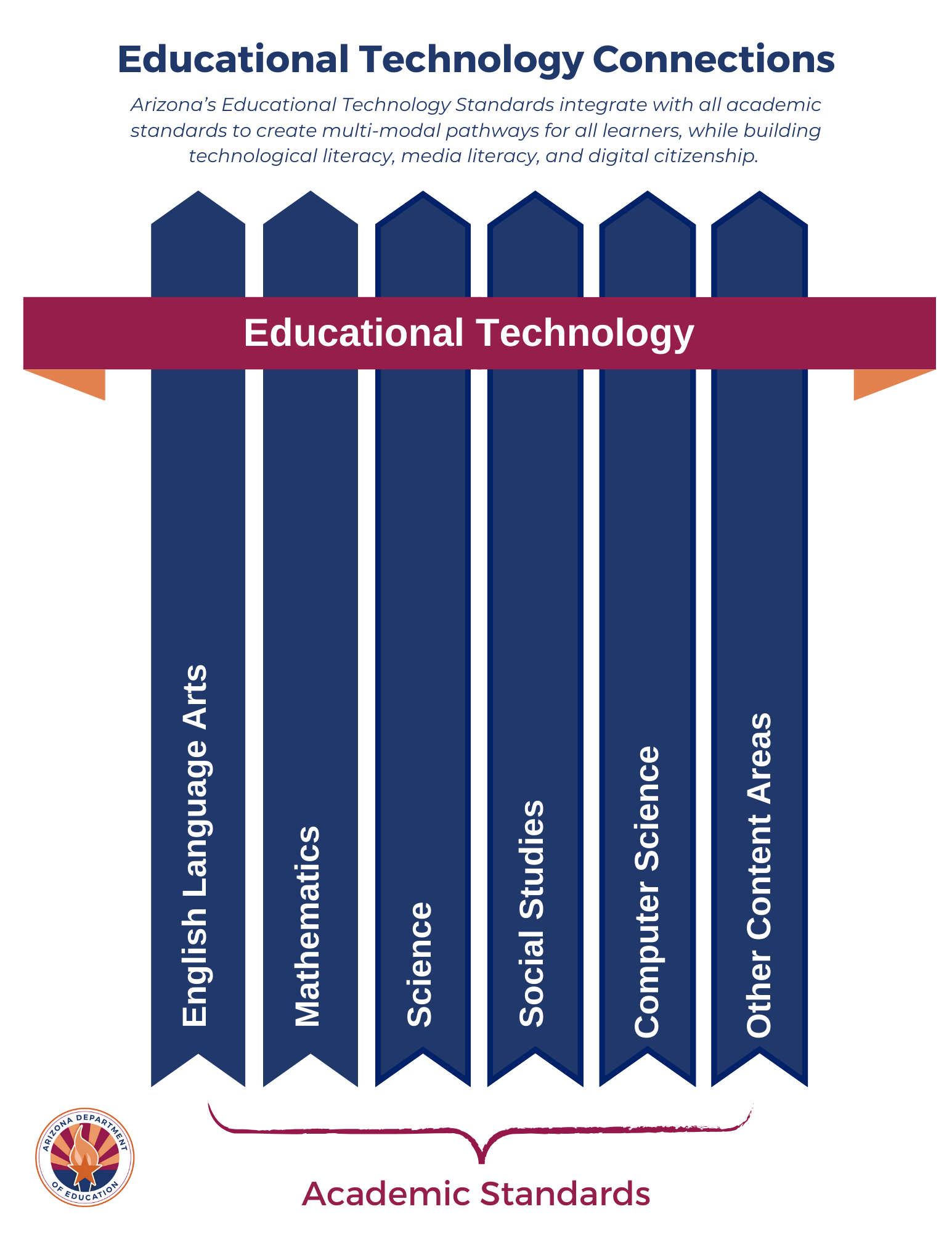
A decorative graphic that lists English Language Arts, Math, Science, Social Studies, and other content areas as multi-modal pathways that could be integrated with Educational Technology to build technological, media, and digital literacy.


Arizona Educational Technology Standards

Arizona Educational Technology Standards by Grade Level (Approved  January 24, 2022)  

 Scope and Sequence

Example Technology Scope and Sequence PDF | Word | CASE

 EdTech Professional Development Opportunities

Educational Technology Professional Development - Sign Up Here

 EdTech Resources

Generative AI and Educational Technology

 Generative AI Guidance Resources

AI Guidance for Arizona Schools - This guidance document, created by the Arizona Institute for Education and the Economy and Northern Arizona University, is designed to give Arizona schools and school systems direction as well as a common language as leaders and educators collectively pursue effective and responsible implementation of Gen AI.

Arizona AI Alliance - The AZ AI Alliance is a collective of education organizations that are committed to the responsible, ethical, and effective implementation of AI in Arizona’s K-12 schools.

AI4Learning - AI4Learning is the public-facing site of the AI in Education work done by the Agua Fria UHSD in Avondale, AZ.

TeachAI - AI Guidance for Schools Toolkit - Designed collaboratively by Code.org, ISTE, Khan Academy, and ETS, this toolkit serves as a support for education authorities, school leaders, and teachers to navigate the benefits of incorporating artificial intelligence (AI) in education, while recognizing and mitigating the potential drawbacks and risks. 

CoSN/Council for Great City Schools (CGCS) K-12 Gen AI Maturity Tool - This innovative tool supports schools in assessing their readiness for the responsible integration of Generative AI technologies to support both instructional and operational goals and initiatives. 

 Resources for Teaching with AI and about AI

Arizona Digital Educators Library
Access ADEL Standards aligned resources

Arizona Physical Education Standards

Arizona Physical Education Standards

Physical Education Standards

decorative image

Introduction to the Physical Education Standards  |  (Word version

(Approved May 2015)

K-5 Standards 6-8 Standards High School Standards

PDF | Word

Kindergarten Through 5th grade Standards document

PDF | Word

6 through 8th grade standards document

PDF | Word

High School Standards Document

Physical Education Resources and Assessment Information


Physical Education Resources

Assessment Resources

P.E. Sample District Pre & Post-Assessments

Resources

Image for PE Resurces

Assessments

Decorative Image for PE

Sample Tests (6-8)

Decorative Image for PE
decorative image

Recess Law
On April 4, 2018, Senate Bill 1083 was signed into law. The law requires all schools that have grades K-5 to provide two recess periods per school day. Per the law, recess is defined as “a period of time during the regular school day, including time before or after a scheduled lunch period, during which a pupil is able to engage in physical activity or social interaction with other pupils”.

Grades K-12 and Competencies and Academic Standards Exchange (CASE)

 Recommended Instructional Minutes

 ASU Survey Results for Physical Education | Recess | Wellness

Physical Education Standards, Certification and Resources    PE Standards Coding     PE Scoring Guide   Arizona Health Standards

Recess QuestionsPhysical Education Questions


PAASport LogoAccessPAASport

Look for the word CASE next to each of our Word and PDF files. The Competencies and Academic Standards Exchange is the framew ork that allows for the navigation and integration of Arizona Academic Standards.

Arizona Arts Standards

Arizona Arts Standards

ADE Arts Logo

Arizona was one of a few key states to participate in the development of the 2014 National Core Arts Standards. In 2015, the Arizona Arts Standards were updated to mirror them more closely. These standards are rooted in the philosophy of process over product, and they center on the importance of cultivating artistic literacy for all students. They are sequential and include five recognized artistic disciplines: Music, Dance, Media Arts, Theatre and Visual Arts. 

Regardless of artistic medium or discipline, the Arizona Arts Standards emphasize and are organized around the creative process, and as such, all standards-based arts courses should be organized around the Four Artistic Processes:    

Artistic Processes

The 2015 Arizona Academic Standards in the Arts have a new look, but the content remains the same. Start with the guide below or select your artistic discipline to explore the 2015 standards and supporting instructional resources. 

Understanding & Using the Academic Standards in the Arts

Dance Standards

Download the complete K-12 Dance Standards document, or view them in ADEL.

Standards placemats and Supporting Instructional Resources for Dance are being rebranded. Resources will be linked above as they become available. In the meantime, view the previously published versions below: 

K-12 Dance Student-Friendly-Language Learning Intentions with Sample Lesson Plans

K-12 Dance Placemat

Media Arts Standards

Download the complete K-12 Media Arts Standards document, or view them in ADEL.

Standards placemats and Supporting Instructional Resources for Media Arts are being rebranded. Resources will be linked above as they become available. In the meantime, view the previously published versions below: 

K-12 Media Arts Student-Friendly-Language Learning Intentions with Sample Lesson Plans

K-12 Media Arts Placemat

 Music Standards

Download the complete K-12 Music Academic Standards document, or view them in ADEL.

Standards placemats and Supporting Instructional Resources for Music are being rebranded. Resources will be linked above as they become available. In the meantime, view the previously published versions below: 

K-8 Music Student-Friendly-Language Learning Intentions with Sample Lesson Plans

K-8 General Music Placemat

Theatre Standards

Download the complete K-12 Theatre Academic Standards document, or view them in ADEL.

Standards placemats and Supporting Instructional Resources for Theatre are being rebranded. Resources will be linked above as they become available. In the meantime, view the previously published versions below: 

K-12 Theatre Student-Friendly-Language Learning Intentions with Sample Lesson Plans

K-12 Theatre Placemat

Visual Arts Standards

Download the complete K-12 Visual Arts Academic Standards document, or view them in ADEL.

Supporting Instructional Resources for Visual Arts are being rebranded. Resources will be linked above as they become available. In the meantime, view the previously published version below: 

K-12 Visual Arts Student-Friendly-Language Learning Intentions with Sample Lesson Plans

K-12 Visual Arts Placemat


Contact Information: Arts Education Inbox 1535 West Jefferson Street, Bin #32 Phoenix, Arizona 85007

Arizona Science Standards

Arizona Science Standards

Subscribe to the Science & STEM Mailing List

Science Standards

Standards Support Materials

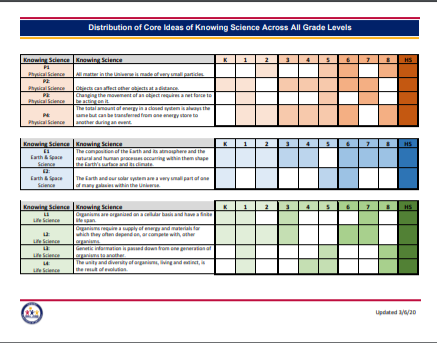
Vertical Progressions & 3-Dimensional Elements

Arizona Science Standards


Distribution of Core Ideas Preview image


Arizona Science Standards Image

Instructional Planning Tools 


Arizona Science Standards Image

Standards Implementation Guidance

 High Quality Instructional Materials 

Implementation Guidance 

  • *New* State of Science - This District Planning Tool is a resource that supports districts, schools, and educators in setting goals and prioritizing needs by identifying strengths and growth opportunities.

  • Designing Phenomena-Based Instruction - A simple flowchart designed to explain how to begin designing phenomena-based instruction.

Recommended Instructional Minutes

Administrator Toolkit 


Arizona Science Standards Image
  • Look Fors for Administrators - A great tool for administrators and educators that indicates the three "look for" in a 3-Dimensional Science Classroom.

  • STEM Teaching Tool 4- Are there multiple instructional models that fit with the science and engineering practices in NGSS? (Short answer: Yes.)

  • STEM Teaching Tool 21- What school building administrators should know about the new vision for K-12 science education.

  • STEM Teaching Tool 32 - Why focus on science and engineering practices--and not "inquiry?" Why is "the scientific method" mistaken?

Graduation Requirements

Professional Learning Opportunities

Professional Development

Recorded Webinars & Online Courses

Online Courses

Explore online professional development opportunities through ADE’s Learning Platform, APLD. These self-paced courses are designed to support educators with high-quality content, flexible access, ready-to-use resources, and practical strategies you can apply right away. Start learning today and earn professional development credit for eligible trainings offered through APLD!

Featured Courses:

Previously Recorded Webinars

Looking for past webinars? Scroll down to explore recordings, presentation slides, and helpful resource pages from the trainings. Please note: professional development credit is not available for viewing the resources below. Only trainings offered through APLD Online Courses are eligible for PD credit.

Three-Dimensional Science

Instructional Practices to Support Science Sensemaking

Science Performance Assessments

Science Standards Videos 

Science Standards Videos

Additional ADE Resources

ADE Science and STEM Resources Page


PAASport-Icon_with-Seal.png

Access PAASport

Look for the word CASE next to each of our Word and PDF files. The Competencies and Academic Standards Exchange is the framework that allows for the navigation and integration of Arizona Academic Standards.


**The views and opinions expressed in any third-party resource do not necessarily reflect those of the Arizona Department of Education (ADE) and do not imply an endorsement by ADE.

For an accessibility version of a document, please contact the Academic Standards unit.

Standards: World and Native Languages

Standards: World and Native Languages

World and Native Languages Standards 

CLASSROOM RESOURCES 

Decorative Image

ADE World and Native Languages Professional Learning Search: WNL

Click Here for the Latest Events and Trainings Updated weekly!

Sign up to get the updates right in your mailbox.

World and Language Standards PDF

Digital World and Native Languages Standards

World And Native Languages Standards 

Download the complete Standards document PDF | CASE

Helpful Resources to Implement the Standards

The World and Native Languages Standards describe what students should know and be able to do as they study and learn to communicate in languages other  than English. By engaging in learning a world language, students build 21st century literacy skills. Reading, writing, listening, speaking, and viewing are integral to the language learning process. This approach to language learning focuses on performance and aims to build learners’ capacity to use the language(s) in functional and meaningful ways. These standards state what students need to know about languages and cultures, including their own; what students need to be able to do to demonstrate language proficiency; and how this knowledge and these abilities relate to the subject matter of other core areas.

Term to know: ACTFL - American Council for Teachers of Foreign Language

HQIM Resources

HQIM (High-Quality Instructional Materials) are curricula and learning resources that are:

Aligned to rigorous academic standards
Built on evidence-based instructional practices

These materials go beyond textbooks—they include lesson plans and instructional strategies crafted to help students meet high academic expectations. (ANet)

Seal of Biliteracy Page

Contact Information:

Please email [email protected] to be directed to the World and Native Languages Team. 

World and Native Language Standards Approved 5/19/2015

Standards: History and Social Science

Standards: History and Social Science

Arizona History and Social Science Standards

Arizona Civics Test Information and Reporting Guide


Visit our resources page for the latest Events and Trainings - UPDATED WEEKLY!

JOIN OUR EMAIL LIST - to get updates delivered right to your inbox! 

flyer

ARIZONA 250 TOOLKIT

Celebrate the US Semiquincentennial through an AZ lens! The above toolkit includes local and national organizations, resources, and activities for K-12 and beyond!

Classroom Resources

History and Social Science Standards PDF

History and Social Science Standards Digital (ADEL)

Standards by Grade Band

Download the complete standards document: History and Social Sciences PDF or the find the digitized version of the standards on PAASPort

Standards Guidance Documents

THESE GUIDANCE DOCUMENTS ARE MEANT TO HELP WITH PLANNING AND ORGANIZING. SCHOOLS AND DISTRICTS SHOULD PROVIDE A CURRICULUM MAP THAT INCLUDES ALL GRADE LEVEL STANDARDS.

Do not use these guidance documents to make curricular decisions.

It is with great excitement that the Academic Standards Social Studies Team, as well as a dedicated working group, releases new Social Studies Standards Guidance Documents for K-12 teachers. These documents, the How to Use Guide and grade level Guidance Documents, were created to support integrating the Arizona State Standards and inquiry into the K-12 Social Studies classroom. When building out these documents, the working group, which consisted of K-12 Social Studies educators and leaders, considered what type of document would be helpful to new classroom educators, long-term subs, administrators, and those stepping into the subject or grade for the first time.

K-2 Guidance Documents

3-5 Guidance Documents

6-8 Guidance Documents

High School Guidance Documents

We want to emphasize that this is just a guidance document to be used for support and that teachers should be referencing district/school curriculum maps, pacing guides, and priority standards. While we decided to select priority standards (standards that are emphasized through all major topics throughout the year), teachers should be teaching all state standards. 

NEW! Vertical Alignment of Arizona’s History and Social Science Standards

HISTORY AND SOCIAL SCIENCE STANDARDS SUPPORT MATERIALS

High Quality Instructional Materials Guidance

The following tools were developed by American Institutes for Research (AIM) and are a great resource for determining high-quality instructional materials for social studies. 

The following tool was created by inquirED and can be used to evaluate social studies materials. Contact information must be provided for free access. 

Data Literacy and Data Science

Data literacy refers to the ability to read, understand, interpret, and communicate data or claims derived from data. It involves teaching students how to critically evaluate data, including understanding its origins, limitations, and potential biases, and effectively communicate data through visualizations and other means. These are crucial skills for students, as data literacy lays the foundation students need to make decisions, develop critical thinking skills, and understand the underpinnings of the data-driven world we live in, regardless of their role or industry, as they enter the workforce. **

The Inquiry Arc is the framework in the C3 (College, Career, and Civic Life) Social Studies Standards that guides students through the process of inquiry. It consists of six elements: developing compelling questions, planning inquiries through supporting questions, gathering and evaluating sources and using evidence, communicating conclusions, and taking informed action. This approach helps students think critically, analyze evidence, and engage in problem-solving around real-world issues. The six components of the Inquiry Arc are found in the Arizona Social Science and History Standards through the Disciplinary Skills and Processes Anchor standards and appear at each grade level.

Social studies inquiry is a powerful approach for analyzing and interpreting data because it emphasizes asking questions, investigating evidence, and drawing conclusions—skills that align perfectly with data analysis. And of course, analyzing sources includes the analysis of historical and modern data. 

ADE Documents:

Helpful Websites:

**ADE's working definition of data literacy has been adapted from the work of Data Science for Everyone. 

 Recommended Instructional Minutes

ARIZONA CIVICS TEST

At this time, the parameters of the Arizona Civics Test will not change. Please continue to administer 100 questions from the USCIS Naturalization Civics Test (2008 or 2025 version). Questions, please email [email protected].

Arizona Civics Test Requirement and Guidance

High school graduates are required to receive a passing score of 70/100 on a civics test identical to the civics portion of the naturalization test used by the U.S. Citizenship and Immigration Services. As a courtesy, the Arizona Department of Education, with help from the Maricopa County Education Service Agency and Arizona educators, developed a mostly multiple-choice version of the 2008 version of the USCIS test. In 2026, the Arizona Department of Education create a second sample civics test based on the 2025 version of the USCIS test. Schools can continue to use the 100 questions from the 2008 USCIS test.

Students with Disabilities and the Arizona Civics Test

The Arizona Civics test may be altered in accordance with a student who requires an alternative test. All students should take the test, but the pass/fail determination may be waived based on the student's needs. Please refer to a student's IEP or 504 and speak with the school staff for more guidance. Please find official guidance from the Arizona Department of Education Assessment team HERE.

Homeschool students and students attending a private school are not required to take the Arizona Civics Test. 

Civics test implementation began in 2017 and was updated in 2023.

Arizona Civics Test Administration Guide

*Administration Guide Updated February 2026

Reporting the Arizona Civics Test

Beginning in 2023-2024, LEAs are required to report civics test aggregate data by grade level. All public schools and charters who serve studetns in any grades 7-12 are required to submit the Reporting Form EVEN IF STUDENTS WERE NOT TESTED. Submit your data on or before June 15, and only submit data once for your school or charter school. No student information will be collected.

Click the Reporting From button below to open the form.

Schools/charter must collect the following data by district AND grade level:

  1. Median score
  2. Percentage of passing students
  3. Percentage of failing students

Reporting Form

Civics Test Teaching Materials

The Arizona Department of Education does not require the use of any of the following resources. Please always reference your district's/school's curriculum, resources, and pacing guides.

The Civic Literacy Curriculum, from Arizona State University’s Center for American Civics, is a free resource designed for students preparing for the civics test. It includes over 100 lessons, assessments, historical backgrounds, primary texts, exercises, worksheets, discussion prompts, and other tools for in-school or home learning.

Civic Literacy Curriculum

Please contact [email protected] to be directed to the K-12 Social Studies Team.

Seal of Personal Finance Page     Seal of Civics Literacy Page

Arizona History and Social Science Standards Adopted 10.22.2018

Arizona English Language Arts Standards

Arizona English Language Arts Standards

ELA Updates     ELA Professional Learning   Office Hours   Subscribe

Adopted 2016

The Arizona English Language Arts Standards define the knowledge, understanding, and skills that need to be effectively taught and learned for all students to be ready to succeed in credit-bearing, college-entry courses, in the workplace, and/or in military service. The standards present a vision of what it means to be a literate person in the twenty-first century. Grade-specific K-12 standards in Reading, Writing, Speaking and Listening, and Language translate the broad aims of The Arizona English Language Arts Anchor Standards into age- and attainment-appropriate terms. These standards allow for an integrated approach to literacy to help guide instruction. These standards were adopted by the Arizona State Board of Education in 2016 (unless otherwise noted).

Anchor Standards, Introduction, Glossary

Introduction PDF | Word | CASE

Standards Glossary PDF | Word | CASE    

Anchor Standards PDF | Word | CASE 

Grades K-5

K-5 STANDARDS

K-5 STANDARDS PLACEMATS

Kindergarten (Revised 7/17)  PDF | Word | CASE

Kindergarten (Revised 7/17)  PDF | Word | CASE

First Grade (Revised 7/17)  PDF | Word | CASE

First Grade (Revised 7/17)  PDF | Word | CASE

Second Grade  PDF | Word | CASE

Second Grade  PDF | Word | CASE

Third Grade  PDF |  | WordCASE

Third Grade  PDF | Word | CASE

Fourth Grade  PDF | Word  | CASE

Fourth Grade  PDF | Word | CASE

Fifth Grade  PDF | Word | CASE

Fifth Grade  PDF | Word | CASE

Grades 6-12

6-12 STANDARDS

6-12 STANDARDS PLACEMATS

Sixth Grade  PDF | Word | CASE

Sixth Grade  PDF | Word | CASE

Seventh Grade  PDF | Word  | CASE

Seventh Grade  PDF | Word | CASE

Eighth Grade (Revised 3/17)  PDF | Word  | CASE

Eighth Grade (Revised 3/17)  PDF | Word | CASE

Ninth/Tenth Grades  PDF | Word | CASE

Ninth/Tenth Grades  PDF | Word | CASE

Eleventh/Twelfth  PDF | Word | CASE

Eleventh/Twelfth  PDF | Word | CASE

Vertical Articulation of the K-12 ELA Standards

Arizona ELA Standards Vertical Articulation - The Vertical Articulation document shows the progression of each standard over the course of the K-12 continuum. It is important to have an understanding of how a skill/standard develops over time.

ELA and Assessment

Arizona Assessments AASA (Arizona's Academic Standards Assessment) is the statewide achievement test for Arizona students in Grades 3-8.  All Arizona public school students in Grades 3 - 8 will take the grade-level AASA assessments in English Language Arts and Mathematics. Grades 9 and 11 students will take the ACT Aspire assessment. Cohort 2023 (typically grade 11) students will take the ACT assessment. 

AZELLA - AZELLA (Arizona’s English Language Learner Assessment) is a Standards-Based Assessment that measures a student’s English language proficiency based on the Arizona English Language Proficiency Standards.

NAEP - NAEP (National Assessment of Educational Progress) is a national assessment of academic content outlined in the NAEP Academic Frameworks. The assessments are given to a sample of students in Grades 4, 8, and 12.

**ELA and Assessment - Would you like to learn more about the new Arizona assessments?  Visit Assessment for lots of helpful information and resources, including their Friday Focus Webinars! 

ELA Professional Learning

Literacy Professional Learning

For questions regarding registration, certificates, accessing courses, etc., please refer to our APLD Participant Guide: APLD FAQ Page.

ELA Resources

Frequently Asked Questions from the Certification Department regarding the K-5 Literacy Endorsement


Access ADEL Standards aligned resources

Arizona Digital Educators Library


ADEL (Arizona Digital Educators Library) - Look for the word CASE next to each of our Word and PDF files. The Competencies and Academic Standards Exchange is the framework that allows for the navigation and integration of Arizona Academic Standards.


**The views and opinions expressed in any third-party resource do not necessarily reflect those of the Arizona Department of Education (ADE) and do not imply an endorsement by ADE.

Standards: Mathematics

Standards: Mathematics

Arizona Mathematics Standards

Decorative Image

Access PAASport

Look for the word CASE next to each of our Word and PDF files. The Competencies and Academic Standards Exchange is the framework that allows for the navigation and integration of Arizona Academic Standards.

decorative image

(Adopted December 2016)

The Arizona Mathematics Standards define the knowledge, understanding, and skills that need to be taught and learned so all students are ready to succeed in credit-bearing, college-entry courses and/or in the workplace. The Arizona Mathematics Standards are the foundation to guide the construction and evaluation of mathematics programs in Arizona K-12 schools and the broader Arizona community. These standards were adopted by the Arizona State Board of Education in December 2016.

Grades K-5 Standards

 Intro. to the Arizona Mathematics Standards | Glossary 

STANDARDS
K-5 Standards K-5 Standards Placemats
Kindergarten Standards(Updated 4.2.18) wrd|pdf|CASE Kindergarten Standards (Updated 4.18) wrd|pdf|CASE
First Grade Standards (Updated 4.2.18) wrd|pdf|sp|CASE First Grade Standards (Updated 4.18) wrd|pdf|CASE
Second Grade Standards (Updated 4.2.17) wrd|pdf|CASE Second Grade Standards (Update 4.18) wrd|pdf|CASE
Third Grade Standards(Updated 4.2.18) wrd|pdf|CASE Third Grade Standards (4.18) wrd|pdf|CASE
Fourth Grade Standards(Updated 4.2.17) wrd|pdf|CASE Fourth Grade Standards (4.18) wrd|pdf|CASE
Fifth Grade Standards (Updated 4.2.18) wrd|pdf|CASE Fifth Grade Standards (4.18) wrd|pdf|CASE

The Arizona Mathematics Progression Documents are a great place to start with curriculum mapping and scope and sequence. Please also reference the major and supporting content emphasis documents. These documents provide information that will assist you in determining how much instructional time you should spend on different clusters of math content and each grade or in each high school course.

Even though the Arizona Mathematics Standards were reviewed and revised in 2016, it is suggested that you still utilize Common Core math support documents to assist with planning, curriculum design, and professional development. Please make sure that you are analyzing the Arizona Mathematics Standards for alignment with the Common Core Math Standards. There are some differences between the Common Core and the Arizona Mathematics Standards. However, support materials are still beneficial in planning and in getting to know the content standards.

Here are additional reliable and valid progression documents to assist your planning.

Progression Documents for the Common Core Math Standards The Common Core State Standards in mathematics were built on progressions: narrative documents describing the progression of a topic across several grade levels informed both by research on children's cognitive development and by the logical structure of mathematics. These documents were spliced together and then sliced into grade-level standards. Progression documents can explain why standards are sequenced the way they are, point out cognitive difficulties and pedagogical solutions, and give more detail on particularly tricky areas of mathematics. Progression documents should be useful in teacher preparation and professional development, organizing curriculum, and writing textbooks. Progression documents also provide a transmission mechanism between mathematics education research and standards. Research about learning progressions produces knowledge that can be transmitted through the progressions document to the standards revision process; questions and demands on standards writing can be transmitted back the other way into research questions.

*Please contact the Academic Standards Math Team for an accessible version.

Grades 6-8 Standards

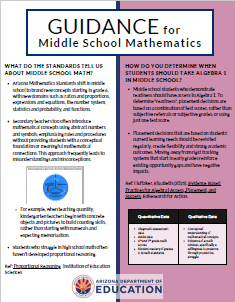
Guidance for Middle School Mathematics

Middle School Math Webinar

House Bill 2477

(Adopted during the Fifty-third Legislature Second Regular Session, 2018)

Notify Parents if students were not proficient on the statewide assessment for Math.

HB 2477 requires LEAs to provide parents with written notice that includes:

1. What the student's mathematics deficiencies were on the statewide Math exam; and

2. How those deficiencies are being addressed through services provided to the student, which could include supplemental instruction and any supporting programs designed to address the student’s specific mathematics deficiencies. LEAs are required to provide notice to parents regarding the Spring statewide assessment results by the first half of the second quarter of this school year if students scored in the minimally proficient or partially proficient range on the statewide Math assessment. LEAs can identify how below mastery in the scoring category is being addressed through Tier 1 (first instruction), Tier 2 (supplemental instruction), and possibly through supporting programs, which could include but are not limited to after-school tutoring.

The ADE Assessment and K-12 Standards Team has created a sample letter that you can customize with your school letterhead and site-specific supplemental instruction and/or supporting programs specific to the individual student. Understanding in Mathematics, when a student understands a mathematical concept, they move fluidly between the concrete and abstract. There is evidence that they can make sense of and justify mathematical connections. Evidence of understanding includes connections among:

♦Verbal or written reasoning ♦Pictorial representations ♦Real-world application ♦Procedures/Computation

Intro. to the Arizona Mathematics Standards | Glossary 

*Please contact Academic Standards for accessible versions.

Grades 6-8 Standards 6-8 Standards Placemats
Sixth Grade Standards (Updated 4.2.18) wrd|pdf Sixth Grade Standards (4.18) wrd|pdf
Seventh Grade Standards (4.18) wrd|pdf Seventh Grade Standards (Updated 4.2.18) wrd|pdf
Eighth Grade Standards (4.18) wrd|pdf  Eighth Grade Standards (Updated 4.2.18) wrd|pdf

The Arizona Department of Education K-12 Standards Section is providing planning guidance regarding the major and supporting clusters found within the Arizona Mathematics Standards, adopted in 2016. The Math Workgroup has made changes to the content emphasis documents (below) based on what we have learned since 2010. Please consider the following designations when planning an instructional scope for the school year. The ADE is suggesting instructional time encompassing 70% for Major Clusters at each grade level/course.

Mathematics Content Emphasis Documents

6th Grade7th Grade8th Grade

6-Algebra 2 AZ Mathematics Progression Documents

Thank you to the East Valley Mathematics Leaders Group and the Peoria District Math Team for completing the Arizona K-5 Mathematics Progression Documents. The East Valley Math Leaders met throughout the 2018-2019 year to complete the work on the 6-Algebra 2 progression documents.

The Arizona 6-Algebra 2 progression documents are one way to look at the progression of standards across grade levels and courses. The specific pathway that was utilized in these progressions is a progression around and through Number sense. Number Sense is the “big idea” across all the progressions. Number Sense then has pathways into Statistics, Expressions and Equations, and Proportional Reasoning. Proportional Reasoning is a giant and has pathways into Functions, Probability, and Congruence/Similarity.

Please open the Progression document, then click the link on each of the progressions to see how content progresses from 6th grade all the way through to Algebra 2.

*Please contact the Academic Standards Math Team for an accessible version.

Grades 9-12 Standards
 Intro. to the Arizona Mathematics Standards | Glossary 

AZ Mathematics Standards: High School

Content Emphasis Documents

Algebra 1 Grade Standards (Updated 4.2.18) wrd|pdf

Algebra 1

Geometry Standards (Updated 4.2.18) wrd|pdf

Geometry

Algebra 2 Standards (Updated 4.2.18) wrd|pdf

Algebra 2

Plus Standards (Updated 5.2.18) wrd|pdf


Quantitative Standards (Updated 9.7.18) wrd|pdf


Precalculus-Fourth Credit HS Math (Updated 9.7.18) wrd|pdf

High School Placemats
Algebra 1 Placemat (Updated 3.23.23) wrd|pdf
Geometry Placemat (Updated 3.23.23) wrd|pdf 
Algebra 2 Placemat (Updated 3.23.23) wrd|pdf

High School Placemats

Thank you to Ryan Carle-Ogren from Sahuarita High School for completing the Arizona High School Mathematics Placemats.

*Please contact the Academic Standards Math Team for an accessible version.

Math Resources

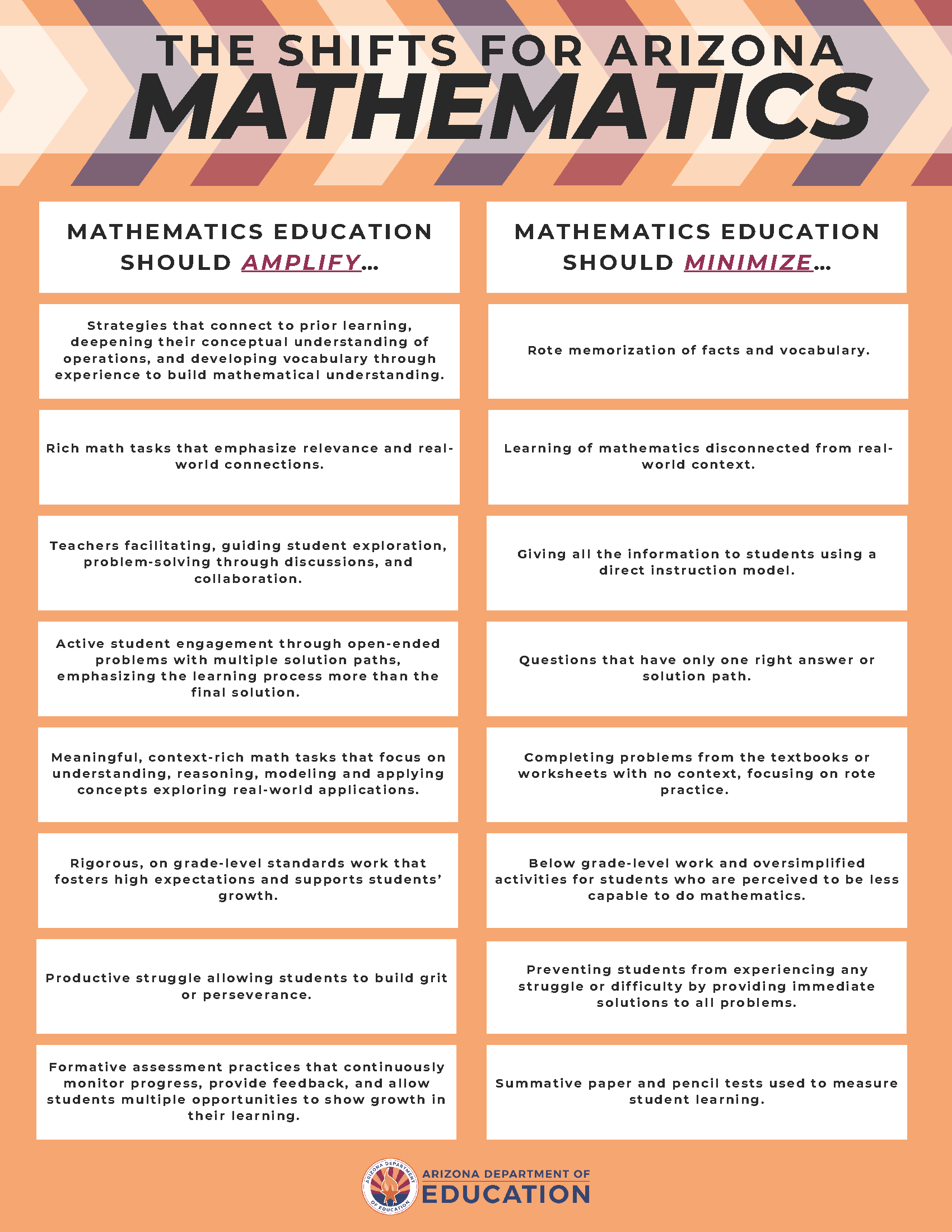
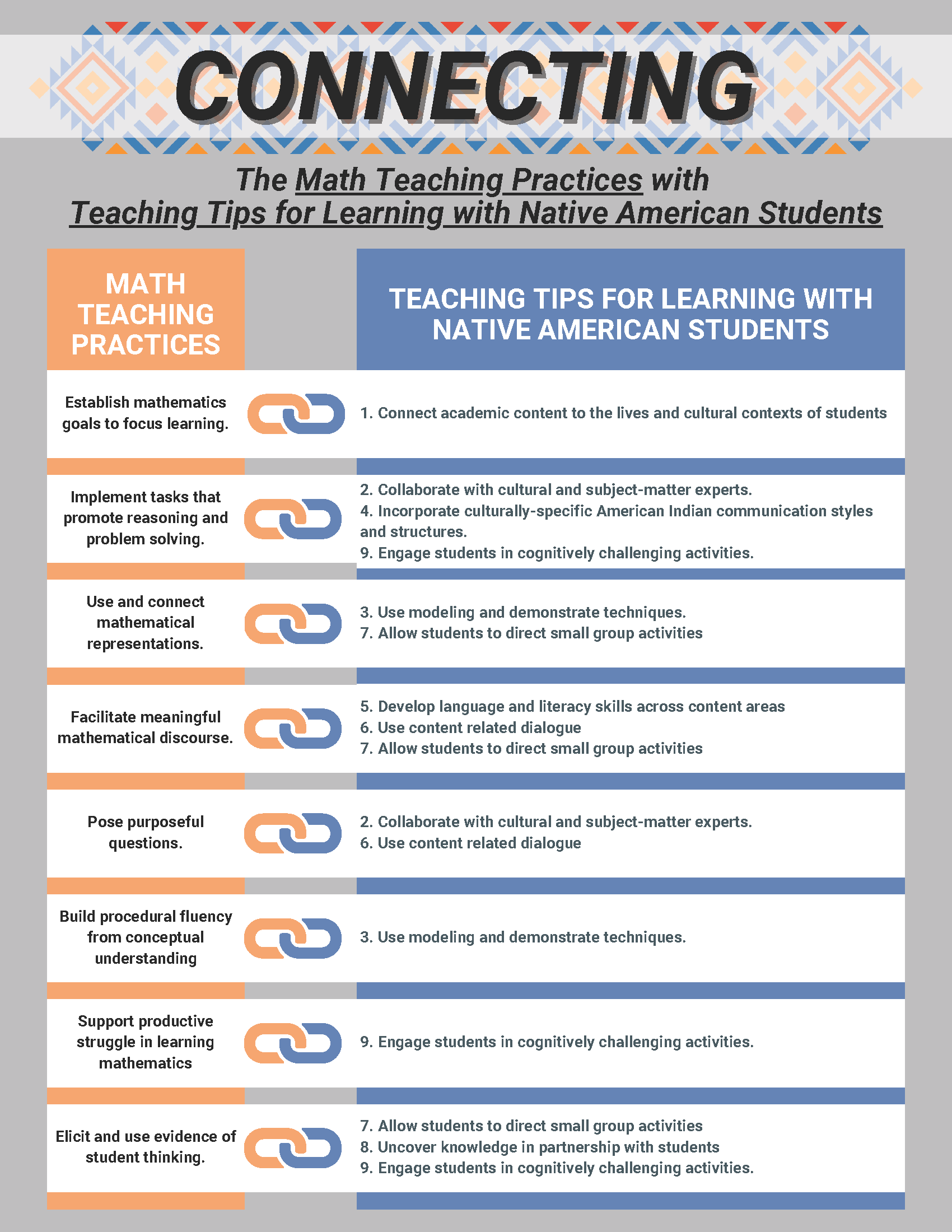
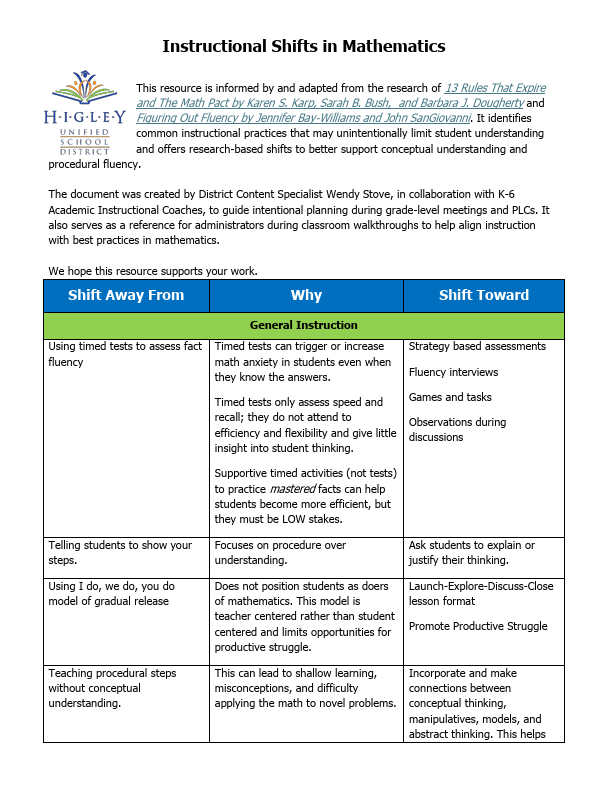
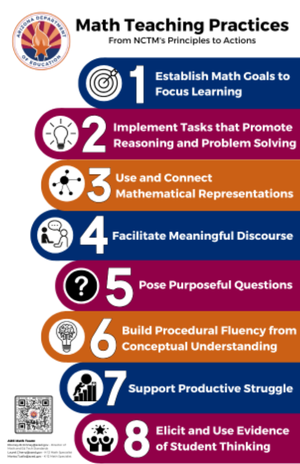
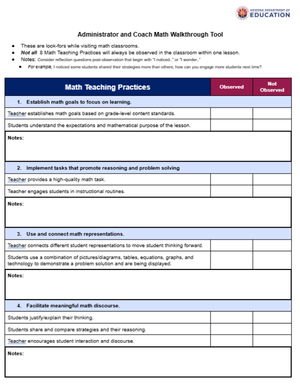
Guidance for Middle School Mathematics Connections for Success (CFS) The Shifts for Arizona Mathematics The Math Teaching Practices with Teaching Tips for Learning with Native American Students Instructional Shifts in Mathematics
Decorative Image
Connections for Success logo

Connections for Success (CFS) was developed after House Bill 2135 was passed in 2021.  CFS focuses on high school math standards, specifically Algebra 1, Geometry, and Algebra 2.  Each document highlights a standard cluster and its vertical alignment to prior and upcoming standards.  

Decorative Image
Decorative Image
Math Instructional Shift Document Image


Decorative image

Mathematics and Statistics Awareness Month

Month of March: Math & Statistics Month 


MATH AND STATS BINGO


Decorative image

Additional Math Resources

Achieve the Core has a Coherence Map for mathematics from kindergarten through Algebra 2. Standards relate to one another, both within and across grades. The Coherence Map is an interactive website that illustrates the coherent structure of the Common Core State Standards for Mathematics, K–High School. This site provides one representation of how the standards are connected and is derived from this wiring diagram. A great video is linked to the site that illustrates the importance of coherence in mathematics. The Coherence Map shows the connections between the common core state standards for mathematics.

Fourth Credit High School Guidance and Standards

The development of the fourth credit guidance and standards began in January 2017 under the guidance of the Arizona Department of Education. A statewide committee of high school mathematics teachers, district Mathematics Specialists and Professors, and Mathematicians from Institutes of Higher Education reviewed research and other state standards to create the general guidance and standards related to fourth-credit mathematics. The Quantitative Reasoning and Precalculus Standards are also aligned with the high school Plus Standards. Standards outline what a student needs to know, understand, and be able to do by the end of each grade. Standards are built across grade levels in a progression of increasing understanding and through a range of cognitive demand levels. Standards are adopted at the state level by the State Board of Education (A.R.S. §§15-701 and 15-701.01). Arizona retains the authority to approve and modify academic standards; there is no federal law requiring the adoption of specific standards. The fourth-credit standards for Quantitative Reasoning and Precalculus are not board-adopted since fourth-credit mathematics courses are a local control decision.

These documents represent guidance only for schools and districts. It is a local control decision what courses are offered in a four-credit mathematics pathway.

Fourth Credit Math General Guidance (Sept. 2018), Arizona Precalculus Standards (Sept. 2018) Arizona Quantitative Reasoning Standards (Sept. 2018)

*Please contact The Academic Standards Math Team for an accessible version.

Summary of Revisions & Planning Documents

Summary of Revisions & Planning Documents

SUMMARY OF REVISIONS AND PLANNING DOCUMENTS: K-8  & HS

Grade PDF WORD
Kindergarten (Updated 5.10.17) pdf wrd
First Grade (Updated 7.27.17) pdf wrd
Second Grade (Updated 7.27.17) pdf wrd
Third Grade (Updated 7.20.17) pdf wrd
Fourth Grade (Updated 7.20.17) pdf wrd
Fifth Grade (Updated 7.20.17) pdf wrd
Sixth Grade (Updated 8.16.17) pdf wrd
Seventh Grade (Updated 8.16.17) pdf wrd
Eighth Grade (Updated 3.28.17) pdf wrd
Algebra 1 (Updated 8.16.17) pdf wrd
Algebra 2 (Updated 5.1.17) pdf wrd
Geometry (Updated 8.16.17) pdf wrd


 Follow our AZ Math Professional Learning Calendar                 Sign up for the Math Mailing List


Arizona Science and History_Social Science Standards Review

Arizona Science and History_Social Science Standards Review

History/Social Studies Public Meeting  Science Public Meeting

The DRAFT Arizona Science Standards and DRAFT Arizona History and Social Science Standards will be available for review on March 26, 2018. The survey to collect public comments on the draft opens on March 26, 2018. The survey will remain open until May 28, 2018. In addition to the survey, ADE will hold two Public/Community Meetings. History and Social Science will be held Thursday, April 5, 2018. Science will be held Friday, April 6, 2018. Both meetings will be located at the Arizona Department of Education, in the State Board of Education Board Room, and are scheduled from 3:30 p.m. - 5:00 p.m. A recorded version of the live meetings will also be available on demand.[/column-left][column-right] Science Standards Working Group Overview History and Social Science Revision Timeline Standards Development Process (approved SBE 5/19/14)

SCI/Hist/SS Tech_Reviewers

REVIEW THE DRAFTS

Science, History and Social Science Survey Responses and Comments

Archived Survey Responses and Comments

Archived Survey Responses and Comments

To review the Archived Public Comments Prior to Revision Reports click here.

Due to technical difficulties, the survey for the Draft Science Standards will be extended to Thursday, May 31, 2018 at 12:00pm.

Professional Development Opportunities

Professional Development Opportunities

Academic Standards Professional Development

Our Event Management System (EMS) is called ADE Professional Learning and Development (APLD). Please use the dropdown bars below to learn how to access all current and future PDs on the APLD site.

Interested in a virtual or face-to-face PD for your school?

For more information, please send us an email.

Click Here To See Search Keywords

To find specific content area professional Development opportunities:

  1. Click on the K12 link above to be taken directly to a complete list of K12 content area Professional Development Opportunities
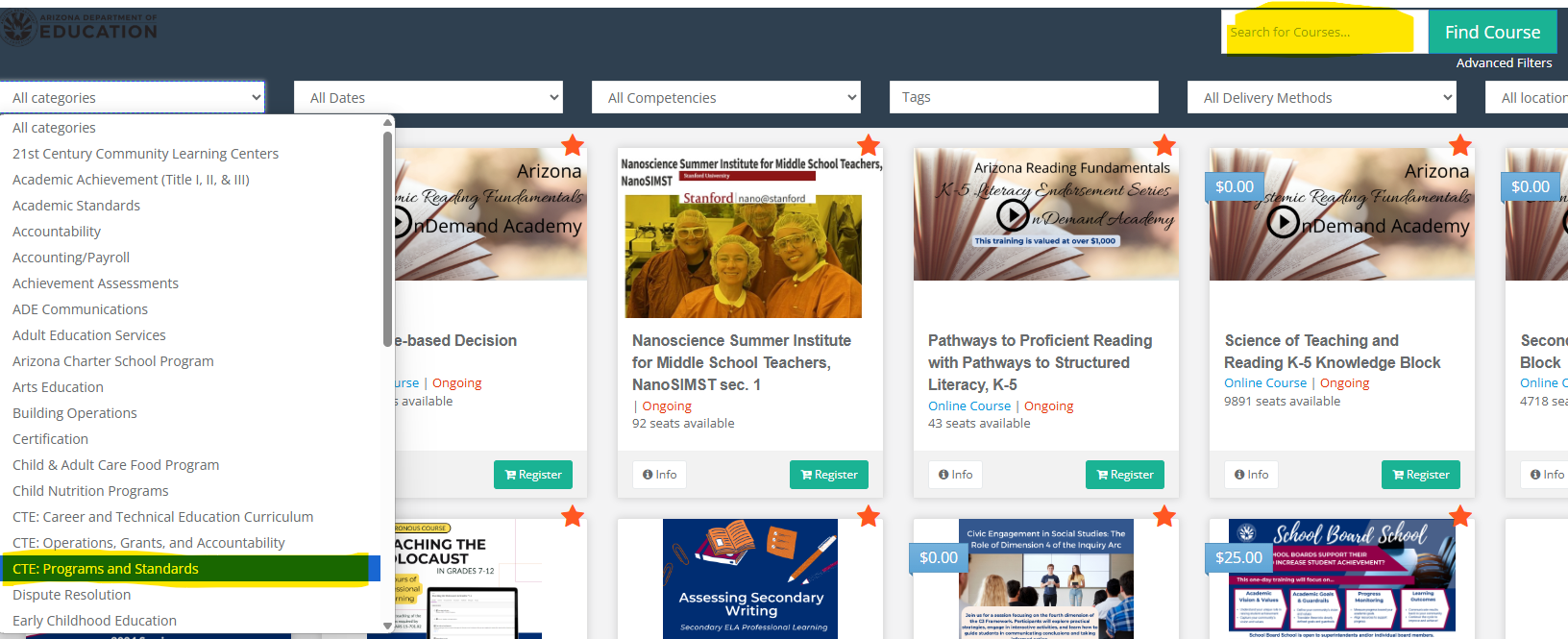
  2. Type the following keywords in the Search Bar (see image below) for a list of specific content area PDs.
Genesis Search Engine

Use the following keywords

tYPE OF pdComp. Sci.EDU. tECH.sCIENCE  PEmATHS.Sela W.N.L

Face  to Face

K12-AS-CS

K12-AZ-EDTECH   

K12-AS-SCI

WK12-AS-PE 

K12-AS-Math

K12-AS-SS

K12-AS-ELA

K12-AS-WNL 

Webinars

WK12-AS-CS 

WK12-AS-ET 

WK12-AS-SCI 

WK12-PE 

WK12-AS-Math

WK12-AS-SS 

WK12-AS-ELA

WK12-AS-WNL

Online Courses

OK12-AS-CS 

OK12-AS-ET

OK12-AS-ELA 

OK12-AS-PE 

OK12-AS-Math 

OK12-AS-SS

OK12-AS-ELA 

OK12-AS-WNL 

 Early Childhood Education

Click on the Early Childhood Education link below to be taken directly to a complete list of ECE Professional Development Opportunities.

Early Childhood


 Other Business Units

Career and Technical Education (CTE)

Image of ADE Professional Learning and Development (APLD) portal

  • Choose the All Categories dropdown
  • Choose CTE: Programs and Standards
  • Type in a few keywords from the event you are searching for in the search bar (highlighted in the image above)

Help with Registration

Coconino County Educational Service Agency (CCESA)