Path
standards-practices
Contact
Contact name or title
Academic Standards Front Desk
Contact phone number
(602) 364-2333
Contact name or title
Click the subscribe button below to receive content area updates

Early Literacy Grant

Early Literacy Grant

The Early Literacy Grant (ELG) is literacy-focused funding for eligible schools serving our most at-risk populations in grades Kindergarten through third grade. These funds support current literacy goals and initiatives of the school to increase the literacy proficiency of students.

Early Literacy Grant Timeline

December: Amended Early Literacy Grant Awards are submitted to the State Board of Education for Approval.

Mid-January: Early Literacy Grant Awards reach LEAs.

June: All schools submit the Annual Report. The form to complete the Annual Report is now housed in EMAC. Please log in to ADEConnect to access EMAC. See the guidance documents below for more details.

Historical Information

The Early Literacy Grant Program originated during the 2017-2018 academic year with an $8 million appropriation from the legislature. This program was designed to be administered to schools with at least a 90% free and reduced lunch population, and funds were to be used for K-3 literacy programs and full-day Kindergarten. It originally allowed for participating schools to receive available funding throughout a three-year grant cycle, provided all requirements were met. At this time, there were 242 eligible schools, of which 175 schools elected to participate. Year two of the grant began in the 2018-2019 academic year, and a $12 million appropriation from the legislature was included for all 242 eligible schools. To comply with the legislation and maintain the integrity of the grant program for the participating schools, the eligibility list of schools from the previous academic year was used to determine the funding for the next academic year. Moving forward, eligibility will be determined on an annual basis, provided the continuation of funding. Because the Early Literacy Grant is an entitlement program, there is no application required for participation. However, each school that receives Early Literacy Grant funds is required to submit an Annual Report by June 1st of each calendar year.

The report must include information related to the following:

  • Summary of the school’s funded activities
  • The school’s progress toward achievement goals
  • Specific findings on grant-funded strategies and activities
  • The level of effectiveness in improving reading proficiency


While both the Early Literacy Grant and Move On When Reading address K-3 literacy, they are separate endeavors. All schools with K-3 students are required to submit Move On When Reading literacy plans according to the legislated timeline, even if they are also receiving the Early Literacy Grant.

Legislation

Funding and Usage 

  1. ELG funding is allotted at the school level and may not be used for non-eligible schools in the same district/charter system
  2. ELG funding is to be used to support all-day kindergarten and/or K-3 reading.
    1. Similar to Move On When Reading (MOWR) funding, ELG funding can be used in any of the following large buckets:
      1. K-3 Reading: Staffing
      2. K-3 Reading: Instructional Materials that support evidence-based science of reading practices
      3. This includes curricula, materials such as a reading table, and/or technology used to support reading.
      4. K-3 Reading: Assessment Materials
      5. K-3 Reading: Professional Development that supports evidence-based science of reading practices
  3. Because final funding amounts are determined by ADM, ELG funding has typically been provided in one payment to schools following approval by the State Board of Education.
    1. Please note that funding amounts listed in eligibility documents are estimated. The allocations report is sent to the State Board of Education for approval as soon as it is finalized.
    2. Funds are included in the Operating Budget, typically denoted in ‘Other State Funds.’
    3. Distribution of funds occurs when all approvals are finalized.  Please note that the ELA team does not determine when allocations are released and does not control the timing of allocations.
  4. The ELG does allow the carryover of funds. 
     

Guidance Documents and Resources 

Early Literacy Grant Assignment and Task Guidance

Please use this document to assign the ELG task to individual schools, assign EMAC users, and complete the required documentation required each year by June 1st. EMAC is a system housed within ADE Connect and where all reporting will occur for the ELG. Please use this document to help add EMAC to user profiles. If you have any other issues, please reach out to the EMAC HelpDesk.

Early Literacy Grant Annual Report Guidance
The annual report is due June 1. This document shares the requirements and needed information to complete the form within EMAC.

ESSA Tiers of Evidence

In 2015, the Every Student Succeeds Act replaced No Child Left Behind. ESSA empowers states to better identify and support the needs of their schools. Beginning in 2017-2018, the K-3 reading programs used by schools must meet the ESSA criteria for being evidence-based. To receive MOWR and any federal funding (Title 1, etc.), programs must meet one of the top three tiers of evidence (Strong, Moderate, or Promising).

**For more information on ESSA, including videos and other guidance, please visit the MOWR for Administrators page, and go to the blue bar titled "ESSA (Every Student Succeeds Act)".

Previous Annual Early Literacy Grant Reports 

Previous ELG reports are shared below as a reference:

2023-2024 (FY25)


FY26 ELG funds by LEA and County

Formative Assessment Resources

Formative Assessment Resources

Formative Assessment

Formative Assessment Micro-Course Button

Click the "Learn More" button to sign up for one of the Micro-Courses!

decorative image

The Formative Assessment process used by teachers can help them determine the status of student learning, giving them the ability to adjust their teaching – in the moment - and to move all learners forward. Embedding formative assessment dimensions in everyday teaching is a research-based practice to improve individual student learning.

A central goal of the Arizona Department of Education (ADE) is for every individual in the state’s education system to work in concert to enhance student achievement. To that end, the ADE has developed a formative assessment framework.

.

View the 2-page overview of the ADE Formative Assessment Framework document.   

2-Page Overview 

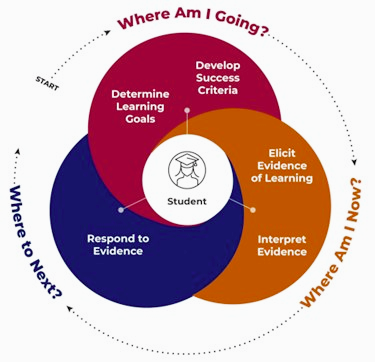
Where am I going, Where am I now, Where to next Graph

Effective use of the formative assessment process requires students and teachers to integrate and embed the following practices in a collaborative and respectful classroom environment:


What Formative Assessment is...What Formative Assessment is not...
A process used by leaders, teachers, and students in partnershipA checklist of what students can’t do or don’t know
Grounds decision making in ongoing evidence of learningSeparate from learning/working processes
Transparent about the learning expectations and how to get therePoints, scores, or grades
A process that moves all student learning forwardA mini-summative assessment, e.g., a test or quiz
Informs learning, rather than sums up learning with a scoreInterpreted only by teachers or leaders


Framework Roles in Formative Assessment

Decorative image of roles

ADE Full Framework Document

Decorative Image

 Formative Assessment Framework Micro Courses

Below is a series of micro-courses for you to learn more about Formative Assessment, the Formative Assessment Framework, and the vision for each role group in the system.

Micro Course 1

Micro Course 2

Micro Course 3

What is Formative Assessment?

Decorative Image
Decorative Image

Picture of Children collaboratively working together in a classroom

Introduction to the Arizona Formative Assessment Framework

Children working together
Decorative Image

The Teacher's Role in a Formative Assessment Classroom

Kids working together

Micro Course 4

Micro Course 5

Micro Course 6

A Vision for Students and Families in Schools Grounded in Formative Assessment Principles

Children working together

The Site Leader's Role in a School Grounded in Formative Assessment

Black space


Kids gathered together

Decorative Image

A Vision for State and District Leaders in a Formative Assessment System

Black space
Decorative image
Decorative Image

Decorative Image

Familes' and Caregivers' Role

Framework Section


Going Deeper

 General Resources 

Arizona Formative Assessment Resources:

This learning series provides district and school teams with a process to guide and assist in building a foundation for systems change that will impact literacy outcomes by closing the achievement gap for students with specific learning disabilities. Every part of the professional learning series will empower students to be successful learners in a safe, supportive, and inclusive learning environment.

Other Resources

This document, by the Formative Assessment for Students and Teachers (FAST) State Collaborative on Assessment and Student Standards SCASS), provides an up-to-date, research-based definition of formative assessment. It also includes detailed descriptions of the formative assessment practices and the support teachers need to implement them.

Commissioned by the Formative Assessment for Students and Teachers (FAST) State Collaborative on Assessment and Student Standards (SCASS) of the Council of Chief State School Officers (CCSSO), this observation tool includes ten dimensions of formative assessment to support the reflection and improvement of teachers’ formative assessment practice.

This article from the GettingSmart website provides an overview of research that grounds formative assessment practice.

This article from the Center on Standards and Assessment Implementation provides a foundation for learning and successful formative assessment implementation.

 Contact Information: [email protected] 

Social Studies Newsletter Subscription Form

Social Studies Newsletter Subscription Form

Thank you!

Thank you!

""
""
""

Your request has been processed. Thank you for subscribing to the K-12 Standards Newsletter.

You'll receive monthly newsletters at the beginning of each *month; please check your Junk/SPAM folders if you have not received a newsletter within the first two weeks of the month.

Subscribe to our blog
To receive daily or weekly updates subscribe to our blog.

Please add [email protected] to your address book to ensure that our emails reach your inbox.

*With the exclusion of the summer months. Follow us on Twitter and Facebook#K12STANDARDS #K12AZPD4>

Arizona Math Standards Development Process & Documents

Arizona Math Standards Development Process & Documents

Arizona ELA Standards Development Process & Documents

Arizona ELA Standards Development Process & Documents

Parent and Guardian Math Resources

Parent and Guardian Math Resources

Decorative Image

The videos included here support the Arizona math standards and help guide parents and guardians so they can support students at home to achieve greater success in mathematics. 

The following three questions will be addressed...

  • What does my child need to know?  
  • What does this look/sound like?
  • How can I support my child at home?

KINDERGARTEN - FIFTH GRADE

KINDERGARTEN

Click on the links below to find video resources on how to practice Kindergarten math skills.  

FIRST GRADE

Click on the links below to find video resources on how to practice First Grade math skills.  

SECOND GRADE

Click on the links below to find video resources on how to practice Second Grade math skills. 

THIRD GRADE - COMING SOON

FOURTH GRADE - COMING SOON

FIFTH GRADE - COMING SOON

SIXTH - EIGHTH GRADE 

SIXTH GRADE - COMING SOON

SEVENTH GRADE - COMING SOON

EIGHT GRADE - COMING SOON 

K-12 Standards Feedback

K-12 Standards Feedback

For comments and feedback related to the Draft Arizona Science Standards and the Draft Arizona History and Social Science Standards, please visit the respective survey for public comment.

Presidential Awards for Excellence in Mathematics and Science Teaching

Presidential Awards for Excellence in Mathematics and Science Teaching

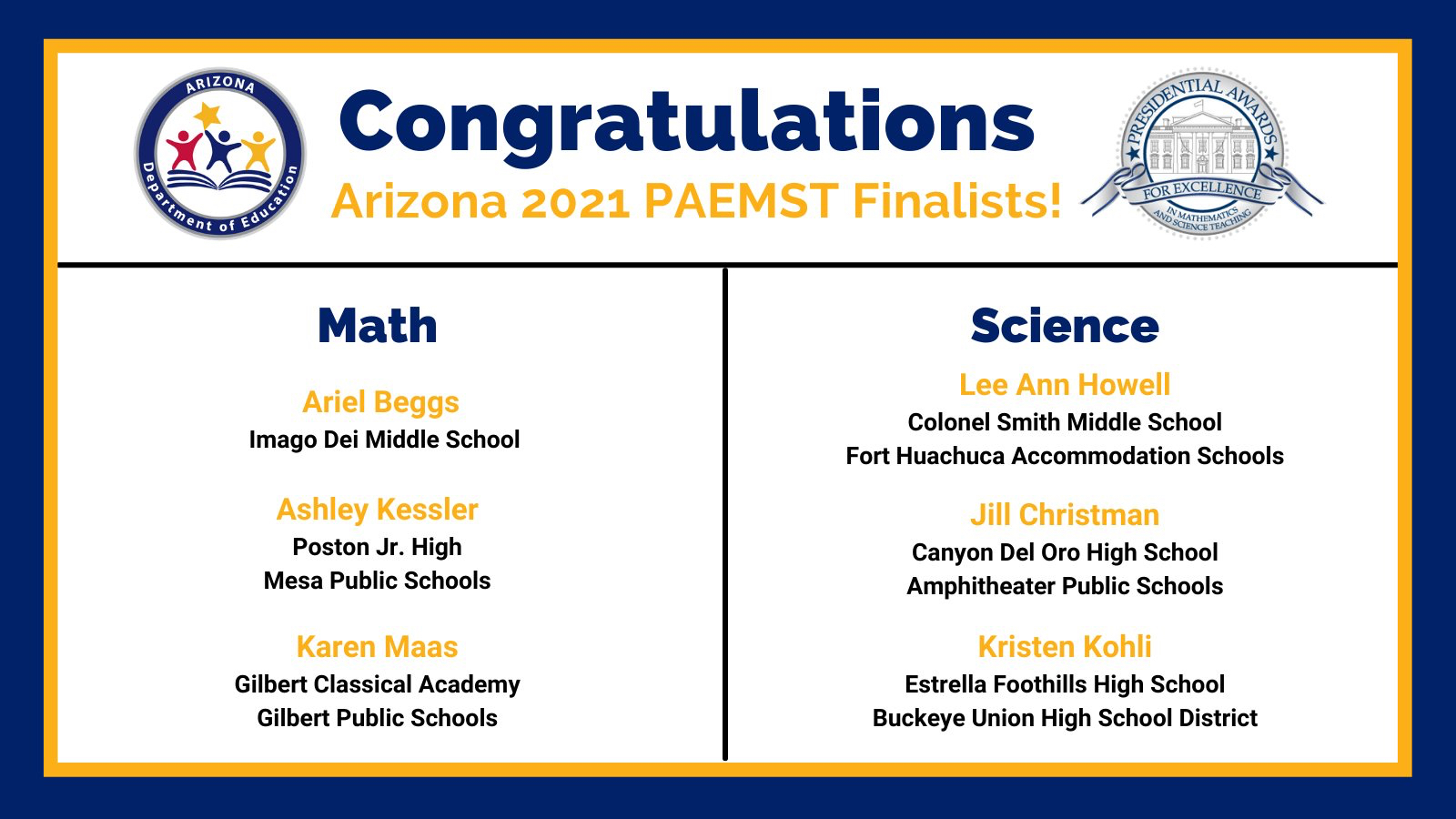
PAEMST Seal
The Presidential Awards for Excellence in Mathematics and Science Teaching (PAEMST) is the nation’s highest honor a K-12 science, technology, engineering, mathematics, and/or computer science teacher can receive in the nation. The Awards were established by Congress in 1983. highest honor for teachers of mathematics and science. The Awards recognize exemplary K-12 teachers for their contributions in the classroom and to their profession. Excellent teachers perform miracles every day with little or no recognition. The Presidential Awards demonstrate the value and appreciation the nation has for the teaching profession. Nominate an outstanding math or science teacher today for this prestigious award.

Awards are given to science, technology, engineering, mathematics, and/or computer science teachers from each of the 50 states, the District of Columbia, the Commonwealth of Puerto Rico, the Department of Defense Education Activity schools, or the U.S. territories as a group.

The award recognizes those teachers who have both deep content knowledge of the subjects they teach and the ability to motivate and enable students to be successful in those areas. 

For more information, please visit the PAEMST website.


Currently, the National Science Foundation (NSF) program is on pause.

Presidential Awards Recipients

Click on the images below to enlarge them.

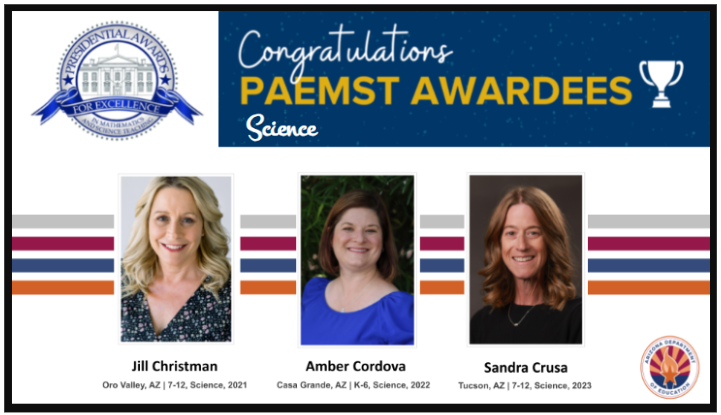
2021-2023 Science Awardees

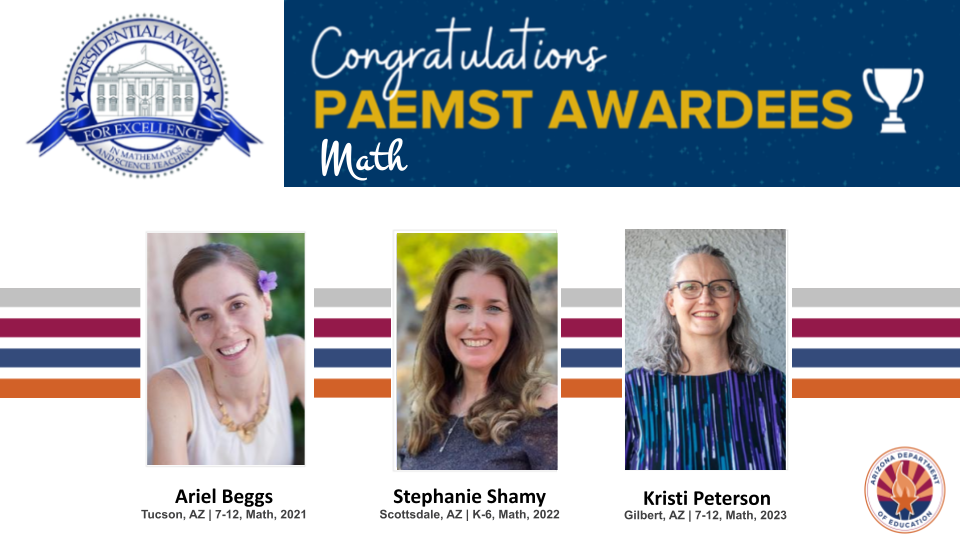
2021-2023 Math Awardees

The Presidential Awards for Excellence in Mathematics and Science Teaching

The Presidential Awards for Excellence in Mathematics and Science Teaching

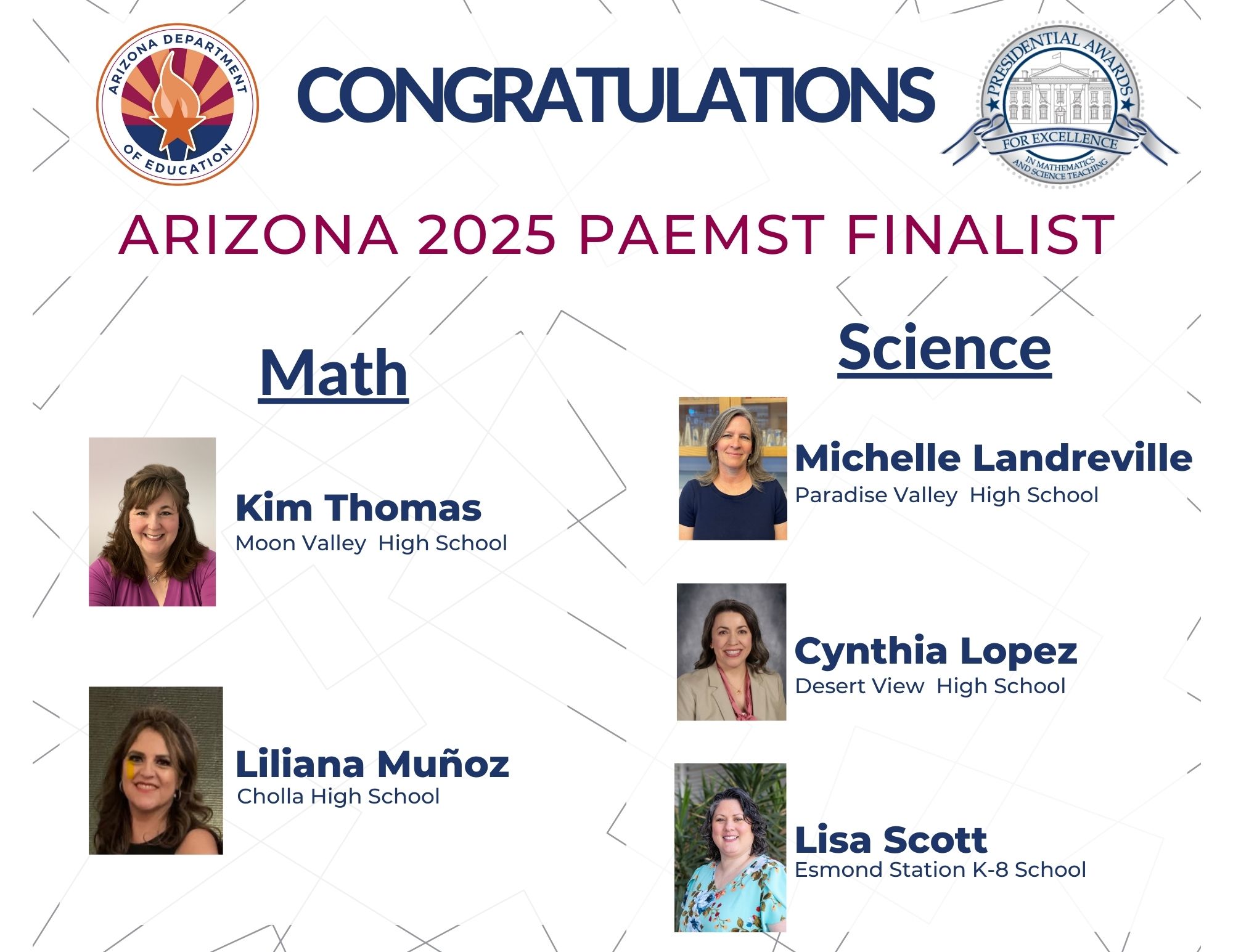
2025 Finalist

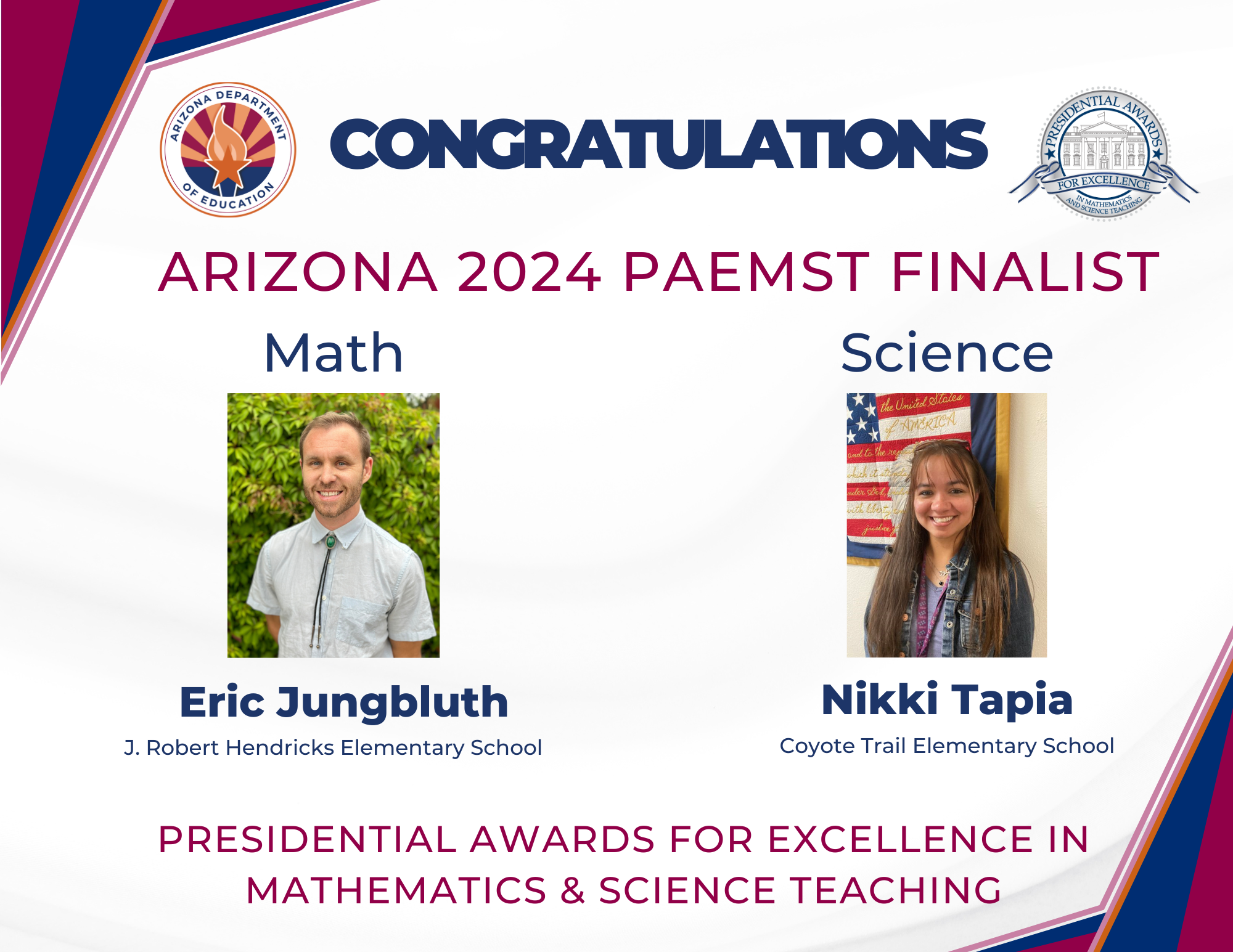
2024 Finalist

 The Presidential Awards for Excellence in Mathematics and Science Teaching

The Presidential Awards for Excellence in Mathematics and Science Teaching

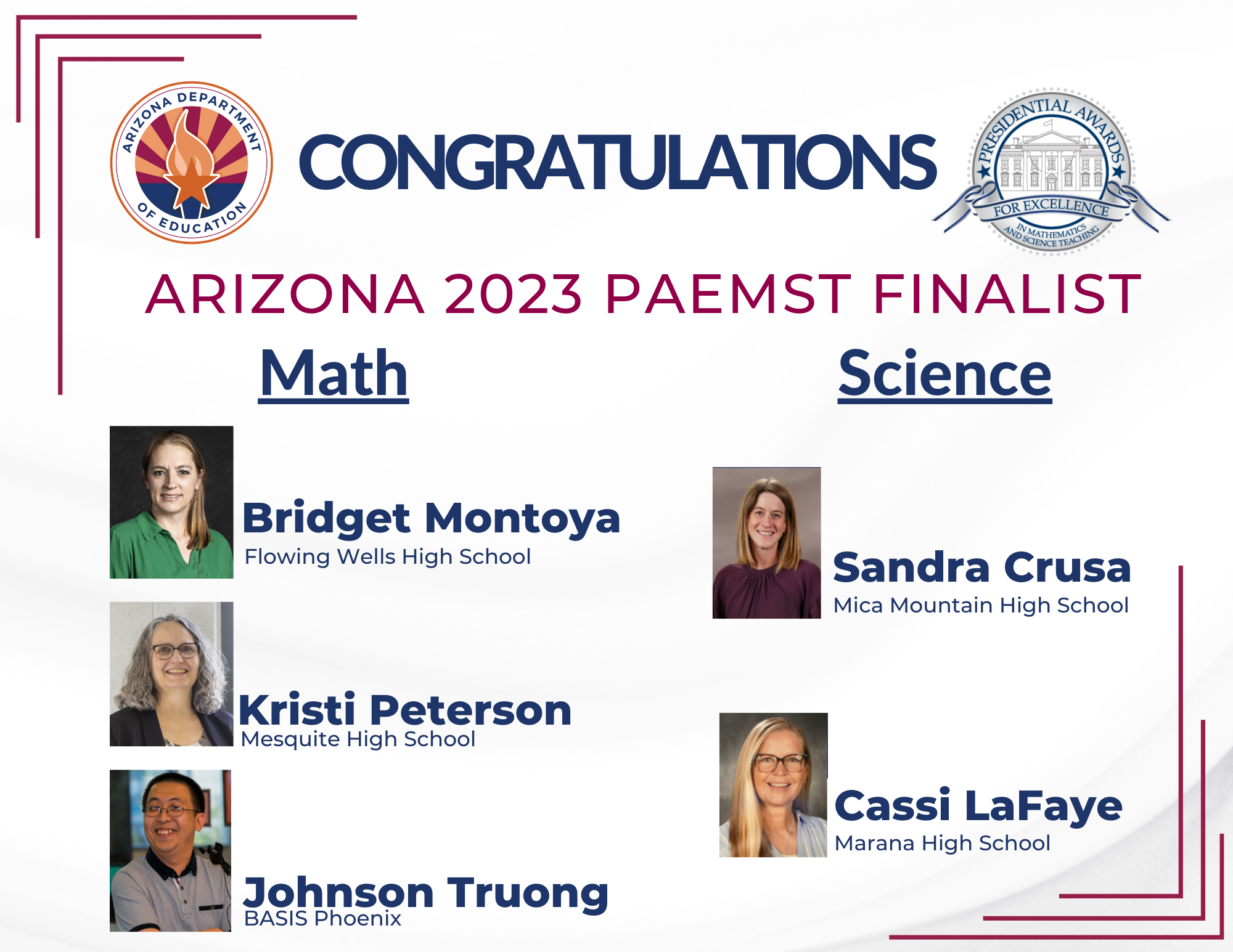
2023 Finalist

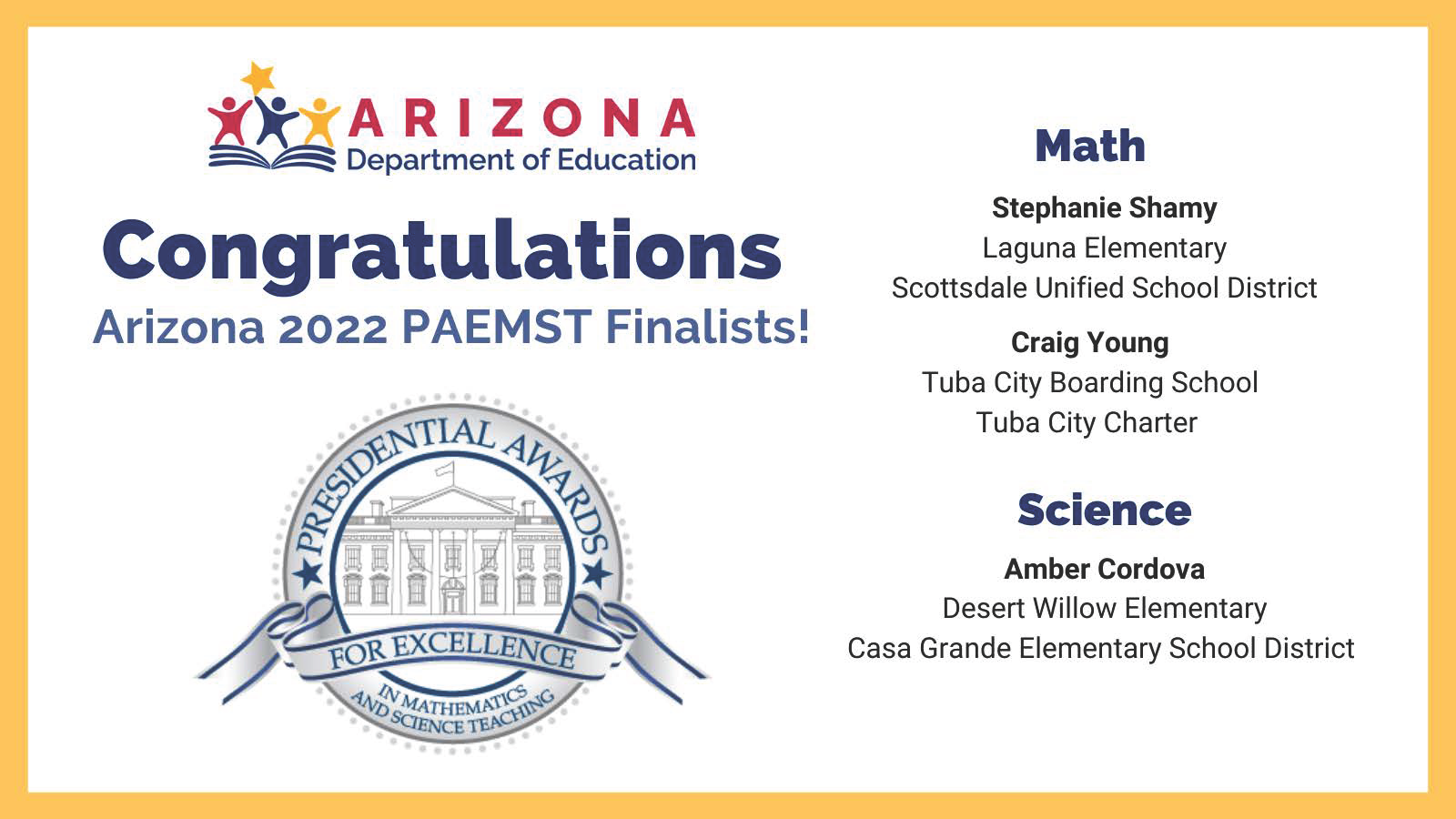
2022 Finalist

The Presidential Awards for Excellence in Mathematics and Science Teaching

The Presidential Awards for Excellence in Mathematics and Science Teaching

2021 Finalist

Black space
PAEMST 2021 Awardee

The Presidential Awards for Excellence in Mathematics and Science Teaching

Black space

 What is the Application Process? Click to find out more.

Nominations and applications for mathematics and science teachers, grades K-6, are open. To submit a nomination, you only need the teacher’s contact information. If you know more than one teacher deserving this award, you may submit more than one nomination. Teachers may also initiate the application process themselves at www.paemst.org

Arizona Health Standards

Arizona Health Standards

Comprehensive Resources

Image of a Comprehensive Resources Flyer


Approved Spring 2010) Introduction to the Health Standard  PDF version | Word version | CASE

Health Standards Placemat PDF (color) | PDF (B/W) |  | CASE | Contact us for an accessible version

Blue Decorative line

Health Concepts Explanations

Health Concepts Explanations PDF | Word | CASE

Health Performance Objective

Health Performance Objective PDFWord  | CASE

Health Education Standards Examples

Health Education Standards Examples PDF | Word | CASE

Strands 1 -5

Strand 1: Comprehension of Health Promotion and Disease Prevention Concepts PDF | Word | CASE

Strand 2: Analysis of Factors Affecting Health Behaviors PDF | Word | CASE

Strand 3: Access to Health Information, Products, and Services to Enhance Health PDF | Word | CASE

Strand 4: Use of Interpersonal Communication Skills to Enhance Health PDF | Word | CASE

Strand 5: Use of Decision-Making Skills to Enhance Health PDF| Word | CASE

Strands 6-8

Strand 6: Use of Goal-Setting Skills to Enhance Health  PDF | Word | CASE

Strand 7: Ability to Practice Health-Enhancing Behaviors PDF | Word | CASE

Strand 8: Ability to Advocate for Health PDFWord | CASE

Recommended Instructional Minutes Health

Information Regarding CPR Legislation

CPR instruction is not a graduation requirement. The requirement is that LEAs provide each student CPR instruction at least once in high school, however, there is not a provision saying that if a student does not receive the training, they are prohibited from graduating and there is an opt-out provision. There is also specific guidance regarding online school. Download the CPR Legislation

Health & Nutrition Civil Rights | Safe & Healthy StudentsEvent Registration  |    Contact Us

Health Education Standards and Resources |  Physical Education  Resources

Health Standards Questions

Decorative image
Arizona Digital Educators Library
Access ADEL Standards aligned resources


Look for the word CASE next to each of our Word and PDF files. The Competencies and Academic Standards Exchange is the framework that allows for the navigation and integration of Arizona Academic Standards.