Path
standards-practices
Contact
Contact name or title
Academic Standards Front Desk
Contact phone number
(602) 364-2333
Contact email address
Contact link
Contact name or title
Click the subscribe button below to receive content area updates
Contact link
CLSD Supplemental Grant
CLSD Supplemental Grant
Comprehensive Literacy State Development-Supplemental Grant
Arizona has been awarded the Comprehensive Literacy State Development-Supplement (CLSD-Supplemental) Grant. This is a 2-year grant with a total of $2,064,650 million in funding that will enhance and expand the current goals and activities of the Comprehensive Literacy State Development (CLSD) Grant. Per Federal guidelines, funding is broken down into three tiers: 15% of grant funds must be used for children from birth through kindergarten entry and 40% for K-5 and 6-12 grades.
CLSD-Supplemental competitive grant opportunities include literacy-based curriculum and high-quality resources that meets Tier 1 or Tier 2 Strong to Moderate ESSA requirements, Dyslexia Designee Training, K-5 Literacy Endorsement Professional Development, and high impact Intervention that meets Tier 1 or Tier 2 ESSA Evidence requirements.
To determine ESSA requirements, you may use the following resources:
Click here for a list of approved K-5 Literacy Endorsement trainings.
Click here for a list of approved Dyslexia Designee trainings.
Eligible LEA’s, Charter Schools, Early Childhood programs, and Educational Consortiums will be able to apply for subgrant funding through a competitive application process.
Applicants must not currently be a CLSD, PDG B5 or HQEL grantee.
Application and Resources
The CLSD Funding Application opened August 1, 2023, and closes on October 13, 2023.
If your program does not currently have the below, refer to How to Access the CLSD-Supplement Grant to begin your process.
- ADE Entity or CTDS Number
- SAM.gov UEI Number
- Ever received funds from ADE
- Grants Management role in ADEConnect
The SAM.gov UEI registration process can take up to 10 business days to complete.
How to Access the CLSD-Supplement Grant Application
CLSD-Supplemental Grant Overview Presentation
Grants Management Resource Library
Grants Rubric and Narrative Questions
ADE CLSD-Supplemental Tier 1 or Tier 2 Strong to Moderate Vetted List (Updates will be coming soon.)
*The CLSD-Supplemental grant operates on a federal calendar year from 10/1-9/30 concluding 9/30/2025.
Identifying Evidence-Based Language and Literacy Practices
Videos
- Understanding the ESSA Tiers of Evidence Video and handout
- Reading a study
- Using the WWC to Identify ESSA Evidence Ratings
Tools
- LitHubAZ
- Science of Reading
- Evaluating evidence to align with current needs/wants/context
- The Science of Reading: Defining Guide from The Reading League
Evidence-Based Resources
Evidence-Based Instructional Practices and Strategies
Videos
- 3-minute "elevator speech" about the Science of Reading, as explained by Dr. Stephanie Stollar.
- Providing Reading Interventions for Students in Grades 4–9: What the IES Guide and Research Tell Us
Tools
- LitHubAZ
- Science of Reading
- COX Campus Coaching Courses
- Move On When Reading: Professional Development
- Assessing the body of evidence for a particular intervention
- ADE Move on When Reading Interventions and Supplemental Programs
Evidence-Based Resources
- Evidence-Based Resource Websites (ESSA)
- Selecting Evidence-Based Practices for Low-Performing Schools
- Evidence for ESSA
- IRIS Center Peabody College Vanderbilt
- CLSD Program Resources: Evidence-Based Practices
- Ohio's Evidence-Based Clearinghouse
- Connecticut State DOE Evidence-Based Practice Guide
- What Works Clearinghouse
- Scarborough’s Reading Rope
- The Center for Literacy and Learning: The Simple View of Reading
- Early Childhood Technical Assistance Center
- Pre-K Practice Guide: Preparing Young Children for School
CLSD Supplemental Grant Awardees
- Arizona State School for the Deaf and Blind
- Avondale Elementary District
- Casa Grande Elementary District
- Espiritu Community Development Corp.
- Espiritu Community Development Corp.
- Gila Bend Unified District
- Marana Unified District
- Phoenix Elementary District
- Prescott Valley Charter School
- Southwest Human Development
- Washington Elementary School District
- Winslow Unified District
CLSD Awardees Onboarding
CLSD Awardee Resource
Join us at our Virtual Office Hours
Office Hours: Tuesdays from 2:00pm - 3:00pm and Fridays from 8:30am - 9:30am
Contact Information: CLSDG Inbox
ConnectionsforSuccess
ConnectionsforSuccess
- Where are they coming from?
- Where are they now?
- Where are they going?
These documents are designed to be a resource for all math educators around the state of Arizona to not only help with connecting standards, but to finding quality open resources for math tasks and instructional routines.
To learn more about instructional routines and math tasks, read through the definitions that were developed by the statewide working group. If you are looking for additional resources to support educator learning, check out Modernizing the Mathematics Classroom.
If you have a great instructional routine or math task that you would like to share with ADE, please use this Microsoft Form to submit your idea(s).
| Algebra 1 cluster document | Geometry cluster document | Algebra 2 cluster document |
|---|---|---|
 |  |  |
STEM Resources
STEM Resources
Arizona STEM Resources
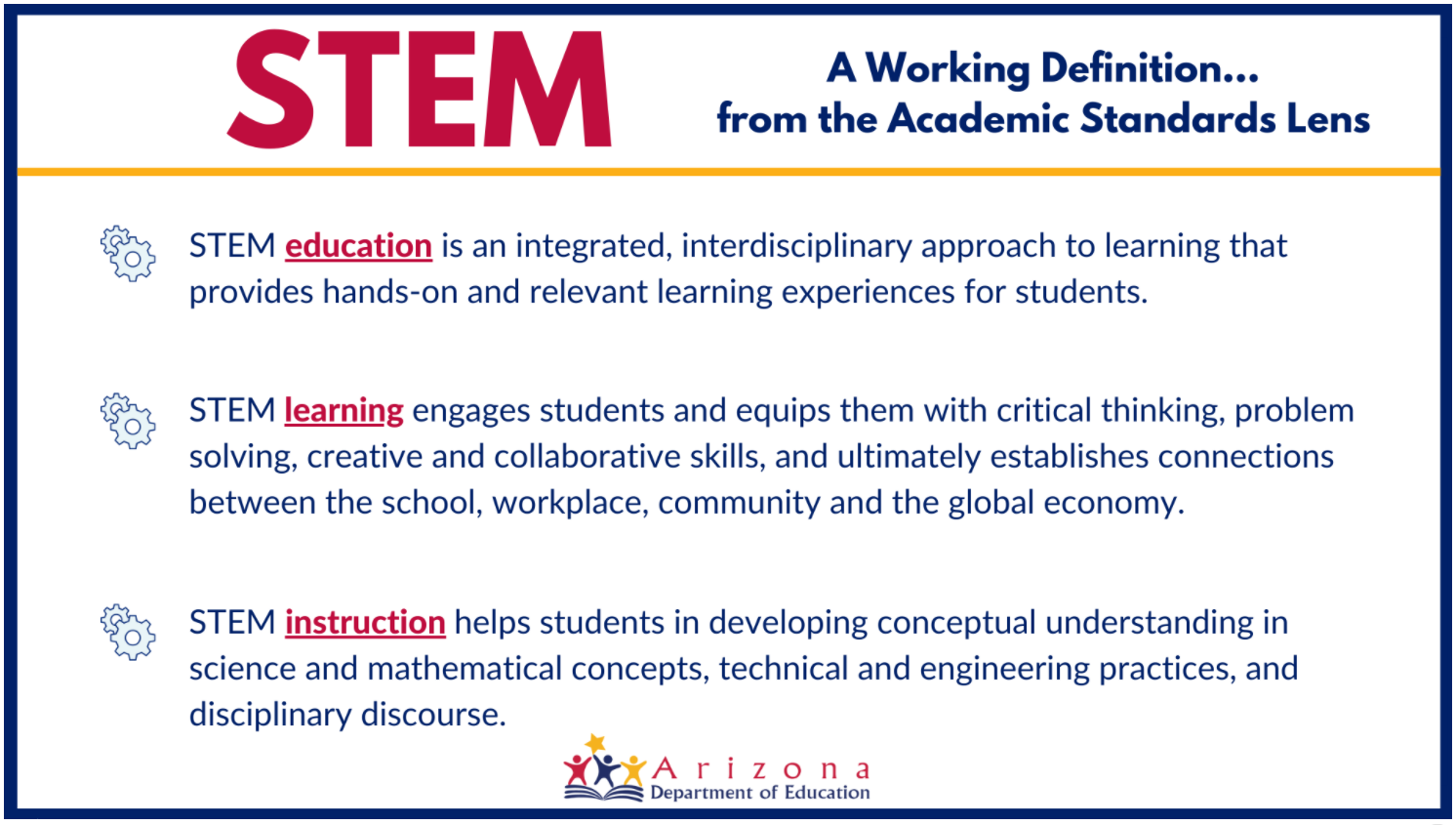
Click here for a larger view of the image below.
STEM Instructional Resources
Science Lab Safety Resources
Professional Learning Opportunities
Science & STEM Professional Learning Opportunities
Science Professional Organizations
Certification Information: Testing Information
Grants & Awards
Assessment Information
General Science Assessment Information - National & State
National Assessment of Educational Progress (NAEP) The National Assessment of Educational Progress (NAEP), also known as “the Nation’s Report Card,” is the only nationally representative and continuing assessment of what America’s students know and can do in various subject areas.
Arizona Assessment Information
Contact Information: Sarah Sleasman, Science and STEM Director | 602-364-2353
Contact Information: Rebecca Garelli, Science and STEM Specialist | 602-364-2356
**The views and opinions expressed in any third-party resource do not necessarily reflect those of the Arizona Department of Education (ADE) and do not imply an endorsement by ADE.
High School Graduation Information
High School Graduation Information
High School Graduation Information
The Arizona State Board of Education establishes the requirements for graduation from high school. The minimum course of study and competency requirements are outlined in Title 7, Chapter 2 of The Arizona Administrative Code. The minimum course of study State Board Rule, is R7-2-302.
Credit Requirements
Click to review the Graduation Requirements
The table below summarizes the minimum credit requirements for high school graduation in Arizona, starting with the graduating class of 2017. Please note that school districts and charter schools may, at their discretion, establish additional graduation credit requirements for their students.
| SUBJECT | CREDITS |
|---|---|
| English or English as a Second Language | 4 credits |
| Mathematics | 4 credits |
| Science | 3 credits |
| History & Social Science | 3 credits |
| Fine Arts or Career and Technical Education | 1 credit |
| Locally Prescribed Courses | 7 credits |
Key highlights from R7-2-302 are listed below.
Mathematics (1) Three credits containing course content in preparation for proficiency at the high school level on the statewide assessment and aligned to the Arizona Mathematics Standards for Algebra I, Geometry, and Algebra II. These three credits shall be taken beginning with the ninth grade unless a student meets these requirements prior to the ninth grade. (2) The requirement for the third credit covering Algebra II, may be met by, but is not limited to the following: a math course comparable to Algebra II course content; computer science, career and technical education and vocational education, economics, science and arts courses as determined by the local school district governing board or charter school. (3) The mathematics requirements may be modified for students using a Personal Curriculum.
Science (4) Three credits of science in preparation for proficiency at the high school level on the statewide assessment.
History and Social Science (5) History and Social Science will minimally consist of one credit of American history, including Arizona history; one credit of world history/geography; and one-half credit of government and one-half credit of economics. Note: Specific course requirements are outlined in R7-2-302.
Civics Graduation Test - Graduation Requirements
Arizona Civics Test Homepage | Arizona Civics Test Administration Guide (Updated October 2023)
New Legislation Signed in 2022: There is new legislation that was signed into law in 2022 that requires students graduating in 2026 and after must have a passing score of 70/100. If a student graduates in 2026, and has already taken the civics test and scored a 60-69, they will need to retest and score a 70/100 sometime before they graduate in 2026.
Special education students with an Individualized Education Plan are only required to pass the civics test if it is mentioned in the student's Individualized Education Program (IEP). As a courtesy, the Arizona Department of Education, with help from the Maricopa County Education Service Agency and Arizona educators, has developed a mostly multiple-choice version of the required test.
Updates:
For all students to meet the civics test graduation requirement, please use the 2008 U.S. Citizenship and Immigration Services (USCIS) (linked above) test. There is a 2020 test with additional questions that the Trump administration created. It is only an option for a small number of immigrants who applied for and were interviewed during a short period of time. The Biden administration chose to return to the 2008 test, and that is the test you will use for students to meet the graduation requirement. The current passing rate for students is 60/100 for students graduating from 2022 to 2025.
Civics Test Reporting Information:
Beginning in 2023, LEAs are now required to report civics test aggregate data by grade level. The Reporting Form can be found on the Arizona Civics Homepage.
If you have any questions regarding the reporting of civics test data, please email K12 Standards at [email protected].
Statewide Achievement Assessments
AzM2/AzMERIT has been replaced by Arizona's Academic Standards Assessment (AASA) for grades 3-8 and by ACT Aspire for grade 9 and ACT for grade 11.
Passing the above tests is not a requirement for graduation; however, local schools may choose to develop their own academic requirements. See the assessment webpage for more information about the statewide summative assessments.
Frequently Asked Questions
Can a student graduate early?
A student may be eligible for early graduation if they fulfill all necessary requirements. Ultimately, the decision lies with the school or district, made in collaboration with the student’s parents. For further details, please consult the above graduation requirements.
Can dual enrollment courses count for graduation?
Since dual enrollment programs are managed locally, it is recommended to reach out to your local high school's counseling team or your nearby community college. They can provide detailed information about:
- Dual enrollment opportunities
- Tuition assistance options
- Admission requirements
Please review the resources below for more information:
Can homeschooled students take dual enrollment courses?
Students, including those who are homeschooled, are eligible to fully engage in dual enrollment programs and earn college credits as per the relevant statute 15-1821.01.
Do students need a second language to graduate?
No. A second language is not an Arizona state graduation requirement. However, some universities and state universities require two years of a second language to enroll.
Does a student need to complete FAFSA to graduate?
No. However, the Arizona Department of Education (ADE) highly recommends students complete the free application for Federal Student Aid (FAFSA) to leave all options open to them after high school.
How can I obtain a transcript?
The Arizona Department of Education does not house student transcripts or records. Contact the school or district issuing the diploma or credits for transcripts and records. Guidance on obtaining transcripts or records can be found at this website: /adeinfo/transcripts-and-student-records/.
- For a closed district or school, please contact the District Office.
- For a closed Charter school, please contact the Arizona State Board for Charter Schools at (602) 364-3080.
Additionally, you can check the resources below:
How many days does a student have to attend to be eligible to graduate?
There is no state mandate specifying the number of attendance days necessary for graduation or promotion. However, in Arizona, schools are required to provide a minimum of instructional hours annually; high school students must complete at least 720 hours. Due to local control, most educational decisions, including attendance policies, are managed by local school districts and governing boards.
Helpful resources:
What are the graduation and age requirements for students with special needs?
Please refer to Arizona State Legislation for more information on this topic. You can find additional Special Educational resources on our Exceptional Student Services (ESS) webpage.
What if I am an adult and want to get my diploma?
Please reach out to our Adult Education unit for more information on this topic.
What is a credit?
Per Board Rule and Statute R7-2-302, “a credit” refers to a year-long course. For high school, a class is typically 55 minutes/day or 275 minutes/week for 180 days.
SurveyNews
SurveyNews
Academic Standards Survey Two
Academic Standards Survey Two
K-5 Literacy Endorsement
K-5 Literacy Endorsement
The K-5 Literacy Endorsement requires literacy teachers in grades K-5 to participate in additional training in reading instruction and intervention, and a passing score on the Foundations of Reading Assessment by Pearson. The information on this page is designed to help clarify the expectations and answer questions. If you have additional questions about the approved trainings, please click the blue button at the bottom of this page.
Certification Requirements/Submission
Guidance Document: Frequently Asked Questions from Certification
*The ELA team does not process the endorsement coursework/paperwork. Please click the button above to go to the Certification page.
General Information
Legislation: A.R.S §15-501.1 K-5 Endorsement - Full text of bill
-
A.R.S. §15-501.1 establishes a literacy endorsement as a requirement for teachers who provide literacy instruction in kindergarten through grade five. Under the rules adopted by the Board to conform with this statute, the Literacy, K-5 endorsement requires:
-
A. Three semester hours of college coursework or 45 clock hours of approved training in the science of reading instruction, including systematic phonics instruction; and
-
B. Three semester hours of college coursework or 45 clock hours of approved training in reading instruction, including assessments, instructional practices, and interventions to improve student reading proficiency for struggling readers, including students with the characteristics of dyslexia
-
-
Additionally, teachers must also receive a passing score on the Foundations of Reading exam by Pearson.
-
Pre-service teachers will have until 2025 to secure the endorsement, while certificated in-service educators have until 2028 to complete the requirements.
-
Teachers who already have a reading endorsement listed on their certificate are exempt from these requirements, as the reading endorsement has several more requirements.
-
Video: This video describes the requirements and other important details of the K-5 endorsement.
*The final slide in this video contains outdated contact information for the ADE ELA team. Please see the current contact information on this webpage.
Approved Trainings
K-5 Literacy Endorsement Approved Trainings *The latest revision date can be found on the final page of the list
Arizona Reading Fundamentals OnDemand Academy now includes two new courses that are aligned with the K-5 Literacy Endorsement training requirements. These courses have been added to the list of Approved Trainings. See the blue tab below for more information.
Vendors: ADE has an RFI process to request information from vendors for courses or training opportunities that meet the requirements of the legislation. As a result of the review process, an approved list of training has been generated. The list is continually evolving and will be updated as needed. Any organization interested in having a course or training included on the list should review materials as directed in the RFI document.
Responses to the RFI must be received between January 1 - March 1 of each year for review and will be reviewed in the order they are received. Any submissions after March 1 will go on the review list for the following year’s submission window. Reviews will be completed by August 1st. If edits are required and not submitted by the end of the review window, then a new submission will be required the following year. Please submit responses to all components with the chosen focus area/s (A and/or B).
Approved Trainings via the ADE OnDemand Academies
Enrollment is closed permanently for the Pathways to Proficient Reading with Pathways to Structured Literacy, K-5, offered through APLD/ADEConnect, as of 12/19/2025. Please see the list under approved trainings above for other options. We will have another option for a free course available in late summer of 2026. Information on that course and how to enroll will be provided here as soon as it is available.
Foundations of Reading Assessment
The Foundations of Reading (NT 890) test for Arizona assesses proficiency in and depth of understanding of the subject of reading and writing development. The test reflects scientifically based reading research.
The Pearson website created for Arizona educators includes basic information, registration, and preparation materials to support educator practice before taking the test.
Upon registering for the Foundations of Reading exam, participants will see a cost of $139.00. However, after the registration, this cost will be eliminated. All Arizona educators have an opportunity to take the exam one time at no charge. It is highly recommended that you take the required coursework/training before taking the exam, as only one attempt is free.
Visit the ADE Foundations of Reading Test Prep site for the following:
- Study guide with test strategies and test design
- Free sample test and question analysis
- Free videos and tutorials to prepare you to successfully pass the exam
- Options to purchase test prep materials
Foundations of Reading Test Prep
Re: PHONICS OR DYSLEXIA DEFICIENCY - Though these approved trainings can be used to remove your Phonics and/or Dyslexia Deficiency, the Academic Standards team cannot answer any questions about deficiency removals. You will need to contact our Certification department about anything related to deficiency removals.