Exceptional Student Services

Path
specialeducation
Contact
Contact name or title
ESS Reception Desk
Contact phone number
(602) 542-4013

SPED DATA INFO: Updates When Reporting Students on an Institutional Voucher When Students are Attending a Neighboring Districts

Data Management
Updates
Vouchered students are normally reported by the district of residence (DOR) that is responsible for his or her education. In certain circumstances for students receiving services through an ASDB regional cooperative, a student may be attending a public school outside of the DOR.

SPED DATA INFO: Indicator 8 Parent Involvement Survey Opens January 19

Parent Involvement Survey
Updates
All school districts and charter schools are required to annually administer the State Performance Plan Indicator 8 Parent Involvement Survey to parents of students with an Individualized Education Program (IEP). The survey will open January 19 ADEConnect ESS Data Surveys. For more information, visit the survey web page.

RECRUITMENT & RETENTION INFO: Reserve Your Spot at the Arizona Education Virtual Job Fair Before It’s Too Late!

Professional Learning and Sustainability
Updates
Registration for the 2021 Arizona Education Virtual Job Fair is closing soon! Registration is open to Arizona public school districts and charter schools on a first-come, first-served basis until Wednesday, January 27, 2021.

AT–Just One Thing (AT-JOT)

AT–Just One Thing (AT-JOT)

AT-JOTs are back!

Overwhelmed by PD? Don’t have time for a 90-minute webinar? We got you! AT-JOT stands for Assistive Technology–Just One Thing. These fast, 30-minute sessions each showcase just one assistive technology tool or strategy. Each JOT will be presented on Wednesdays at lunchtime and again after school. This year’s all-new topics include:

 September 29—Check This Out: Revisiting the Loan Library

The ADE AT Loan Library has over 5,000 items in its inventory, from old standbys to the latest and greatest. ADE’s four AT Specialists and the Loan Library Program Coordinator will each share some of their recent favorites and tell you why you might want to “check these out.”

Register for September 29 at 11:30 

Register for September 29 at 2:30

 October 13—Rewordify

Rewordify is free online software that simplifies English websites and text to a lower reading level with the click of a button, which is wonderful. And it can do much more than that! Come learn about all the fantastic but lesser-known features of Rewordify that can support students with disabilities that affect reading comprehension.

Register for October 13 at 11:30

Register for October 13 at 3:30

 October 27—Use Whatcha Got: Built-In Accessibility Options for Chromebooks

Teach your students to use common computer accessibility features that are right at their fingertips. Did you know that Chromebooks have accessibility features built in? Come and learn more about what you have available for your students. In 30 minutes, you will learn some of the features available to you and your students.

Register for October 27 at 11:30

Register for October 27 at 3:30 

November 10—Every Student Can Be an Author 

We know that some students cannot write using traditional pencil and paper and that creating digital content is motivating and engaging for all students. Join us as we explore several websites that let students write and publish books, magazines, and comics, and learn about the features that can support students with disabilities.

Register for November 10 at 11:30

Register for November 10 at 3:30

December 1—Speech to Text 

The ability to use your voice to write was once an expensive and highly specialized accommodation for specific students. Now it is found in many places and is better than ever. It is a motivating tool for students who need a quicker way to get their ideas down or for those who simply struggle with fine motor skills or spelling. Join us to learn about the basics of speech recognition and review some easily accessible tools.   

Register for December 1 at 11:30

Register for December 1 at 3:30

Contact Us

Email the AT Inbox

Page revised 9/22/21

DATA MANAGEMENT ALERT: FY21 ESS October 1 Data Collection UPDATE

Data Management
Updates
ESS Data Management has released two new training videos. These training videos focuses on Phase II: Reconciliation so individuals can pick and choose the relevant training videos that meets their needs.As a friendly reminder, please continue checking the SPED07 report on a regular basis during this time, even if your PEA’s counts reconcile early in the process. Please ensure Phase II: Reconciliation is completed in AzEDS by Friday, January 15, 2021 at 5:00 P.M. Note there is no submission action for Phase II. Ensuring your Verification and SPED07 counts reconcile on January 15th will indicate completion.

Early Childhood Inclusion Task Force

Early Childhood Inclusion Task Force

preschool aged children
"Inclusion in early childhood programs refers to including children with disabilities in early childhood programs, together with their peers without disabilities; holding high expectations and intentionally promoting participation in all learning and social activities, facilitated by individualized accommodations; and using evidence-based services and supports to foster their development (cognitive, language, communication, physical, behavioral, and social-emotional), friendships with peers, and sense of belonging. This applies to all young children with disabilities, from those with the mildest disabilities, to those with the most significant disabilities."- Policy Statement US DoE and HHS, 2023

Members and Purpose

The Inclusion Task Force is made up of school leaders, parents of children with disabilities and state agency personnel, with representation from institutes of higher education, coaches, and trainers in inclusion. The members are committed to advancing the opportunities of children with disabilities to participate in quality inclusive learning environments--environments that are able to meet the needs of all preschool aged children. Most of the members have participated for multiple years, providing guidance and feedback, resources and ideas designed to reduce barriers and increase access to inclusive settings. We are grateful for all those who have contributed to the effort through their involvement over the years. 

Developing a Theory of Action

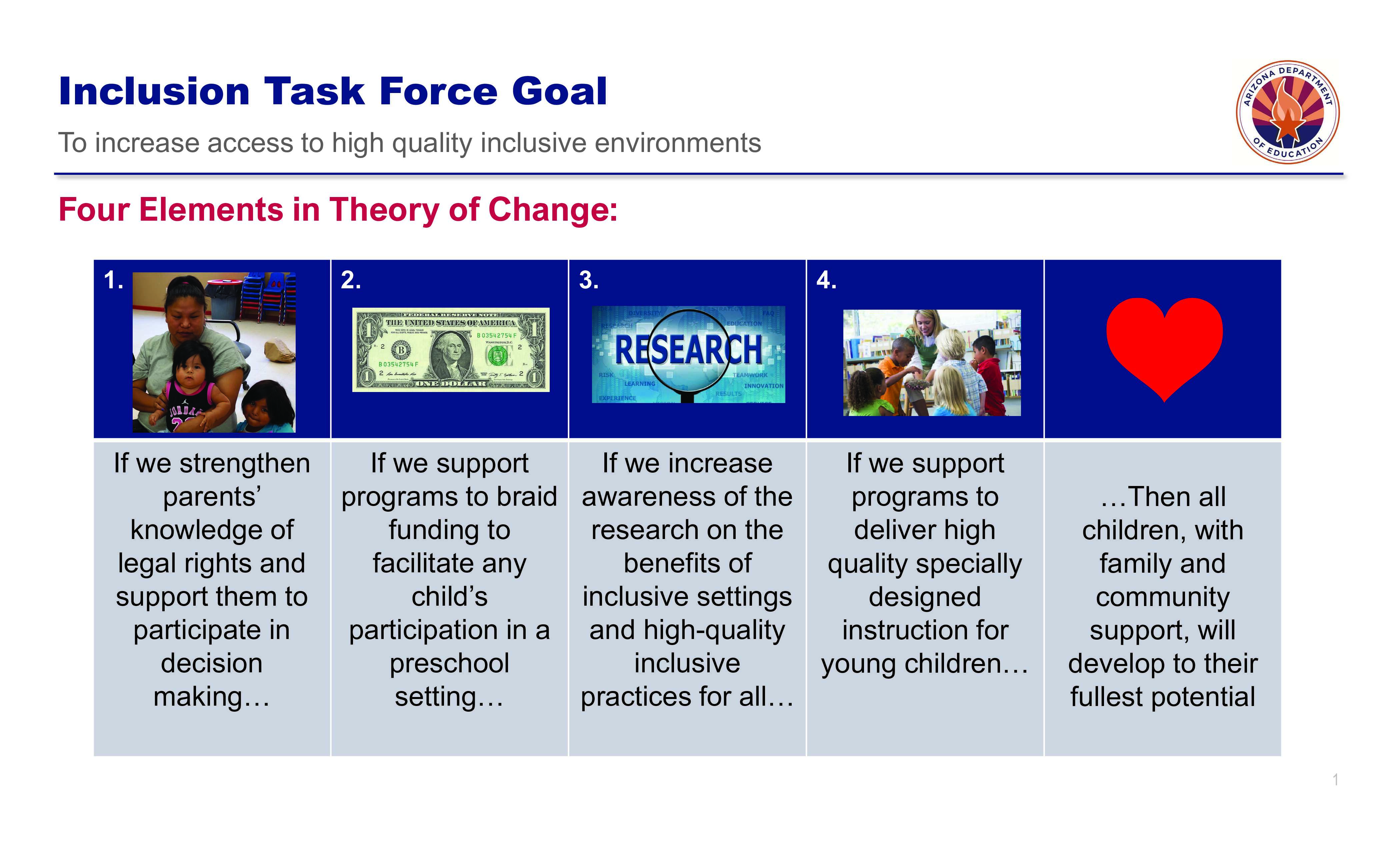
The Inclusion Task Force members shared the most frequent barriers they experienced--those most often preventing the offer of an inclusive preschool setting. The issues cited were confirmed through survey data, reseach, and described through personal and professional experiences. The many barriers were organized into four main categories: funding, access to non-disabled peers, lack of familiarity with research, and challenges delivering instruction to children with disabilities. These barriers were translated into action committments and today represent our Theory of Change. They reflect the committments of the group to develop aligned, supportive systems and resources. We expect to offer a pathway to new practices in each of these areas by sharing resources, the development of new trainings, coaching through communities of practice, and by the support of parents and families and administrators of programs. 

Inclusion Task Force Goal

Preschool Environments Data

Over the past five years the Task Force members have provided supportive feedback on a variety of professional development and technical assistance initiatives. Learning activities offered by the Early Childood Special Education Unit included sharing research based practices and technical assistance through presentations at state and local conferences and professional development events. Many local school districts have participated and have made concerted efforts to adopt new practices. Training on High Quality Inclusion, Least Restrictive Environment, Embedded Learning Opportunities, the Itinerant Early Childhood Special Education Model, and the Inclusive Classroom Profile were provided over the years in an effort to support schools to transition from existing separate programs and develop new programs that offered regular early childhood environments, in which more than 50% of the children in a classroom are non-disabled.

The progress of the state is evident, as reflected by the Preschool Environments chart that shows the percent of preschool aged children attending regular early childhood settings, special education settings, or receiving services in the home. There has been a reduction in the percent of children who attend preschool programs in separate settings. There is an increase in the percentage of children attending regular early childhood settings. We are currently meeting state targets for increasing participation in inclusive settings and decreasing participation in separate settings.

From Theory to Practices

The members discussed the barriers to offering settings in which preschool aged children with disabilities would participate with their typically developing peers. Through discovery activites and using Technology of Participation (TOP) tools, four themes emerged. If programs were able ensure that the first consideration for a child's placement would be the program they had been attending prior to eligibility, supported by parents, with funding, and high quality instruction, that would be optimal, and meet the intent of the IDEA as described in the Preschool Dear Colleague Letter on Inclusion. The Task Force members spent the next two years developing a theoretical way over, around and through the barriers that were identified, and have organized the information into four recommended practices. Each practice is profiled below. 

  1. Parents Are Supported to Participate in Decision Making
  2. Multiple Funding Streams Are Used to Support All Children's Participation
  3. Early Childhood Program Development is Research Based
  4. Specially Designed Instruction is Supported by All Adults

Inclusion Task Force Campaign Posters

EXTERNAL PD OPPORTUNITY: Opportunity to Partner with an OSEP-Funded Technical Assistance Center

Training
Updates
Are you looking for ways to shift the focus from compliance alone to educational programming designed for student progress toward meeting challenging goals? Are you interested in learning more about an opportunity to partner with an Office of Special Education Programs (OSEP)-funded technical assistance center that provides information, resources, tools, and services to support local education agencies from kindergarten through secondary transition?

RECRUITMENT & RETENTION INFO: Registration for the 2021 Arizona Education Virtual Job Fair is now open!

Professional Learning and Sustainability
Updates
ADE/ESS is pleased to announce that registration for the Arizona Education Virtual Job Fair is now open! Join us online on Saturday, February 27, 2021. Registration is open to Arizona public school districts and charter schools on a first-come, first-served basis.