Path
standards-practices
Contact
Contact name or title
Academic Standards Front Desk
Contact phone number
(602) 364-2333
Contact email address
Contact link
Contact name or title
Click the subscribe button below to receive content area updates
Contact link
Math
Math
Computer Science Mailing List
Computer Science Mailing List
Sci and Hist_SS Technical Reviewers
Sci and Hist_SS Technical Reviewers
Dr. Malcolm Butler
Professor of Science Education, College of Education and Human Performance
University of Central Florida
Orlando, Florida
Dr. Lisa Elfring
Assistant Vice Provost, Instruction and Assessment
University of Arizona
Tucson, Arizona
Dr. Ronald Madler
Dean, College of Engineering
Embry-Riddle Aeronautical University
Prescott, Arizona
Dr. Peter Rillero
Associate Professor of Science Education
Arizona State University
Tempe, ArizonaCV/Resume
History and Social Science Technical Reviewers
Christi Carlson
Lecturer, Department of History
Northern Arizona University
Flagstaff, Arizona
Tech-Review CC
Dr. Tina Heafner
Professor, Department of Middle, Secondary, & K-12 Education
University of North Carolina
Charlotte, North Carolina
Tech-Review TH
Dr. Kelly Stewart
Assistant Professor, College of Education
Ashford University
San Diego, California
Beth Ratway
Senior Consultant
American Institutes for Research
Washington, D.C.
Holocaust and Genocide
Holocaust and Genocide
Arizona Holocaust and Genocide Education Toolkit
This webpage provides resources, training, and support for educators in meeting this requirement. It also houses the work of the Task Force on The Holocaust and Other Genocides - a Toolkit for teachers and students.
“We believe it is important for students to know the history of genocides so we will all be determined to never let that happen again. However, it is important to note that no individual is responsible for any crimes committed by his or her ethnic group in the past. All individuals must be treated with respect. In the context of learning about genocide in the past, it is important to learn this moral message.” -- Tom Horne, Arizona Superintendent of Public Instruction
Holocaust and other Genocides Upcoming Events
Arizona Mandate Information
The Arizona State Board of Education, in October 2020, adopted revisions to the Minimum Course of Study and Competency Goals for Arizona schools. These changes require teaching about the Holocaust and other genocides at least twice between the seventh and twelfth grades.
In 2024, HB 2779 amended ARS 15-701.02 to read: the state board of education shall include a requirement that students be taught about the Holocaust and other genocides for at least three school days, or the equivalent, on at least two separate occasions during any of grades seven through twelve.
Although this instruction is required as part of the 2018 History and Social Science Standards, this legislation further stresses the importance of these topics and events.
About the Holocaust Task Force
The Taskforce on "The Holocaust and Other Genocides" is a collaborative effort among Arizona's three public universities, several community colleges, high-school educators, and representatives of civic organizations who are committed to teaching about these atrocities in order to prevent future suffering. The Arizona State Board of Education, in October 2020, adopted revisions to the Minimum Course of Study and Competency Goals for Arizona schools. These changes require teaching about the Holocaust and other genocides at least twice between the seventh and twelfth grades. The Taskforce has prepared a special toolkit to enable educators in middle schools and high schools to teach the causes, progression, and significance of these historical events. By teaching about the Holocaust and other genocides, Arizona's public schools will ensure that its youth will become responsible, informed, and empathetic adult citizens who can use their knowledge to prevent injustices and human suffering. This toolkit will be periodically updated and enhanced.
All materials in Toolkit 3.0 are exemplary and not comprehensive. Materials cover the Holocaust as well as several other genocides. The taskforce decided to limit other genocide examples to four case studies where genocidal violence and ethnic cleansing occurred: Armenia (the first modern genocidal atrocity), former Yugoslavia (Europe: a recent ethnocide with genocidal moments), Rwanda (Africa: the fastest-moving genocidal killing in the 20th century), and Native Americans (long legacy of displacements, massacres, and genocidal killings in the Americas). Resources shared on this site are intended for professional use by educators and should be reviewed for age appropriateness, content sensitivity, and alignment with district guidelines. Users are responsible for adapting materials to meet best practices and the specific needs of their students and classrooms.
The Taskforce welcomes comments from teachers and educators. We want to know what works and what could be better. Send your comments to: [email protected]
Before You Begin Teaching About the Holocaust and Other Genocides
Before presenting a lesson plan or giving resources to students, teachers should first understand best practices when teaching these difficult topics. "Because you have to" is not the appropriate rationale to use when asked, "Why are you teaching the Holocaust?" While it is true that teaching the Holocaust and other genocides is embedded in the Arizona State Social Science Standards as well as legislatively required, teachers must understand not only the rationale of the state, the Department of Education, and their own district/charter who are choosing materials, but they must have a deep understanding of their own rationales. Use the materials below to start your journey.
Teaching the Holocaust Grades 7-12 Self-Paced Online Course (Register through APLD - search: Holocaust)
Holocaust and Genocide Policy in Arizona Slide Deck (Arizona Department of Education)
Guidelines for Teaching About the Holocaust: Consider these guidelines when developing your rationale and using the Rubric (USHMM)
Guidelines for Teaching Difficult Histories: Holocaust and Genocide (Created by members of the Taskforce)
Glossary of Terms Related to the Holocaust (USHMM and Echoes and Reflections)
Rationale and Learning Objectives: Fundamentals of Teaching the Holocaust (USHMM)
Rubric for Evaluating Resources to Use in the Classroom: This rubric is for assessing resources you are considering or are assigned to use in your classroom. (USHMM)
Bringing the Learning to the Classroom
Once teachers have their rationale, learning objectives, and have vetted their materials using the Rubric for Evaluation Sources, they can now begin teaching the Holocaust and other genocides in their classroom. There are a plethora of premade units, lessons, and activities to support teaching the Holocaust and other Genocides - it can be overwhelming! If you are new to teaching the Holocaust and other genocides, we suggest that you start with the following resources.
- Foundational Lesson Plans (USHMM)
- Teaching Holocaust and Human Behavior Unit (Facing History and Ourselves)
- Use this 23-lesson unit to lead middle or high school students through a study of the Holocaust that asks what this history can teach us about the power and impact of choices.
- About This Unit and Lesson Plans
- Comprehensive Units, Lessons, and Materials (Echoes and Reflections)
- Introduction to the Holocaust One-Day Lesson Plan
- Introduction to the Holocaust Two-Day Lesson Plan
- Unit XII: Teaching About Genocide
- Student-Directed Activities (Aligned to Echoes and Reflections unit or can be supplementary)
Looking for more in-depth lessons that are aligned to the Arizona State Social Science Standards? Head over to the Arizona Digital Educator Library (ADEL), where teachers can find grade-specific Holocaust and other genocides lesson plans.
Continue Your Learning
While taking the first step into teaching this complex history can be challenging, the journey doesn’t end there. Deepening your understanding of the Holocaust and other genocides is essential—not only to expand historical knowledge, but also to strengthen instructional strategies and become a resource for both peers and students. Below, you'll find curated materials to support your continued professional growth.
U.S. Holocaust Memorial Museum Opportunities for Educators: Videos, Recorded Conferences, Fellowship Programs, Summer Institutes (USHMM)
Education Resources on Genocide and Mass Atrocities: Introduction, Path to Genocide Exhibition, Case Studies, Survivor and Eyewitness Testimonies, Early Warning, Justice and Accountability (USHMM)
The Zekelman Holocaust Center ELA Educator Resources: Pedagogical Principles, Discussion Guides, HC Genocide and Peace Models, Literature Rubric, Template for Education Plan (The HC)
8 Classroom Resources on Genocide: Historical and Contemporary Resources including Lesson Sets, Programs, Case Studies, Videos, Sources (Facing History and Ourselves)
Resources for Education Professionals (International Holocaust Remembrance Alliance)
PHA Educate Page: Conference, Speakers Bureau, Resources, Educator Recognition (Phoenix Holocaust Association)
10 Resources for Teaching about Genocide: Testimony Clips, Connection Videos, Mini Quest Activity, Video Essay Activity, Historical Narrative Activity, Information Quest (USC Shoah Foundation)
Armenian Genocide Museum: Explore the Story, Source Galleries, Downloads (Armenian Museum of America)
History Through a Native Lens | Timeline (Native Philanthropy and Candid)
Supplemental Resources for teaching the Holocaust and Other Genocides
Resources shared on this site are intended for professional use by educators and should be reviewed for age appropriateness, content sensitivity, and alignment with district guidelines. Users are responsible for adapting materials to meet best practices and the specific needs of their students and classrooms.
Oral Histories, Reflections, and Testimonies of the Holocaust and other Genocides
The Robert Sutz, We Remember Holocaust Art Oral History Project (YouTube)
AZ Public Media Holocaust Testimonies of Survivors Living in Southern AZ (AZPM)
Holocaust Survivor Interviews (Phoenix Public Library)
Visual History Archive: Testimonies of life before, during, and after the subject’s firsthand experience with genocide (USC Shoah Foundation)
We Are Living Links | Descendants of Holocaust survivors provide speakers, educator resources, and community engagement (WeAreLivingLinks)
Book Resources
The following lists were compiled and vetted by the Task Force using the USHMM Rubric for Evaluating Resources.
- Suggested Reading List to Assist and Prepare Teachers
- Reading List for Students Grade 7-12
- Reading List for All Reading Levels: Teaching the Holocaust and other genocides should not be occurring before grade 7, but teaching the culture and background is encouraged; these texts are ideal for differentiation.
- Books by Arizona Survivors and Descendants of Survivors
Video Resources
Select Films and Documentaries on the Holocaust and Genocide (Created by the Task Force)
Holocaust (European History) Videos (Encyclopedia Britannica)
The Hidden Children: Reflections of Arizona Holocaust Survivors - Teacher's Guide (Phoenix Holocaust Association)
Inheriting the Holocaust: Children of Survivors in Arizona - Teacher’s Guide (Phoenix Holocaust Association)
Resilience: Reflections of Arizona Holocaust Survivors - Teacher Guide (Phoenix Holocaust Association)
Untrustworthy Neighbors (Bosnia) (Illinois Holocaust Museum and Education Center)
The Bosnian Genocide by Volker Benkert | Slides (Arizona State University and Arizona Department of Education)
Bystanders, Resistance, Rescue, and Aftermath by Volker Benkert | Slides (Arizona State University and Arizona Department of Education)
Native America and Genocide by Alex Alvarez | Slides (Northern Arizona University and Arizona Department of Education)
United States Holocaust Memorial Museum Guidelines for Teaching the Holocaust and Genocides for Arizona Teachers Webinar (USHMM and Arizona Department of Education)
Virtual Tours, Field Trips, and Teaching Trunks
6 Million Voices: Live-Guided, Virtual Tours of Auschwitz and Other Nazi Concentration Camps (East Valley JCC Affliate Program)
Tucson Jewish Museum and Holocaust Center Curriculum Tour (YouTube)
The Holocaust: History and Memory | Virtual Field Trip and Lesson Plan (USHMM)
The Hope Chest: A complete set of teaching resources designed to immerse students in Holocaust survivor Oskar Knoblauch’s memoir, A Boy’s Story, A Man’s Memory: Surviving the Holocaust 1933–1945; teachers can "check out," use in their classroom, and return to Scottsdale Center for the Arts
Teaching Trunks: Virtual and Physical Trucks on a Variety of Themes for Grades 3-12 (Illinois Holocaust Museum and Education Center)
The Phoenix Holocaust Association is now accepting reservations for classroom tours. Email [email protected].
Updated July 2025 | Questions? Email [email protected].
Stay updated
Stay updated
Subscribe to a distribution list and receive our monthly updates and more!

Computer ScienceEarly Childhood Educational Tech. ELAMathematics Physical Education Science|STEMSocial StudiesWorld & Native Lang.

Comprehensive Literacy State Development Grant
Comprehensive Literacy State Development Grant
Arizona has been awarded a 5-year $20,000,000 federal Comprehensive Literacy State Development (CLSD) grant. The Arizona CLSD project is a competitive grant that proposes to improve child literacy skills and instructional capacity on the science of reading. This grant project aims to strengthen collaboration, improve efficiency, and drive innovation to accelerate language and literacy outcomes.
The focus will be on children from birth to grade 12 in high-needs schools and qualified opportunity zones serving Arizona's most disadvantaged students. CLSD is a substantial investment that will award up to 25 qualified schools and/or early childhood programs that have demonstrated readiness and the ability to implement.
*For a screen reader-compatible version of the timeline below, please see pages 16-24 in the CLSD AZ Project Narrative Document.
Office Hours
Tuesdays from 12:00 pm - 1:00 pm and Thursdays from 8:00 am - 9:00 am
CLSD AZ Project Narrative Document | CLSD Timeline | Guidance DocumentCLS
Application and Resources
The CLSD grant funding application opened in Grants Management
2/22/2021 and closed on 4/16/2021
How to Apply to the CLSD Flow Chart | Accessible version (updated 2/8/21)
CLSD Funding by Age Bands | CLSD Grant Awards Accessible Version
Grants Management Resource Library
User Roles and User Access Administration
Eligibility Lists
CLSD Webinars
Grant Logic Model
CLSD AZ Project Narrative Document
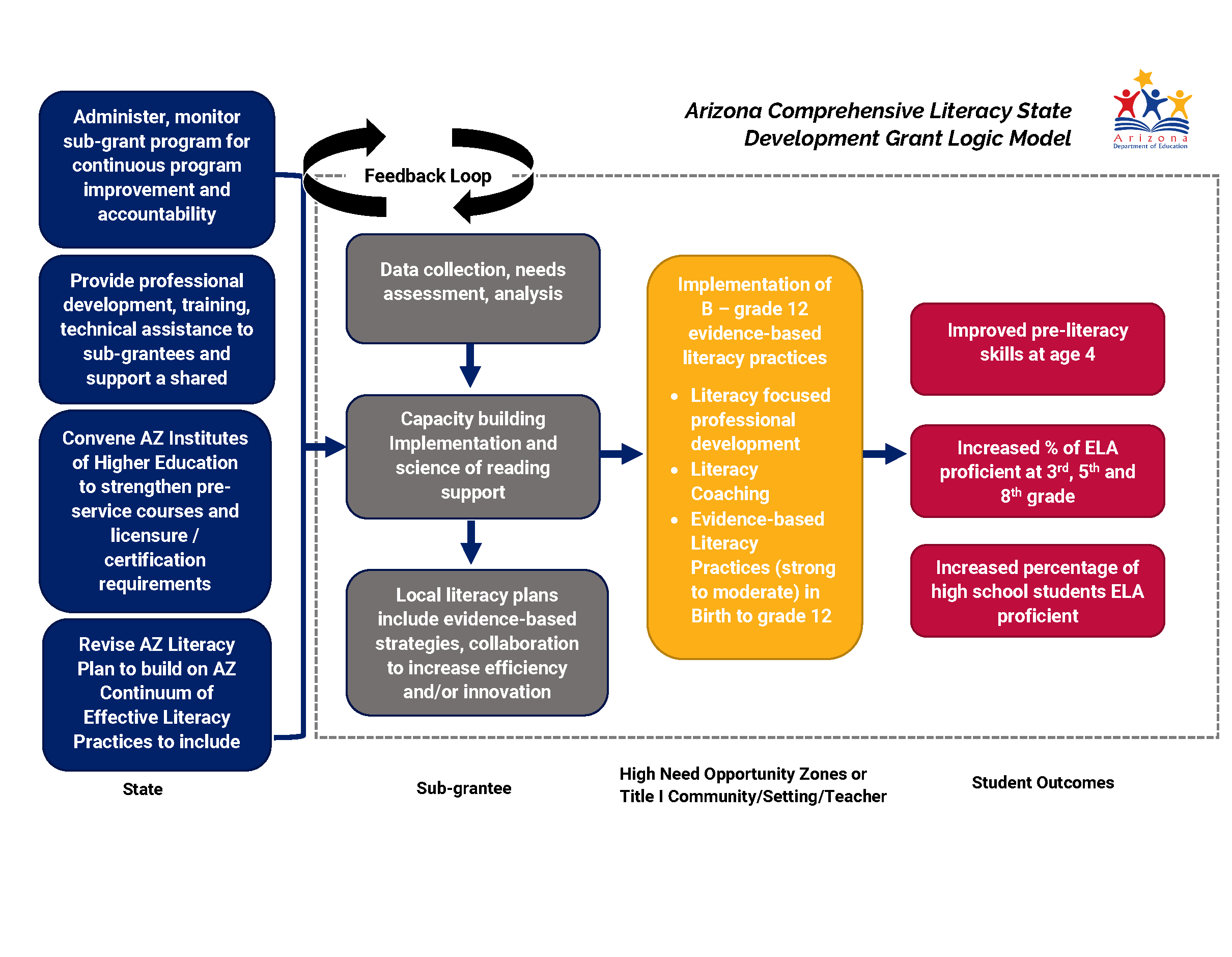
*For a screen reader-compatible version of the above information, please see page 9 in the CLSD AZ Project Narrative Document.
Age Bands
EARLY CHILDHOOD |
ELEMENTARY EDUCATION |
Secondary Education |
|---|---|---|
Not less than 15% of grant funds must be used for state and local programs and activities pertaining to children from birth through kindergarten entry. | Not less than 40% of grant funds must be used for state and local programs and activities, allocated equitably among the grades of kindergarten through grade five. | Not less than 40% of grant funds must be used for state and local programs and activities, allocated equitably among grades six through twelve. |


For this competition, State Education Agencies are required to prioritize subgrant applications that meet the higher evidence levels of strong or moderate evidence included in the definition of “evidence-based”.
Identifying Evidence-Based Language and Literacy Practices
Videos
Tools
Evidence-Based Resources
Evidence-Based Instructional Practices and Strategies
Videos
- 3-minute "elevator speech" about the Science of Reading, as explained by Dr. Stephanie Stollar.
- Providing Reading Interventions for Students in Grades 4–9: What the IES Guide and Research Tell Us
CLSD Professional Learning Modules
Tools
- LitHubAZ
- Science of Reading
- Move On When Reading: Professional Development
- ADE Move on When Reading Interventions and Supplemental Programs
Evidence-Based Resources
- Evidence-Based Resource Websites (ESSA)
- Selecting Evidence-Based Practices for Low-Performing Schools
- Evidence for ESSA
- IRIS Center Peabody College, Vanderbilt
- Ohio's Evidence-Based Clearinghouse
- Connecticut State DOE Evidence-Based Practice Guide
- What Works Clearinghouse
- Scarborough’s Reading Rope
- The Center for Literacy and Learning: The Simple View of Reading
- Early Childhood Technical Assistance Center
- Pre-K Practice Guide: Preparing Young Children for School
CLSD Grant Awardees
- Frye Elementary School
- Ganado High School
- Garfield School
- High Desert Middle School
- Holdeman Elementary
- Imagine Camelback Middle, Inc.
- Imagine Coolidge Elementary, Inc.
- Littleton Elementary School
- Make Way For Books
- Mesquite Elementary School
- Mohawk Valley School
- Navajo County School Superintendent
- Page Unified Preschool School/Desert View
- Roberts-Naylor K-8 School
- San Luis Middle School
- San Marcos Elementary School
- Secrist Middle School
- Southwest Leadership Academy
- Valley of the Sun United Way
- Western Arizona Council of Governments
- Wilson Elementary School
- Yavapai County Education Service Agency
- Yuma Elementary District
CLSD Awardees Onboarding
Comprehensive Literacy State Development Awardees Onboarding
Start Here
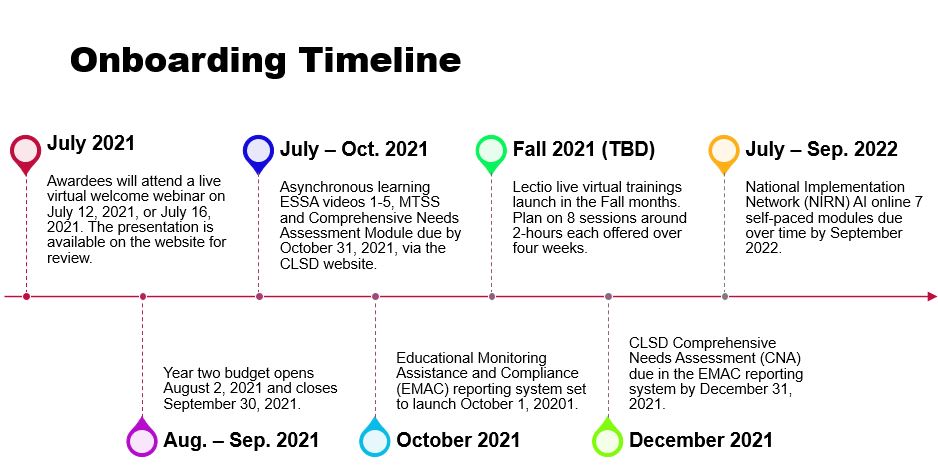
Welcome Presentation and Webinar
CLSD Welcome Onboarding PowerPoint Presentation | CLSD Welcome Webinar Session
Required Asynchronous Learning
CLSD Awardees are required to complete each webinar listed below. | National Implementation Network (NIRN) AI online self-paced modules. |
|---|---|
*Please note this webinar provides an overview of the CNA in full. Not all six principles of the CNA are required for CLSD. Awardees are required to upload their applicable CNA principles for CLSD into the Educational Monitoring Assistance and Compliance (EMAC) system only. |
|
CLSD Awardee Resources
CLSD Statewide Impact & Annual Reports
Language Essentials for Teachers of Reading and Spelling (LETRS) Training
In 2020, ADE awarded twenty-three CLSD subgrantees representing 12 counties who are leveraging CLSD grant resources to improve child literacy skills and instructional capacity on the science of reading.
In 2021, ADE extended four professional development cohorts in the science of reading focused on LETRS ® (Language Essentials for Teachers of Reading and Spelling) to the field and to all CLSD applicants who were not awarded the CLSD grant. Over one hundred practitioners across four counties are participating in LETRS ® Early Childhood or LETRS ® K-12 3rd Edition professional development cohorts. Click on this link to learn more about the CLSD AZ Project!
Join us at our Virtual Office Hours
Office Hours: Tuesdays from 2:00 pm - 3:00 pm and Fridays from 8:30 am 9:30 am
Contact Information: CLSDG Inbox
Intent to participate app
Intent to participate app
Participating school districts or charter schools must submit a report no later than 90 days after the end of the school year containing information about the Seal of Civic Literacy student participation. Participating school districts or charter schools that fail to submit this required report may be denied participation in the following year. The report submission form is available on the Department website.