Path
titleiv-a
Contact
Contact name or title
Title IV-A

Arizona State Seal of Arts Proficiency

Arizona State Seal of Arts Proficiency
 

ADE Arts Logo

History

The Arizona State Seal of Arts Proficiency is the latest testament to a rich history of excellent arts education in the state. This diploma seal is administered by the Arizona Department of Education’s Office of Arts Education and is awarded to graduates who complete the minimum arts pathway requirements throughout their high school career. The State Seal of Arts Proficiency, or SB1111, as sponsored by Senator Paul Boyer, had bipartisan support and was a grassroots effort from Arizona Arts Education advocates from across the state. It was signed into law by Governor Doug Ducey on May 14th, 2019. Board rule was adopted by the State Board of Education on October 28th, 2019.

After the approval of SB1111, the Arizona Department of Education encouraged students to submit their designs for the seal. The winning design pictured here was submitted by Chloe Ball from Pinnacle High School in the Paradise Valley School District. This design will be printed on copper foil and affixed to the diplomas of all future graduates who qualify for the Arizona State Seal of Arts Proficiency.  

Seal of Arts Proficiency


Objectives

Stakeholders from across the state of Arizona convened during the summer of 2019 to outline seal objectives and pathway requirements. The goals of the Arizona State Seal of Arts Proficiency are to:  

  • Celebrate students who demonstrate elevated levels of proficiency in the Arizona Arts Education Standards through personal expression and creative experiences in arts education programs  
  • Identify pathways of artistic literacy that cultivate skills for 21st-century success 
  • Prepare students for college and career readiness, including active participation in the creative industries sector  
  • Promote increased access to well-rounded, high-quality arts education across the state 

Timeline

Jul 20, 2026: Application Open

Aug 5, 2026: State Seal of Arts Proficiency 26-27 Kick-off Webinar (3:30pm-4:15pm) - Recording | Slides

Sep 15, 2026: Application Due (11:59pm)

Oct 1, 2026: Notification of Application Status

Oct 16, 2026: Arizona Diploma Seals Information Session & Program Showcase (9:00am-2:00pm) - Register

Feb 13, 2027: Achievement Report Open

Apr 15, 2027: Achievement Report Due

May 1, 2027: Seals Received by LEAs, Coordinator and Recipient Surveys Open, Capstone Submission Open

June 1, 2027: Surveys, Capstone Submissions and CTE Program/Course Addition Requests Due 


Implementation Guidance and Resources


The 2026-2027 State Seal of Arts Proficiency District/ Charter Application is open now through September 15, 2026. This form is to be completed by those coordinating the Arizona State Seal of Arts Proficiency for their entire district or charter organization. Only one submission will be accepted per district/charter organization. District-level Seal of Arts Proficiency Coordinators, select the button below to get started.


District-Level Coordinator Resources 

The resources below have been shared by experienced Seal of Arts Proficiency Coordinators from Dysart and Gilbert Unified Districts as examples for those coordinating the Seal of Arts Proficiency for their district or charter organization. 

Dysart Unified District

Gilbert Unified District

Arizona School for the Arts

Queen Creek High School

Queen Creek High School Arts Seal Page

Tucson Unified School District

Want to showcase your students' amazing work? Select the button below to share student capstone projects associated with the Arizona State Seal of Arts Proficiency. Submitted projects may be displayed on this website, at state and national conferences, or at ADE sponsored events. Sharing is encouraged but not required. Thank you for sharing the artistic accomplishments of your students!

Participating Schools 

Title IV-A Spotlight on Success!

Title IV-A Spotlight on Success!

Title IV-A Logo
Thank you for leveraging Title IV-A funding to support students and provide academic enrichment activities! The Arizona Department of Education Educator & School Excellence Unit is seeking evidence of Title IV-A success stories to share with our local, national, and federal partners. We invite you to share your stories of success and how Title IV-A funds are making a difference for students and teachers. We encourage you to participate in this voluntary survey!

Welcome to Digital Learning

Welcome to Digital Learning

PURPOSE

ADE Digital Learning provides leadership, service, and support to educators and administrators to improve the effective use of technology and increase digital learning opportunities to improve the academic achievement and digital literacy of all students. 

Overview of Digital Learning

“Digital Learning is any instructional practice that effectively uses technology to strengthen a student’s learning experience and encompasses a wide spectrum of tools and practices”  - ESSA 4102(1)(A)

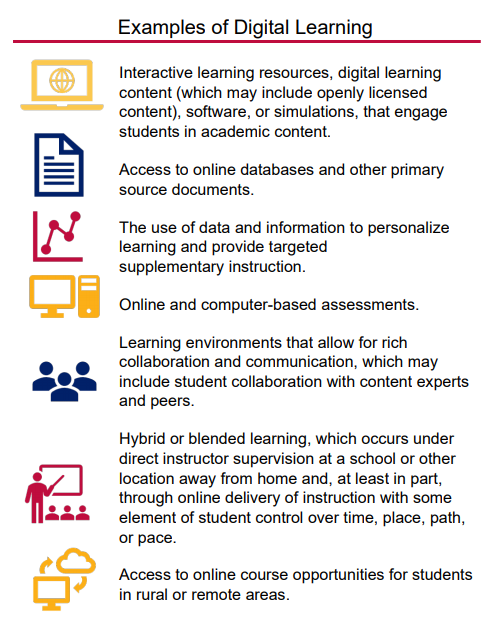
Digital Learning is an integral component of a 21st Century Education, for both students and educators. Digital Learning and the development of Digital Literacy skills helps students engage in critical thinking, collaboration, communication, and creative problem solving across all disciplines and subject areas. Digital Learning can include: 

  • interactive learning resources, digital learning content (which may include openly licensed content), software, or simulations, that engage students in academic content; 
  • access to online databases and other primary source documents; 
  • the use of data and information to personalize learning and provide targeted supplementary instruction; 
  • online and computer-based assessments; 
  • learning environments that allow for rich collaboration and communication, which may include student collaboration with content experts and peers; 
  • hybrid or blended learning, which occurs under direct instructor supervision at a school or other location away from home and, at least in part, through online delivery of instruction with some element of student control over time, place, path, or pace; and 
  • access to online course opportunities for students in rural or remote areas. 

Examples of Digital Learning

 Digital Learning Specialist 

The role of the Digital Learning Specialist is to serve as resource to Arizona educators and the Arizona Department of Education to “increase access to personalized, rigorous learning experiences supported by technology.” (ESSA 4104(b)(3)(C)) The specific duties of the Digital Learning Specialist include, but are not limited to: 

  • Providing educators with the knowledge and skills to use technology effectively, including the effective integration of technology, to improve instruction and student achievement.  
  • Providing technical assistance to LEAs to identify and address readiness shortfalls, use technology to support the learning needs of all students, and build capacity for school leaders to support teachers in using data and technology to improve instruction and personalize learning.  
  • Support schools in rural and remote areas to expand access to high-quality digital learning opportunities.  
  • Developing or using strategies that are innovative or evidence-based for the delivery of specialized or rigorous academic courses and curricula through the use of technology.  
  • Disseminating promising practices related to technology instruction, data security, and the acquisition of and implementation of technology tools and applications.  
  • Making instructional content widely available through open educational resources.  
 

Student Learning Objectives (SLO) in the Arts

Student Learning Objectives (SLO) in the Arts

The Student Learning Objective (SLO) Process is an Arizona state model designed in 2016-2017 to measure student achievement and growth using valid and reliable performance assessments. 

Welcome to Title IV-A Safe & Healthy Students

Welcome to Title IV-A Safe & Healthy Students

Please click on the video below for an overview of the Title IV-A Safe & Healthy Students Program

The purpose of the Arizona Department of Education, Title IV-A Safe & Healthy Students Program, is to provide support to schools and LEAs so that every student can experience a safe, healthy, and supportive learning environment, including focusing on students' physical and mental health and safety. 

Safe & Healthy Students - 9-minute micro-training

Resources and guidance

Safe & Healthy Students LEA Guidance

Overview of Allowable SSAE Program Activities- Safe and Healthy Students (ESEA section 4108)

  • Promoting community and parent involvement
  • Providing school-based mental health services
  • Promoting supportive school climates to reduce the use of exclusionary discipline and promoting supportive school discipline
  • Establishing or improving dropout prevention
  • Supporting re-entry programs and transition services for justice-involved youth
  • Implementing programs that support a healthy, active lifestyle (nutritional and physical education)
  • Implementing systems and practices to prevent bullying and harassment
  • Developing relationship-building skills to help improve safety through the recognition and prevention of coercion, violence, or abuse
  • Establishing community partnerships

Title IV-A Safe and Healthy Students Federal Funding Guide crosswalks allowable funding components of the Title IV-A Safe and Healthy Students Program with Title I, Title II, Title IV-A, and the three rounds of ESSER funding. Printer-friendly version

ADE Title IV-A School Security Request Memo The Safe & Healthy Students Category of the Title IV-A grant allows SEAs and LEAs to foster Safe & Healthy learning environments for students, including school security programs. The School Security Request Memo was created to assist the Arizona Department of Education Title IV-A Team in the processing of all school security requests.

Resources Supporting SB 1376 – Schools; Curriculum; Mental Health Senate Bill 1376 was signed into law in July of 2021 and became effective September 29, 2021. It amends ARS 15-701.02 by requiring Health Education instruction to include mental health instruction.

SchoolSafety.gov is a resource for the American public, primarily K-12 school administrators, to access free information, guidance, best practices, and tools that make school safety initiatives more actionable in schools.

Arizona School and Behavior Health Partnerships: A Resource Guide The Arizona Department of Education (ADE) and the Arizona Health Care Cost Containment System (AHCCCS) are pleased to provide this mental health resource guide for principals, other education administrators, school mental health professionals and anyone who wishes to be a voice that promotes the need for school mental health resources in Arizona.

Safe & Healthy Students Resources

Kaiser Permanente Thriving Schools is our all-in engagement to improve the health of students, staff, and teachers. On this site, you’ll find the tools and ideas to help you create healthier school environments and build habits for healthy eating and active lifestyles.

Empower Vape-Free Youth Campaign The Empower Vape-Free Youth campaign encourages middle and high school educators to speak with students about the risks of e-cigarettes and nicotine addiction. The campaign also provides resources for educators to help students avoid or quit vaping.

Erika's Lighthouse is a nonprofit on a mission to break down the stigma surrounding mental health and provide free suicide prevention programs to any school, anywhere.

Courage First Athlete Helpline The helpline is designed to assist athletes, parents, coaches, and any allies interested in ensuring physical and mental safety for sports communities by offering confidential emotional support, crisis intervention, informational athlete-focused resources, and guidance related to concerns about any type of abuse.

From a Nation at Risk to a Nation at Hope Recommendations from the National Commission on Social, Emotional, and Academic Development- The Aspen Institute National Commission on Social, Emotional and Academic Development was created to engage and energize communities in re-envisioning learning to encompass its social, emotional, and cognitive dimensions so that all children can succeed in school, careers, and life. The Commission’s work has drawn on research and promising practices to recommend how to make all these dimensions of learning part of the fabric of every school and community.

Federal Commission on School Safety, Comprehensive Resource Guide for Keeping Students, Teachers Safe at School. A report created by the Federal Commission on School Safety (Commission) detailing 93 best practices and policy recommendations for improving safety at schools across the country.

U.S. Department of Education- School Climate and Discipline: Teachers and students deserve school environments that are safe, supportive, and conducive to teaching and learning. Creating a supportive school climate—and decreasing suspensions and expulsions—requires close attention to the social, emotional, and behavioral needs of all students.

Glossary of School Health Professionals. This resource outlines some common defining features of various school health professional roles and functions.

StopBullying.gov: Teach kids how to identify bullying and how to stand up to it safely.

The Safe Schools/Healthy Students Framework Tool The Safe Schools/Healthy Students (SS/HS) Framework tool helps you and your partners understand and plan a comprehensive approach to mental health promotion and youth violence prevention.

The Signs of Suicide (SOS) program serves middle and high schools across the country. The program has shown a reduction in self-reported suicide attempts by 40-64% in randomized control studies. Through a video and guided discussion, students learn to identify warning signs of suicide and depression in a single class period.

CDC's Prevention Resources for Action A Prevention Resource for Action is a select group of strategies based on the best available evidence to prevent or reduce public health problems like violence.

The Trauma and Learning Policy Initiative’s (TLPI) TLPI's mission is to ensure that children traumatized by exposure to family violence and other adverse childhood experiences succeed in school. 
 

Physical Education, Health Education, Physical Activity, and Recess

Physical Education is a school-based instructional opportunity for students to gain the necessary skills and knowledge for lifelong participation in physical activity. Physical education is characterized by a planned, sequential K-12 curriculum (course of study) that provides cognitive content and learning experiences in a variety of activity areas. Quality physical education programs assist students in achieving the national standards for K-12 physical education. The outcome of an effective physical education program is a physically literate individual who has the knowledge, skills, and confidence to enjoy a lifetime of healthful physical activity. Effective Physical Education Teachers base their teaching on the Arizona standards for K-12 Physical Education to provide students with a foundation of skills and knowledge that can be applied to many activities, so that students are willing, able, and interested in lifetime enjoyment of physical activity.

ADE's Physical Education Data Project is a report by the Arizona Department of Education that offers insights into physical education course access and participation rates in Arizona schools. 

Health Education provides students with opportunities to acquire the knowledge, attitudes, and skills necessary for making health-promoting decisions, achieving health literacy, adopting health-enhancing behaviors, and promoting the health of others. Comprehensive school health education includes courses of study (curricula) for students in Pre-K through grade 12 that address a variety of topics such as alcohol and other drug use and abuse, healthy eating/nutrition, mental and emotional health, personal health and wellness, physical activity, safety and injury prevention, sexual health, tobacco use, and violence prevention.

Physical Activity in childhood and adolescence is important for promoting lifelong health and well-being and preventing various health conditions. Schools are uniquely positioned to help children and adolescents get the nationally recommended 60 minutes of physical activity each day.

Recess is “a regularly scheduled period in the school day for physical activity and play that is monitored by trained staff or volunteers”. During recess, students are encouraged to be physically active and engaged with their peers in activities of their choice, at all grade levels, kindergarten through 12th grade.

CPR Requirements

CPR Legislation (SB1137) “On or before July 1, 2019, school districts and charter schools shall provide public school pupils with one or more training sessions in cardiopulmonary resuscitation, through the use of psychomotor skills, in an age-appropriate manner, during high school.”  

Supporting National Organizations

Federal Office of Safe and Supportive Schools  OSSS administers, coordinates, and recommends policy as well as administers grant programs and technical assistance centers addressing the overall safe and healthy school community.

National Center on Safe Supportive Learning Environments The National Center on Safe Supportive Learning Environments offers information and technical assistance to States, districts, schools, institutions of higher learning, and communities focused on improving student support and academic enrichment.

Association for Supervision and Curriculum Development (ASCD) ASCD empowers educators to achieve excellence in learning, teaching, and leading so that every child is healthy, safe, engaged, supported, and challenged.

Substance Abuse and Mental Health Services Administration (SAMHSA) The Substance Abuse and Mental Health Services Administration (SAMHSA) is the agency within the U.S. Department of Health and Human Services that leads public health efforts to advance the behavioral health of the nation. SAMHSA's mission is to reduce the impact of substance abuse and mental illness on America's communities.

Society of Health and Physical Educators (SHAPE America) is the nation’s largest membership organization of health and physical education professionals that provides programs, resources, and advocacy to support health and physical educators at every level, from preschool to university graduate programs.

Supporting ADE Programs

Behavioral Health and Suicide Prevention- PROJECT AWARE Project AWARE supports the development and implementation of a comprehensive plan of activities, services, and strategies to decrease youth violence and support the healthy development of school-aged youth.

Mental Health & Wellness- The Arizona Department of Education aims to support schools across the state in creating healthy learning environments. This page is meant to serve as a resource for educators and learners to build their mental health inside and outside the classroom.

For more information on Safe and Healthy Students, please contact:

Keri Schoeff
Title IV-A Safe, Healthy & Active Students Specialist
[email protected]
602-771-5718

Title IV-A FAQs

Title IV-A FAQs

General FAQs


Are all students eligible for AP exam reimbursement?

Not with the Title IV-A grant. Schools may only request reimbursement for students who are identified as low income for any exam taken or registration fees. Advanced placement programs include the College Board Advanced Placement® program, the University of Cambridge International Examinations® program and the International Baccalaureate® program. More information may be found on the Advanced Placement website. NOTE: LEAs may use funds from their Gifted Education grant to pay for exams for students not identified as low income.

Creating or Printing Resources

When developing or printing resources, the federal government requires that State and Local Education Agencies give credit to the Federal Government and funding source. A sample of the wording is below.

The contents of this (insert type of publication; e.g., book, report, film, resource) were developed under a grant from the Department of Education. However, those contents do not necessarily represent the policy of the Department of Education, and you should not assume endorsement by the Federal Government.

What are the 20-20 Portion and 15% Special Rules for Title IV-A?

The 20-20 Portion Rule

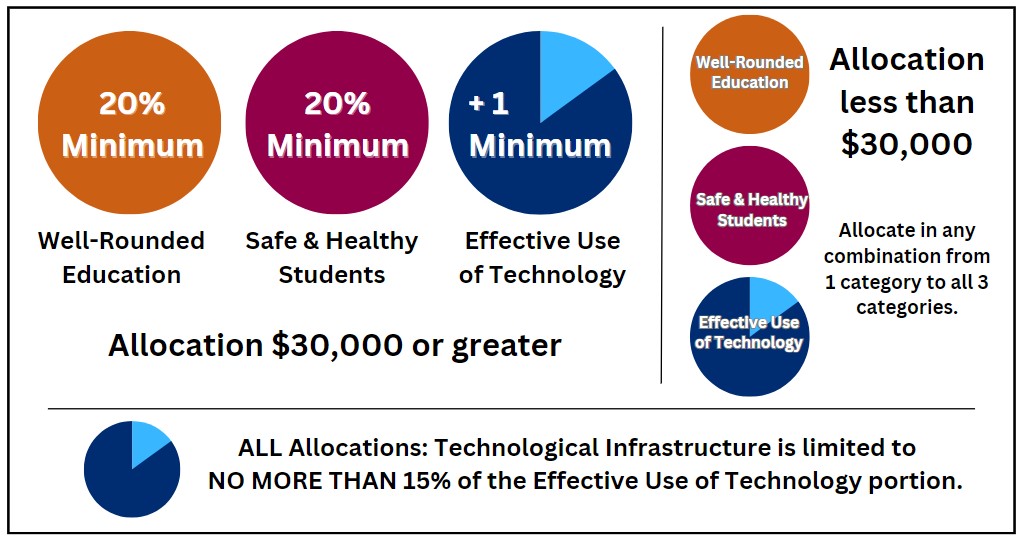
LEAs that receive an allocation of $30,000.00 or MORE must:

  1. Allocate and expend no less than 20% toward Well-Rounded Education activities
  2. Allocate and expend no less than 20% toward Safe and Healthy Students
  3. Allocate and expend a portion of funds to support Effective Use of Technology. The remaining amount, up to 60%, may be used toward any combination of:
  • Well-Rounded Education
  • Safe & Healthy Students
  • Effective Use of Technology (please allocate and expend a portion of the allocation to the Effective Use of Technology category, focused on Professional Learning). Of the portion allocated toward the Effective Use of Technology, only 15% may fund technological infrastructure expenses. 

Key Questions for Activities to Support the Effective Use of Educational Technology

  1. What is the scope and applicability of the 15% Special Rule in section 4109(b)?
    At least 85 percent of the educational technology funds must be used to support professional learning to enable the effective use of educational technology. LEAs or consortiums of LEAs may not spend more than 15 percent of funding in this section on devices, equipment, software applications, platforms, digital instructional resources and/or other one-time IT purchases. Specifically, the statute states that LEAs may not use more than 15 percent for purchasing technology infrastructure as described in section 4109 (a)(2)(B) which states: "purchasing devices, equipment, and software applications to address readiness shortfalls" and in section 4109 (a)(4)(A) which states: "blended learning technology software and platforms, the purchase of digital instructional resources, initial professional development activities, and one-time information technology purchases."

Reference: Non-Regulatory Guidance, Student Support and Academic Enrichment Grants

The 15% Rule - Applies to ALL LEAs

LEAs that receive an allocation LESS than $30,000.00 may:

  1. Place the entire allocation in any ONE of the content categories, OR
  2. Activate any combination of the three categories (Well-Rounded, Safe and Healthy, Effective Use of Technology). Of the portion allocated toward the Effective Use of Technology, only 15% may fund technological infrastructure expenses.

20-20 Portion Rule

Does the 20-20 Special Rule apply if our total allocation exceeds $30,000?

Yes. If the preliminary allocation plus the final allocation equals $30,000 or more, the LEA must review their plan and make adjustments, as needed. For allocations of $30,000 or more per year, at least 20% must be spent on the Well-Rounded Education category and 20% on the Safe and Healthy Students category. A portion must also be used for professional learning in the Effective Use of Technology. The remaining funds may be used in any of the three categories. The 15% Special Rule on technology infrastructure items, as defined by the USED Guidance as devices, equipment, software applications, platforms, digital instructional resources and/or other one-time IT purchases, applies to all LEAs, regardless of the allocation amount. 

What LEA Fund Code Should Be Used?

This grant should fall under the 160-169 range, under Title IV.

How Do We Transfer Title IV-A Funds?

Title IV-A funds are designed to provide “…programs and activities to support well-rounded educational experiences to all students.” (Section 4104 State Use of Funds – SSAEG – Title IV, Part A). The law stipulates that students well-rounded education is a civil right and that such activities must be made available to all students. It is best practice to analyze the needs of your LEA through the lens of Title IV-A prior to transferring funds. For more information about transferring funds, see the Title IV-A website under the tab, "Transferability Options." Note: Funds transferred to Title I may not be transferred again later in the year.

Key Questions, per Guidance from USED

May an LEA use a single activity to address more than one of the application assurances regarding use of funds in the three SSAE program content areas (i.e., well-rounded education, safe and healthy students, effective uses of technology)?

There may be certain activities an LEA wishes to fund that could fit into more than one of the SSAE program content areas and could be used to address the application assurances regarding use of funds in each area. For example, a student trauma recovery program that utilizes student performance art could be categorized in either the safe and healthy students content area (ESEA section 4108) or the well-rounded education content area (ESEA section 4107) and could be used to satisfy expenditures requirements in both areas. In such cases, the LEA should explain in its application to the SEA how the activity fits in more than one content area. The SEA will ultimately approve or disapprove the activity through its application approval process consistent with relevant statutory application requirements.

What other stakeholders should an LEA consider consulting with as it develops its application?

In addition to the list provided above in the “Local Application Requirements” section, an LEA should consider involving members from the business community, health providers, police, social workers, librarians, technology experts, service providers, faith-based community leaders, and other key stakeholders, as appropriate. Under ESEA sections 4107(a)(2) (well-rounded education) and 4108(4) (safe and healthy students), LEAs are explicitly authorized to use a portion of funds in these areas to develop and implement programs and activities that may be conducted in partnership with an IHE, business, nonprofit organization, community-based organization, or other public or private entity with a demonstrated record of success in implementing these activities. In addition, LEAs may find it particularly helpful to include such partners in the needs assessment process.

If LEAs apply for funds as a consortium, how is the consortium's funding determined?

There may be certain activities an LEA wishes to fund that could fit into more than one of the SSAE program content areas and could be used to address the application assurances regarding use of funds in each area. For example, a student trauma recovery program that utilizes student performance art could be categorized in either the safe and healthy students content area (ESEA section 4108) or the well-rounded education content area (ESEA section 4107) and could be used to satisfy expenditures requirements in both areas. In such cases, the LEA should explain in its application to the SEA how the activity fits in more than one content area. The SEA will ultimately approve or disapprove the activity through its application approval process consistent with relevant statutory application requirements.

Is an individual LEA that receives an allocation of less than $30,000 of SSAE program funds required to use a certain percentage of funds for each of the three content areas?

No. Section 4106(f) allows an individual LEA receiving an allocation of less than $30,000 to use funds for only one (or more) of the three content areas in the SSAE program. Such LEAs must provide an assurance that they will either use not less than 20 percent of SSAE funds for well-rounded education, use not less than 20 percent of SSAE funds for safe and healthy students, or use a portion of SSAE funds to support the effective use of technology consistent with 4106(f). However, there is a 15 percent cap on spending for devices, equipment, software and digital content.  

What does supplement not supplant mean in the context of the SSAE program?

Section 4110 requires that SSAE program funds be used to supplement, and not supplant, non-Federal funds that would otherwise be used for activities authorized under the SSAE program. This means that an SEA or LEA may not use SSAE program funds to carry out activities that would otherwise be paid for with State or local funds. In determining whether a particular use of funds would violate the non-supplanting requirement, SEAs and LEAs should consider matters such as whether the cost involved is currently paid for using State or local funds or whether the cost involved is for an activity that is required by State or local law. In no event may an SEA or LEA decrease the amount of State or local funds used to pay the cost of an activity simply because of the availability of the SSAE program funds. There is a presumption of supplanting if Federal funds are used for State-required costs or costs previously covered with non-Federal funds. The presumption may be overcome if the SEA or LEA is able to demonstrate through written documentation (e.g., State or local legislative action, budget information, or other materials) that it does not have the funds necessary to implement the activity and that the activity would not be carried out in the absence of the SSAE program funds.

Must an LEA distribute SSAE program funds to each of its schools?

No. An LEA is not required to distribute SSAE program funds to each of its schools. Consistent with ESEA section 4106(e)(2)(A), an LEA must prioritize the distribution of funds to schools as described in the LEA or Consortium Assurances section of this document and must implement the SSAE program consistent with all relevant statutory requirements. In prioritizing the distribution of funds, an LEA that provides district-wide services with the SSAE program funds must focus those services on schools with the greatest need identified in ESEA section 4106(e)(2)(A).

 Do the application assurances regarding use of funds in the three main content areas apply to the schools to which an LEA distributes funds?

No. The application assurances regarding use of funds in the three SSAE program content areas apply at the LEA level. These assurances serve to establish minimum expenditure requirements (i.e., not less than 20 percent of funds for activities to support well-rounded educational opportunities, not less than 20 percent for activities to support safe and healthy students, and a portion for activities to support the effective use of technology) that an LEA must meet with respect to its entire allocation. In meeting these requirements, an LEA has flexibility in determining the amount of funds to distribute to a school and for which activities, provided its determinations are consistent with its needs assessment and school prioritization. An LEA might, for example, use 20 percent of its funds for an arts program in only two of its elementary schools and use 40 percent of its funds for a district-wide school climate program, consistent with its assurance to prioritize schools most in need.

In the case of a consortium of LEAs, do the application assurances regarding use of funds in the three content areas apply to the consortium as a whole or to each member LEA?

The application assurances regarding use of funds apply to the consortium as a whole, i.e. each LEA in a consortium is not required to meet the expenditure requirements individually with respect to its allocation. Thus, a consortium may, for example, spend less than 20 percent of a single member LEA’s allocation of SSAE program funds for activities to support well-rounded educational opportunities in that LEA, provided the consortium spends at least 20 percent of its aggregate funds for those activities.

Is an LEA required to provide Equitable Services for Private School Students with SSAE program funds?

Under sections 8501- 8504 of the ESEA, LEAs receiving funds under Title IV, Part A must provide for the equitable participation of private school students, teachers and other educational personnel in private schools located in areas these agencies serve in Title IV, Part A-funded activities, including by engaging in timely and meaningful consultation with private school officials during the design and development of their Title IV, Part A programs. New or changed requirements that affect the equitable participation of private school students, teachers and other educational personnel under the ESEA are addressed in [link url="https://www2.ed.gov/policy/elsec/leg/essa/essaguidance160477.pdf"]USED Non-Regulatory Guidance: Fiscal Changes and Equitable Services Requirements under the ESSA[/link]. Except as otherwise provided in that guidance, the existing non-regulatory Title IX, Part E Uniform Provisions, Subpart 1 – Private Schools (Revised March 2009) will remain applicable.

Reference: Non-Regulatory Guidance, Student Support and Academic Enrichment Grants

Title IV-A Contacts

Title IV-A Contacts


[email protected]
Director Title IV-A, Student Health & Wellness 
(602) 771-5718


[column-left] 

[email protected]
Arts Education Specialist 
(602) 542-5268

[email protected]
Gifted Education Specialist
(602) 542-0148

[/column-left]

[column-right]

[email protected] 
Title IV-A Specialist
(602) 364-3345

[email protected]
Title IV-A Specialist 
(602) 542-7213

[email protected]
Title IV-A Specialist 
(602) 542-0055                                                                                                                                                                                                                                                                                                                                                                                                                                                                                                                                  

[/column-right]

For general inquiries, email us at [email protected]

Welcome to Title IV-A

Welcome to Title IV-A


Title IV-A Banner

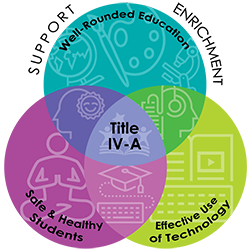
The purpose of the Title IV-A Student Support and Academic Enrichment (SSAE) grant is to improve students’ academic achievement by increasing the capacity of States, local educational agencies, schools, and local communities to provide all students with access to a well-rounded education, improve school conditions for student learning, and improve the use of technology in order to improve the academic achievement and digital literacy of all students. (ESSA Sec.4101) Ensuring all students have access to a holistic well-rounded education is central to the shared work across programs in ESSA. Allowable uses of funds for the SSAE program under each of the three content areas may include, but are not limited to: direct services for students, professional development for teachers and administrators, salaries of personnel to carry out identified programs and services, and supplemental educational resources and equipment.


Research & Advocacy

Research & Advocacy

Arts Education Research

Arizona Arts Education Data Project 

The Arts Education Data Project is a report by the Arizona Department of Education, Arizona Citizens for the Arts, and the Arizona Commission on the Arts which offers insights into arts course access and participation rates in Arizona schools. Quadrant Research prepared the report which features analysis of all available school enrollment data self-reported through the Arizona Department of Education’s AZEDS system by schools across the state, both traditional public schools and charter, grades K through 12. Visit the Art Education Data Explorer Project.

Americans Speak Out About The Arts in 2018 ~ Public Opinion Poll

Americans are highly engaged in the arts and believe more strongly than ever that the arts promote personal well-being, help us understand other cultures in our community, are essential to a well-rounded K-12 education, and that government has an important role in funding the arts. This is What Americans Say About the Arts in 2018. Arizonans Speak Out About The Arts in 2018: An In-Depth Look at Perceptions and Attitudes About the Arts PDF.

Advocacy

Arts ARE Education

The Arts ARE Education is a new national campaign in support of arts education for all students. As states and schools work through multiple challenges in the years ahead, arts education must remain central to a well-rounded education and fully funded to support the well-being of all students and the entire school community.

AzCA Arts Education Initiative

Beginning in July 2018, Arizona Citizens for the Arts (AzCA), with the support of the David and Lura Lovell Foundation and the assistance of ckSYNERGY, convened a Steering Committee comprised of leaders from across the state to build an Initiative that drives systemic change to ensure Arts Education access and equity for every student in Arizona. In order to inform the creation of this Initiative, the committee and consultants sought comprehensive input from across the state of Arizona through listening sessions and a survey; conducted interviews with similar organizations across the country; and reviewed literature and studies. Read the Report from the initial work of this Initiative

Arts Advisory & Action Committee

The Arts Advisory & Action Committee or A3C is an advocacy initiative created by the Arizona Department of Education (ADE). Having numerous iterations over the years, the current A3C convening is centered on gathering arts education stakeholders together in a shared space allowing ADE to better engage with the supporting of the needs and challenges of this specialized group of educators.

Reports

  Fall 2017 A3C Report

  A3C FY18 Summative Report

  A3C FY18 May Presentation - Voice-Over PPT Recording

ADE has partnered with Arizona Commission on the Arts (ACA), and together, ADE and ACA will tour the state to engage stakeholders within their own communities. These meetings are free and open to the public. We encourage teachers, teaching artists, community arts organizations, administrators, parents, and policymakers to attend an event in YOUR area! Data collected through this community will be reviewed by our RTAC Leadership Team, and communicated to education and state leaders.

For more information about this advocacy group and joining A3C, contact [email protected] or call (602) 542-5179.

Creative Industries

 Creative Economies NEA Report

Year End Reports   

 2021-2022 Title IV-A Year End Report

2019-2020 Title IV-A Year End Report

2018-2019 Arts Education Year End Report

Arts Education Resources

Arts Education Resources