
Exceptional Student Services

Path
specialeducation
Contact
Contact name or title
ESS Reception Desk
Contact phone number
(602) 542-4013

Vendor/Exhibitor Application is Open for the 2023 IDEA Conference

IDEA Conference
The Vendor/Exhibitor Application for Arizona’s 2023 IDEA Conference: Creating Connections and Strengthening Systems is open through Friday, May 19, 2023.

Arizona Professional Learning Series (AZPLS)

Arizona Professional Learning Series (AZPLS)

The Arizona Professional Learning Series (AZPLS) provides district and school teams with a process to guide and assist in building a foundation for systems change that will impact literacy outcomes by closing the achievement gap for students with specific learning disabilities. Every part of the professional learning series will empower students to be successful learners in a safe, supportive, and inclusive learning environment.

Collaboration is the key for a whole school to be effective. District and school site leaders will learn the importance of including the entire school community in creating a collaborative culture that supports high expectations for all students. Leadership will apply strategies of intentional collaboration to support teamwork for collective learning and implementation. Leadership will identify how inclusive collaboration connects every teacher to impact student achievement. 

Research shows that schools that support teacher collaboration tend to have higher student achievement than less collaborative schools. According to John Hattie, collective teacher efficacy has the greatest impact on student achievement.

AZPLS Modules

There is a well-planned progression to the AZPLS modules. The organization of the modules, implementation, data analysis, and coaching provide a supportive process for increasing knowledge, skills, and achievement. Participants collaborate to learn and implement strategies that support inclusionary practices to increase student literacy achievement. These practices bring general education teachers, special education teachers, and content area teachers together to use evidence to drive instruction and collaboratively plan the teaching and learning of all students. 

ADE provides the module packages, which include the presentation, facilitator guide, participant packet with handouts, posters, activities, parent modules to share strategies, and technical assistance to support leadership and school staff who facilitate the modules. The Arizona Professional Learning Series Module Overview provides the module topics and briefly describes each module. 

Arizona Professional Learning Series Module Overview

AZPLS Program Design

The AZPLS program design is rooted in systems change and connects the district, school staff, students, and parents. Six systems are embedded into the modules to support sustainable implementation. All professional learning interconnects with leadership, coaching, teams, data, and action planning to reinforce the teaching and learning strategies that will increase literacy achievement for every student in every class. 

Program Design Overview

AzPLS Websites

The AZPLS offers two websites for participating schools. The websites are linked seamlessly so schools can access the high-quality professional learning supported by data collection and analysis. 

The Arizona Professional Learning Series Website provides: 

  • Professional Learning Modules and Materials 
  • Parent Modules and Materials 
  • Teams, Data, Action Planning, and Coaching Guides 
  • District Leadership Team Meeting Materials 
  • Videos of Arizona Teachers Implementing AZPLS 

The Arizona Professional Learning Series Data Portal provides: 

  • Data Tools 
  • Supporting Documents 
  • Real-time Data Analysis 
  • Secure Log-in Access Only 

AZPLS Videos

Videos supplement module content and demonstrate specific strategies through examples from Arizona schools. Videos can be used by presenters, coaches, teams, and individuals.

AZPLS Videos

AZPLS Implementation with Sustainability

The AZPLS modules are facilitated by a teacher leader on staff at each school or district. Between module presentations, time must be allotted for initial strategy implementation and support for teachers, practice with specific teaching and learning strategies, and plans for sustaining the strategy use. Options are available to meet any need. 

By the end of this professional learning series, leadership, teachers, students, and parents will have gained the knowledge and skills to impact literacy learning for every student in all classrooms across their school campus, and districts and schools will have well-developed systems for ongoing reflection and growth toward meeting the needs of all learners. 

Contact Information

Academic Achievement & Inclusive Practices Inbox

Page revised 3/13/25
Assessing Outcomes for Preschool Children with Disabilities 

Assessing Outcomes for Preschool Children with Disabilities 

Bottom of Form

The Child Outcomes Summary Process

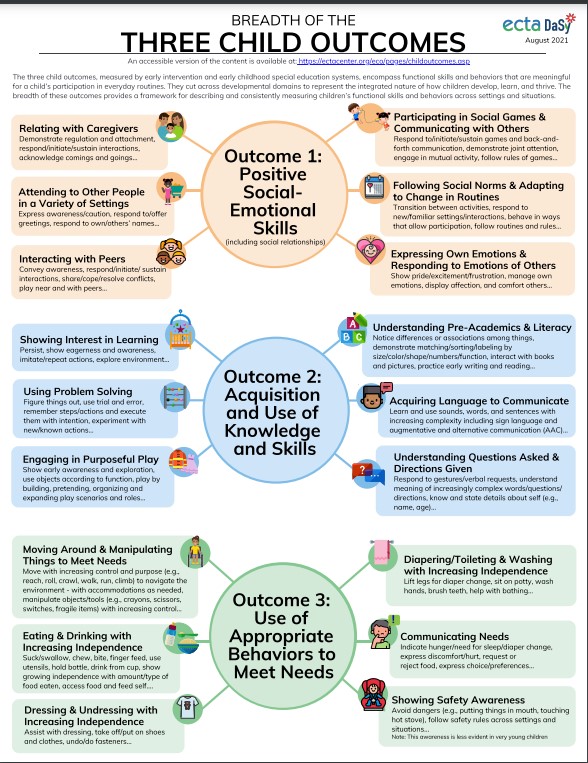
The Child Outcomes Summary (COS) is a team-based process to assess a child's functioning in three outcome areas using a 7-point scale. A team of individuals who are familiar with the child consider multiple sources of information about the child’s functioning to determine the ratings. The documentation of the child’s performance across settings involves parents and other caregiver observations to complete the assessment.

The three areas in which a child’s outcomes are reported are:

  • Positive Social Emotional Skills
  • Acquisition and Use of Knowledge and Skills
  • Use of Appropriate Behaviors to Meet Needs

The ADE will no longer require PEAs to use a single tool to report child outcomes, rather, schools may conduct the Child Outcomes Summary Process using district-selected methods and tools. PEAs may select a preferred tool and train staff on the procedures to conduct the child outcomes assessment to determine outcomes ratings. The process must result in reliable and timely data submissions. The Child Outcomes Scores must reflect the IEP team's view of the child's performance upon entry of each child into the program and upon their exit.

Professional development is available to all Public Education Agencies to support the use of a high-quality COS process.

Purpose for Assessing Child Outcomes

Children's outcomes are assessed for several reasons:

  • Federally reported data is used to determine if federal funding for provision of early childhood special education is making a difference for young children with disabilities and their families.
  • State and Local Programs use results to know how well programs are serving children and families and how to help programs improve.
  • Data is shared with Family and Community Members, so they know how children and programs are doing.
  • Teachers use the results to inform instruction in the classroom.

Reporting Child Outcomes 

Public Education Agencies (PEAs) will provide the Arizona Department of Education (ADE) with Child Outcomes Summary ratings for each outcome area upon entry of each child to a preschool special education program or service. PEAs will provide exit scores when the child leaves the program or service to enroll in kindergarten or is no longer considered a child with a disability. PEAs will also submit scores for each outcome area at the end of each school year. Data for child outcomes will be reported through the Arizona Education Data System (AzEDS) and reports, such as the SPED11 report, will be available for districts to review. The ADE will calculate summary data, such as Developmental Trajectories and Summary Scores, from the entry and exit COS scores for federal reporting. ESS Data Management published a technical assistance manual on Preschool Outcomes Data Submissions into AzEDS. This manual includes sections on Rating Scores, Progress Categories, Measurement Calculations, and AzEDS Data Transactions.

Entry, Exit, End of Year Definitions, and Data submission time frames:

  • Entry: preschool aged children who have been evaluated and found eligible for special education, have an IEP and enroll in the district preschool program or receive special education services are considered to have entered the program. The level of performance upon entry reflects the child's current functioning prior to receiving preschool special education supports and services. The child's rating on the 7-point scale upon entry is used as a baseline score for the child's overall performance in each outcome area and will be compared to their performance at the end of the year and at the end of the preschool program. An entry score must be submitted without delay, and no later than two weeks after enrollment in the program on all three outcome areas (Social Emotional, Knowledge and Skills, Behaviors to Meet Needs). Integrity will fail until the information is provided.
  • Exit: preschool aged children who attended a preschool special education program or received a special education service will receive a rating on the 7-point scale at the end of the program.   This rating is expected to be submitted within 15 calendar days after the child exits the preschool special education program on all three outcome areas. Other exit scenarios include children who exit from special education or the program ends when the child is eligible for Kindergarten, or children who end the program as the result of a 10-day mandatory withdrawal. In each case the district will submit an outcome rating for all three outcome areas. If preschool program exit dates are prepopulated by a student information system, scores shall not be submitted prior to the exit date.
  • End of Year: preschool children with disabilities who attended the district preschool special education program or received special education services will submit a rating on the 7-point scale to represent the status of the child at the end of the school year. The child is not exiting from the program or from services, but rather is expected to be continuing on the following year as a preschool-aged student. This rating is expected to be submitted within 15 calendar days after the child exits the preschool special education program on all three outcome areas. If preschool program exit dates are prepopulated by a student information system, scores shall not be submitted prior to the exit date.


INTERNAL PD INFO—Implementing SB 1654: How Schools Can Successfully Meet the Law’s Requirements and Establish Seizure Action Plans

Updates
The Arizona Department of Education (ADE) is hosting a free discussion on implementing SB 1654 (Seizure Safe Schools). During this session, participants will receive information about the law and step-by-step details for complying with the law, hear about training requirements, and participate in a Q&A session where submitted questions will be answered. In addition, resources about seizure action plans and seizure first aid will be provided.

Data Management Alert: Special Education Data Updates Webinar Wednesday, April 19th

Data Management
Updates
DATA MANAGEMENT ALERT       Special Education Data Updates Webinar Wednesday, April 19th    The Exceptional Student Services Data Management team will host the next Special Education Data Updates live webinar on Wednesday, April 19th, from 2pm – 3pm.

DATA MANAGEMENT ALERT: FY24 Statement of Assurances Open for Submission

Data Management
Updates
FY24 Statement of Assurances is open for submission. The application is open until June 15, 2023.

Youth and Family Scholarship Opportunity for Arizona’s 2023 IDEA Conference!

IDEA Conference
In partnership with the Arizona Department of Health Services, Children and Youth with Special Health Care Needs Program, ADE/ESS is excited to be able to offer scholarships for Arizona youth and their families to attend Arizona’s 2023 IDEA Conference: Creating Connections and Strengthening Systems.

INTERNAL PD INFO: Related Service Providers Seminar Series: Processing Speed and Executive Function with Sarah Ward, CCC-SLP - Register Now!

Training
Updates
Special Education Directors,Due to popular demand, this training has been opened up to general and special educators and administrators.The ADE/ESS Assistive Technology (AT) team is pleased to announce the next in our Related Service Providers Seminar Series: Processing Speed and Executive Function with Sarah Ward, CCC-SLP. This course is intended for General and Special Education teachers, Speech-Language Pathologists, Occupational Therapists, Physical Therapists, School Psychologists, Counselors, and Special Education Administrators.

INTERNAL PD INFO: ADE/ESS 2023 Summer Math In-Person Professional Learning Opportunities

Professional Learning and Sustainability
Updates
Special Education Directors,Please share the following math professional learning opportunities with general and special education teachers who teach mathematics.

PUBLIC NOTICE INFO: Notice of Public Comment Period for FFY 2023 IDEA Part B State Application

Updates
Special Education Directors,Please see the following public notice and comment period information for the IDEA Part B State Application.