Homeless Education listserv
Homeless Education listserv
The McKinney-Vento Homeless Assistance Act was passed in 1987 and was most recently amended by Title IX, Part A of the Every Student Succeeds Act (ESSA) in December 2015. Subtitle VII-B of the McKinney-Vento Homeless Assistance Act authorizes the federal Education for Homeless Children and Youth (EHCY) Grant Program and serves as the primary federal legislation to remove educational barriers due to experiencing homelessness.
The U.S. Department of Education allocates EHCY funding to states according to each state's proportion of Title I, Part A funds. States may retain up to 25 percent of the EHCY funding for state-level program administration and must subgrant at least 75 percent to Local Education Agencies (LEAs).
The State Education Agency (SEA) must run a competitive subgrant process at least every three years to allocate the Education for Homeless Children and Youth (EHCY) funds to Local Education Agencies (LEAs). The EHCY funds are designed to supplement, not supplant, the existing resources and services to eliminate barriers to the identification, immediate enrollment, regular attendance, and academic success of students experiencing homelessness (42 U.S.C. § 11433(a)(3)).
EHCY grant funds are awarded on a highly competitive basis and selection is based on the proposed project’s quality, assessment of the educational and related needs of eligible students, and the ability of the applicant to meet the identified needs.
FY27 is the first year of the current three-year EHCY grant cycle. Other EHCY grant funding opportunities may become available throughout the three-year EHCY funding cycle.
To support LEAs in preparing to apply for the FY27 EHCY Grant, the required grant elements are provided below:
To support LEAs in applying for the FY27 EHCY Grant, an informational webinar will be provided and materials shared below: The webinar will cover eligibility requirements, allowable uses of funds, the application process, and what to expect when applying for the grant. All LEA staff responsible for making programmatic and funding decisions related to children and youth experiencing homelessness, including McKinney-Vento Homeless Liaisons, Federal Grants Coordinators, and Title I Directors, are strongly encouraged to attend.
Session Materials:
If you need to contact a McKinney-Vento Homeless Liaison for support, please utilize the following list:
State of Arizona McKinney-Vento Homeless Liaison Contact List
The McKinney-Vento Act requires that contact information for the local liaisons for homeless children and youth at all public and public charter local education agencies (LEAs) is published an accurate. (42 U.S.C. §11432 (e)(3)(C)(i)(IV)). The following forms are designed to collect this contact information. Please ensure the completion of the correct form. If any questions or concerns arise, please reach the Office of the State Coordinator at [email protected].
Form | Description |
|---|---|
This form is designed to collect the most accurate and up-to-date contact information for the McKinney-Vento Homeless Liaison of Record. This is the individual at the LEA that is designated to provide support for all students experiencing homelessness. | |
| Site-Based McKinney-Vento Homeless Liaison Form | This form is designed to collect the most accurate and up-to-date contact information for all Site-Based McKinney-Vento Homeless Liaisons at an LEA. Site-Based McKinney-Vento Homeless Liaisons may assist the McKinney-Vento Homeless Liaison of Record in meeting requirements to identify and provide support for students experiencing homelessness. A new form must be submitted for each Site-Based McKinney-Vento Homeless Liaison that the LEA utilizes. While submission of contact information for Site-Based McKinney-Vento Homeless Liaisons is required, their contact information will not be published on this website. |
Would you like to receive updates regarding Homeless Education Program in Arizona?* Stay informed by signing up for the newsletter via the link below:
Subscribe to the HEP Newsletter
*McKinney-Vento Homeless Liaisons will automatically receive the monthly newsletter based on their contact form submission, and do not need to subscribe.
The Homeless Education Program (HEP) Liaison Advisory Committee are experienced homeless liaisons committed to providing best interest policies and decisions for the state and local liaisons.
Amphitheater Unified District (Tucson)
Mary Beth Santillan
(520) 696-5061
EdKey Inc. -Sequoia Charter Schools (Phoenix)
Toni Clifton
(623) 606-7277
Flagstaff Unified School District (Northern Arizona)
Stephanie Sivak
(602) 606-3692
Intell-Schools, Inc. (Phoenix)
Lori Everson
(602) 478-1003
Marana Unified School District (Tucson)
Marisa Castro
(520) 352-2421 x2508
Phoenix Elementary School District #1 (Phoenix)
Sara Sims
(602) 523-8988
Phoenix Union High School District (Phoenix)
Cynthia Tercero
(602) 764-1304
Washington Elementary School District (Glendale)
Dorothy Watkins
(602) 347-2636
Williams School District (Williams, Northern Arizona)
Andrew Wollman
(928) 635-4428
Federal Regulations
The Education of Homeless Children and Youth (EHCY) Program is authorized under the McKinney-Vento Homeless Assistance Act (McKinney-Vento Act) and is designed to address the needs of homeless children and youth and to ensure their educational rights and protections. The McKinney-Vento Act defines “homeless” as it applies to children and youth.
There are many resources available that provide guidance on the McKinney-Vento Act.
The McKinney-Vento Act Federal Law (Part B) - Learn about the basic federal laws that pertain to homeless youth. You can read the McKinney Vento Act in its entirety and use for citation.
Non-Regulatory Guidance- The Non-Regulatory Guidance is the most frequented document. This document provides answers to the most frequently asked questions.
Head Start Policy and Regulations - Head Start policies are available to ensure that our vulnerable young homeless children have access to early childhood education.
Local educational agencies (LEAs) are required to ensure that the rights and services guaranteed in the McKinney-Vento Homeless Assistance Act are implemented for all students experiencing homelessness. All LEAs must follow the requirements of the McKinney-Vento Homeless Assistance Act, regardless of if they are a recipient of an Education of Homeless Children and Youth (EHCY) subgrant.
The LEA's McKinney-Vento Homeless Liaison is required to develop, review, and revise policies and procedures to remove barriers to the identification, enrollment, and retention of students experiencing homelessness (42 U.S.C. § 11432(g)(1)(I)), ESSA Arizona State Plan (K)(1); (K)(6)). Required in all LEAs regardless of subgrant status, the McKinney-Vento Homeless Liaison is the primary contact between homeless families, school and LEA staff, shelter workers, and other service providers.
The ADE Office of the Coordinator has developed guidance documents and sample forms in alignment with both the McKinney-Vento Homeless Assistance Act and the ESSA Arizona State Plan. Please note that these documents have been developed for McKinney-Vento Homeless Liaisons to adopt and adapt to fit the needs of their LEAs. To edit a sample document, refer to the Converting Sample Documents for LEA Use Guidance Document.
Please check back frequently for additions and revisions.
We are excited to announce a new and highly requested guidance document, the LEA Homeless Education Program Guidance Documents and Forms List! The information in this document has been compiled to help support Liaisons as they endeavor to establish and conduct policies, practices, and procedures to ensure the removal of barriers for homeless children and youth within their LEA. This comprehensive list organizes all of the available sample documents found on this site with a description, corresponding statute, and a link to each sample document.
As outlined in the Arizona ESEA Consolidated State Plan, all local education agencies (LEAs), including charters, are required to utilize the Arizona Student Residency Questionnaire and Educational Rights of Homeless Children and Youths in the State of Arizona. Please access these documents and their corresponding requirements below.
The McKinney-Vento Homeless Assistance Act requires State education agencies (SEAs) and local education agencies (LEAs) to follow a dispute resolution process when parents, guardians, or unaccompanied homeless youth (UHY) disagree with the LEA’s determination of eligibility for services, school selection, or school enrollment (42 U.S.C. § 11432(g)(3)(E)). The purpose of the dispute resolution process is to ensure the objective consideration of each party’s input to resolve disagreements expeditiously and in compliance with the McKinney-Vento Homeless Assistance Act provisions.
The following dispute resolution forms are aligned with the dispute resolution process established in the Arizona ESEA Consolidated State Plan (42 U.S.C. § 11432(g)(1)(C)).
Every LEA must have a written internal plan detailing the responsible personnel, process (i.e., sequential steps to be taken), and timeline required to provide written notification and assistance to parents, guardians, and UHY in filing disputes at both the LEA and SEA levels.
The LEA’s written dispute resolution procedure to address appeal requests at both the LEA and SEA-levels must reinforce the State dispute resolution procedure to facilitate the efficient and expedient resolution of disputes.
LEA-Level Dispute Resolution (Student/Family vs. LEA)
SEA-Level Dispute Resolution (Student/Family vs. LEA)
In the event of a dispute between two LEAs regarding eligibility for services, school selection, enrollment, or transportation of a child or youth experiencing homelessness, the McKinney-Vento Homeless Liaisons involved must file a dispute resolution request with the SEA.
SEA-Level Dispute Resolution (LEA vs. LEA)
SEA-Level Dispute Resolution Procedure (LEA vs. LEA)
Unaccompanied Homeless Youth Identification Process Guidance & Resources
ADE Identification & Eligibility Interview Questions & Checklist
Written Notification of McKinney-Vento Eligibility & School Placement Determination (Sample Form)
McKinney-Vento and Refugee and Other Newcomer Students: Identification and Enrollment
ADE Best Practice for 10-Day Unexcused Absences Drop from Enrollment
ADE Immunizations for Homeless Students: Education of Homeless Children and Youth
Transportation for Students Experiencing Homelessness Reference Sheet
ADE Transportation Non-Usage Notification Letter Samples
Unaccompanied Homeless Youth Identification Process Guidance & Resources
McKinney-Vento and Refugee and Other Newcomer Students: Unaccompanied Youth
All local education agencies (LEAs) are required to report reliable, valid, and comprehensive data on homeless children and youth (HCY) and unaccompanied homeless youth (UHY) to the State education agency (SEA), as mandated by 42 U.S.C. § 11432 (g)(6)(C). These data are reported to the U.S. Department of Education to determine Arizona's Education for Homeless Children and Youth (EHCY) allocation and guide programmatic decisions for the Arizona Homeless Education Program (HEP). Access information and comprehensive data related to the Arizona HEP by visiting the Arizona Homeless Education Program Data section of our website.
The following resources are designed to support McKinney-Vento Homeless Liaisons collect and maintain reliable, valid, and comprehensive data on HCY and UHY.
The Arizona Homeless Education Program subgrants federal funds to local education agencies (LEAs) to enhance existing programming designated to serve children and youth experiencing homelessness. Access information regarding funding sources currently available to LEAs by visiting the Grant Funding section of our website.
The following resources provide grant funding information and guidance for McKinney-Vento Homeless Liaisons and other LEA personnel.
All Local Education Agencies (LEAs), including charter districts, are required to report reliable, valid, and comprehensive data on homeless children and youth (HCY) and unaccompanied homeless youth (UHY) to the State Education Agency (SEA), as mandated by 42 U.S.C. § 11432 (g)(6)(C). These data are reported to the U.S. Department of Education to determine Arizona's Education for Homeless Children and Youth (EHCY) allocation and guide programmatic decisions for the Arizona Department of Education's (ADE) Homeless Education Program.
Local Education Agencies must adhere to the following reporting requirements for the Homeless Education Program:
Key Considerations:
LEAs can access the following reports via the AzEDS portal to ensure compliance and accuracy in data reporting:
The attached Data Reporting Requirements & Integrity Rules reference document is designed to help local education agencies (LEAs) and McKinney-Vento Liaisons accurately report enrollment data for homeless children and youth (HCY). It also provides guidance on addressing potential data integrity issues when submitting data to the Arizona Department of Education.
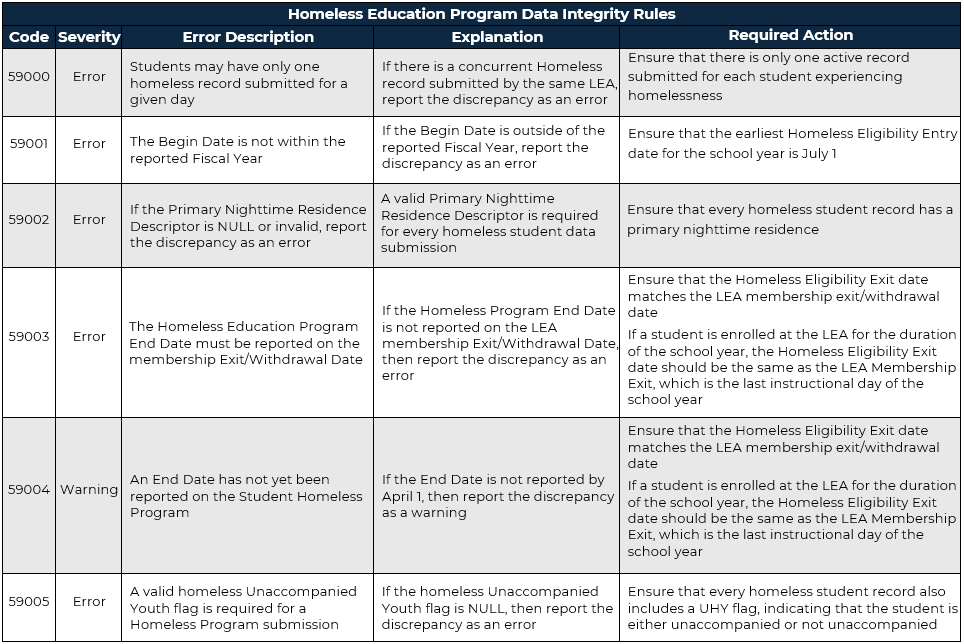
This section includes links to official communications and notifications sent to LEAs across Arizona. These communications provide updates on data reporting requirements, programmatic changes, and critical deadlines. Maintaining access to these documents ensures transparency and supports LEAs in meeting compliance standards.
The Comprehensive Needs Assessment (CNA) conducted by the Arizona Homeless Education Program team identifies the primary needs of homeless students and informs the use of program funds. This assessment is essential for guiding the development and implementation of services that address the unique challenges faced by homeless children and youth. The findings from the CNA help ensure that resources are directed to areas of greatest impact.
The Arizona Annual Consolidated State Performance Report (CSPR) provides comprehensive data on homeless student enrollment and program performance. These reports, compiled through EDFacts by the U.S. Department of Education, are vital for evaluating the effectiveness of federal education programs and ensuring compliance with statutory requirements. The CSPR serves as a critical resource for programmatic decision-making and allocation of funding for the Education for Homeless Children and Youth (EHCY) program.
Visit the following resources for additional information:
For assistance with data reporting, please contact the ADE Homeless Education Program at [email protected].
It is important to understand the McKinney-Vento Act’s definition of “homeless” as it applies to children and youth. Learn about the basic federal laws that pertain to homeless youth. You can read the McKinney Vento Act in its entirety and use for citation. The Non-Regulatory Guidance is the most frequented document, to look for questions and answers. Title 1, Part A is set aside funding for McKinney Vento students and many resources are available to help with how to utilize these funds. Finally, Head Start policies are available to ensure that our vulnerable young homeless children have access to early childhood education.
Silvia Chavez State Coordinator Homeless Inbox (602) 542-4963
Please download the toolkit from NCHE as your resource. It can be found following the link below:
[addsegment title="National Resources"]
[addsegment title="State Resources"]