Path
wellness
Contact
Contact phone number
(602) 364-2281

Shannon David Interview

Shannon David Interview


Shannon David Interview

1. Name and Title as you would like it presented: 

Shannon M. David, BSN, RN, NCSN 

2. School Name where you work: 

Our Lady of Mt. Carmel Catholic School

3. How long have you been a school nurse?

15 years

4. Nurses have a lot of options when deciding where to work. How did you choose to work for a local school and what has kept you in school nursing so many years? 

Though the days can be long and, at times, stressful, there is not a single day that I have regretted my decision to transition to school nursing (I was an ER nurse for 15 years!). The true blessing of being a school nurse is the opportunity to build lasting relationships with the students and families I serve. So many of “my kids” begin attending the school in preschool and will continue through the completion of 8th grade. I get to know them, their parents, their siblings and, in many instances, grandparents and extended family. Also, I am blessed to work in an environment where my expertise and knowledge are valued by my Principal, the teachers and the staff.. 

5. What motivates you to make a difference for your students and community?

I truly believe that there are very few reasons a child cannot attend school. When children with unique health challenges, who previously may have been excluded from traditional classrooms, are welcomed into the school environment, overcome challenges and thrive among their peers, I am inspired to continue to work with administrators and educators to create systems where all children have the opportunity to reach their full potential in an environment where they are loved!

6. What is one thing you’d like the community to know about school nurses? 

Among the metrics used to monitor the response to the COVID outbreak has been the number of ICU beds available. What has not been communicated as effectively, however, is that an “ICU bed” is only an ICU bed when an ICU nurse stands at its side. Similarly, in the school setting, a “nurse’s office” is only truly a “nurse’s office” when a fully trained, licensed nurse is in the position of school nurse. Too often the role of “school nurse'' is filled by a volunteer, ancillary staff member, or some other school employee. I would like the community to know that school nursing is a separate and distinct specialty within the broader practice of nursing. School nurses must have a breadth and depth of knowledge and clinical expertise that encompass many other specialities. School nurses are experts in communicable disease, management of chronic diseases like asthma and diabetes, acute care for injuries and illness, health education of students and anticipatory guidance for parents. I would encourage parents to find out more about the provision of health services at their school.

Lois Leon Interview

Lois Leon Interview


Lois Leon Interview

1. Name and Title as you would like it presented:

Lois Leon, R.N., B.S.N

2. School name where you work:

 Irene Lopez School

3.  How long have you been a school nurse?

I have been the school nurse at Irene Lopez School for 26 years.

4.  Nurses have a lot of options when deciding where to work. How did you choose to work for a local school and what has kept you in school nursing so many years?

I chose to work at a local school as my children were attending this school. I love providing nursing services to the students in my community. I am now servicing the children of previous students. I feel very connected to the families.

5.  What motivates you to make a difference for your students and community?

As a member of the community, I feel an obligation and passion to keep our students and families healthy. Trust has been built with community members. With this trust, families are more likely to follow through with recommendations to seek out health resources, such as the Phoenix Breathmobile which provides diagnosis and treatment for our asthmatic students.

6. What is one thing you’d like the community to know about school nurses?

School nurses are essential to keep students and families physically and emotionally healthy. Health education and promotion as well as chronic illness monitoring/treatment are vital to keep our students physically healthy and able to succeed academically. School nurses are also involved in monitoring the social emotional health of students/staff/community and linking them to resources on campus and outside of campus.

Kristi Torbenson Interview

Kristi Torbenson Interview


Kristi Torbenson Interview 

1.Name and Title as you would like it presented:

Kristi Torbenson, RN/BSN

2.School name where you work:

I split my time between Las Sendas and Red Mountain Ranch Elementary Schools in Mesa.

3.How long have you been a school nurse?

I have been a school nurse for the past 15 years, starting when my youngest went to kindergarten. He’s a college student now! 

4.Nurses have a lot of options when deciding where to work. How did you choose to work for a local school and what has kept you in school nursing so many years?

Having 3 children, and a husband with a very hectic schedule, it was hard to find a nursing job that fit our family’s lifestyle. A friend of mine told me about an opening at our local elementary school, and it seemed like the perfect fit. I have been able to continue my nursing career, while being involved in all my kids’ activities. Now that my kids are grown, I still cannot imagine leaving school nursing because I adore the students and staff that I work with. 

5.What motivates you to make a difference for your students and community?

I have always been passionate about making a difference in people’s lives, which is one of the reasons I chose nursing as a career. The wonderful relationships I have created with students and staff keep me motivated to continue serving our school community. 

6.What is one thing you’d like the community to know about school nurses?

There is so much more to school nursing than just putting Band-Aids on children. The focus of a school nurse is making sure that every student has what they need to learn and learn well, which often includes managing health conditions such as asthma or diabetes. School nurses care for acute and chronically ill students and develop care plans that may include medicine or procedures. We administer screenings for vision and hearing. School nurses must be ready to attend to first aid or emergency care at a moment’s notice for students and staff. We coordinate, verify, and document all state and district mandated student screenings and immunizations. Education is also an important part of our job. We train staff on emergency medication delivery, as well as educate students on several health principles. School nurses are responsible for helping our entire school population stay healthy, and we take immense pride in our job!

The PREPaRE Model: 3rd Edition

The PREPaRE Model: 3rd Edition

About the PREPaRE Model

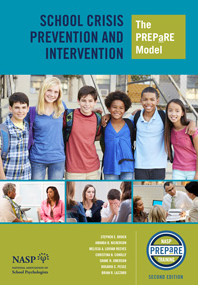
PREPaRE is a crisis prevention and intervention model that prepares educators and school-based mental health professionals to feel confident in their abilities when they fill specific roles and responsibilities during a crisis event.


The PREPaRE Model: School Prevention and Intervention

PREPaRE focuses on the following activities: 

  • Prevent and prepare for crises
  • Reaffirm physical health & welfare, and perceptions of safety & security
  • Evaluate psychological trauma risk
  • Provide interventions
  • and
  • Respond to mental health needs
  • Examine the effectiveness of crisis preparedness

This model is informed by documents published by the U.S. Department of Education and Homeland Security. You can find these documents linked in the Additional Resources section below.

Workshop 1 is a one-day training for all staff. This workshop informs on how to build a school environment that focuses on comprehensive school safety efforts that encompass both physical and psychological safety. Participants will learn a brief overview of a school crisis team's roles and responsibilities, emphasizing crisis prevention and preparedness. 

Workshop 2 is a two-day training for crisis response staff. This workshop provides specialized information on the roles and responsibilities of school-based mental health professionals, specifically during crisis intervention and recovery. Participants in this workshop will develop skills to provide the necessary immediate mental health crisis interventions to the students, staff, and school community members who have been simultaneously exposed to an acute traumatic stressor.

Request PREPaRE Training

Request a PREPaRE workshop for your school or district by contacting us at [email protected].

School Preparedness

School Preparedness

Emergency Operations Planning/Continuity of Operations Planning

Behavioral Threat AssessmentCrisis Prevention and Intervention

Welcome to the School Preparedness webpage!

What is Preparedness?

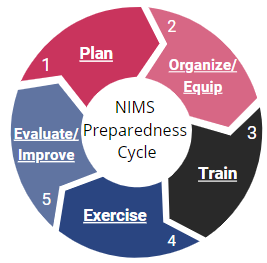
The National Incident Management System (NIMS) defines preparedness as “a continuous cycle of planning, organizing, training, equipping, exercising, evaluating, and taking corrective action in an effort to ensure effective coordination during incident response.” 

The Preparedness Cycle was created to illustrate the following steps: 

National Incident Management System Preparedness Cycle


  1. Plan

  2. Organize/Equip

  3. Train

  4. Exercise

  5. Evaluate/Improve

Each stage in the Preparedness Cycle relates to one or more of the five mission areas in the National Preparedness Goal, as outlined by the U.S. Department of Homeland Security (2015). 


Decorative Line to Separate

The National Preparedness Goal

The five mission areas of the National Preparedness Goal in the context of schools include:

  1. Prevention - To prevent, avoid, or stop a crisis event from happening in a school environment.
  2. Protection - To protect all individuals in a school environment against the greatest threats and hazards to them in their specific school's environment.
  3. Mitigation - To reduce the loss of life and property by lessening the impact of future potential crisis events in a school environment.
  4. Response - To respond to any crisis event on a school campus quickly to save lives, protect the school's property and environment, and meet basic human needs in the aftermath of a catastrophic event.
  5. Recovery - To recover through a focus on the timely restoration, strengthening and revitalization of infrastructure, housing and a sustainable economy, as well as the health, social, cultural, historic and environmental fabric of communities affected by a catastrophic incident.


Decorative Line to Separate

How does ADE support the five mission areas of the National Preparedness Goal?

The Arizona Department of Education supports education agencies across the state in preparing for emergencies of all types. Some activities in school preparedness that ADE supports include:

  • Emergency Operations Planning (EOP) tools and guidance

  • Continuity of Operations Planning (COOP) tools and training

  • Crisis prevention and intervention training

  • School-based threat assessment training

  • Training of the trainers

  • Mental health guidance

  • Suicide prevention training

Decorative Image

School Preparedness Resources 

      • Drills and Exercises: Guidance for Schools: Arizona Department of Education, 2024. 
      • CISA's Tabletop Exercise Packages help planners have coordinated discussions about the variety of safety issues that could arise and how to navigate them.
      • After Action Review and Improvement Template This template is to be used after any drills or incidents on campus.
      • FEMA Independent Study Online Courses The Arizona Minimum Requirements mandate that school employees who fill a role within the Incident Command System (ICS) structure are required to complete three FEMA online training: IS-100.a: Introduction to the Incident Command System, IS-200.C: Basic Incident Command System for Initial Response, and IS-700.B:  An Introduction to the National Incident Management System.
      • County Emergency Management On-site Training Upon completing IS-100.a, IS-200.c, and IS-700.b, district and school ERP teams are strongly encouraged to also complete the Multi-Hazard Emergency Planning for Schools course either through their local emergency management office or FEMA. Districts can schedule the two-day MAG-364 Multi-Hazard Emergency Planning for Schools course by submitting a DEMA (Arizona Department of Emergency and Military Affairs) training request form to the county emergency management office. There is no cost to the district for this training.
      • FEMA Training  E-361 Multi-Hazard Emergency Planning for Schools Course.
      • Advanced Training through DEMA Upon completing FEMA’s E-361 or DEMA’s G-364, key personnel on a district’s ERP team are encouraged to also complete MAG-300 (Intermediate Incident Command Station) and MAG-400 (Advanced Incident Command Station) through DEMA.

      *Please note: DEMA provides G-364 trainings by request only. You can request G-364 trainings by filling out DEMA's Training Request Form and submitting it to [email protected].

            • Safe and Sound Schools 
              • Especially Safe programming engages safety planners in best practice whole school community emergency planning and training that accounts for student developmental needs, including considerations for students with disabilities and access and functional needs. 
              • Straight A Safety Toolkit-provide school safety planners with resources to improve school safety and overall school community preparedness.
              • Annual State of School Safety Reports detail annual stakeholder priorities related to school safety and preparedness.
            • Sandy Hook Promise -to educate and empower youth and adults to prevent violence in schools, homes, and communities.


              Laws 

              Arizona School Nurse Access Program (ASAP)

              Arizona School Nurse Access Program (ASAP)

              logo
              The Arizona Department of Education with funding support from the Arizona Department of Health Services implemented the Arizona School Nurse Access Program (ASAP), an aptly named program to expediently increase the number of school nurses in Arizona. The ASAP idea started in Spring of 2021, and funded school nurses in Arizona for the 2022/2023 and 2023/2024 school year. The ASAP supported the professional growth and development of both new-to-practice school nurses as well as the incumbent workforce through a partnership with the Arizona Foundation for the Future of Nursing (AZFFN) and the Arizona State University (ASU). The goal of the ASAP was to foster a highly educated workforce that functions to the full extent of their license and education. 

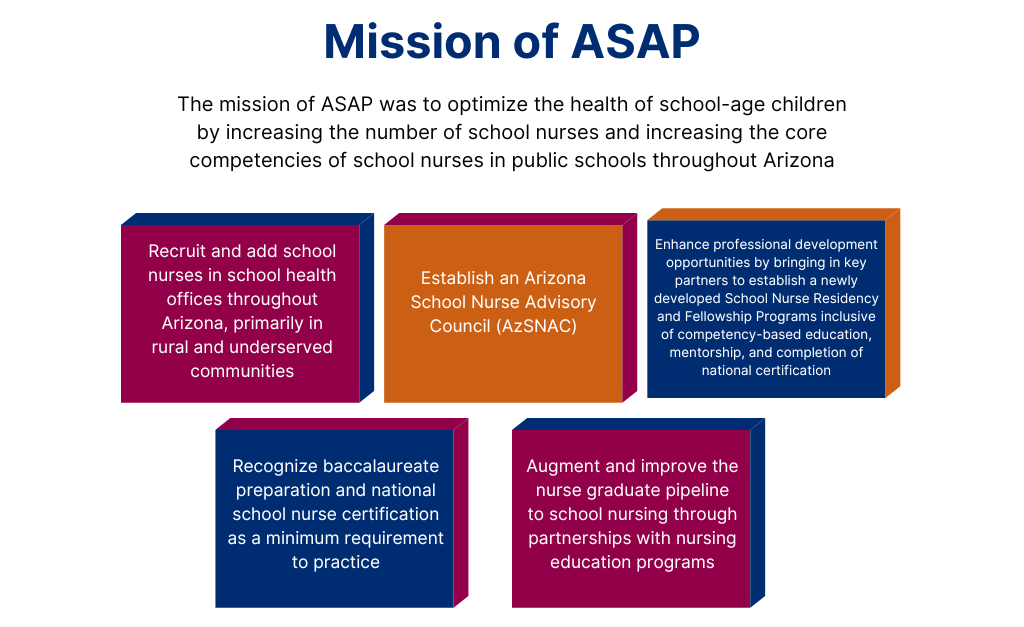
              Mission of ASAP

              A Glimpse Into The ASAP: 49 Nurses Hired Serving Rural Schools In 13 Different Counties

               Key Partners

              ASAP

               ASAP Training Programs

              Mentor Program 

              The ASAP Mentor Program was established to partner experienced school nurses with new nurses hired through ASAP to increase new school nurses' job satisfaction, ability to demonstrate core competencies, and intent to stay. The ASAP Mentor will serve as a role model, teacher, coach, and advisor for the assigned newly hired ASAP school nurse for a year. Mentors attended monthly support sessions with mentee(s) and met with their mentee in between sessions.

              Eligibility

              • Arizona licensed Registered Nurse in good standing
              • BSN preferred
              • A minimum of 2 years of school nursing experience
              • A positive recommendation from your direct supervisor with your direct supervisor acknowledging and supporting your participation in this program, knowing time may be needed to attend meetings and take calls during work hours.
              • National Certified School Nurse preferred or willingness to become certified.
              • Able to attend monthly support sessions scheduled by ASAP and respond to mentee calls and emails in a timely manner.
              • Agree to participate in ASAP evaluation team activities during the ASAP Mentor Program including demographic and satisfaction surveys
              • Submits a completed ASAP Mentor Program Application and sign an ASAP Mentor Program Agreement Statement upon selection

              Mentor Requirements

              • Complete ASAP Mentor Program Orientation
              • Attend monthly support sessions with other mentors, mentees and ASAP staff
              • Participate in ASAP evaluation activities as requested
              • Provide mentee support, feedback and resources throughout the program, completing program mentee reviews as requested
              • Utilize the Arizona Nurses Association provided Online Forum for communicating with those participating in the ASAP Mentor Program
              • Make a one-year commitment to being matched with a mentee
              • Make at least weekly contact with your mentee
              • Participate in a positive manner during each interaction with your mentee and all program participants
              • Maintain open communication with program staff, informing program administration of any difficulties or areas of concern that may arise in the mentor/mentee relationship

              National Certification Training Program 

              The Arizona School Nurse Access Program (ASAP) National Certified School Nurse (NCSN) Program was established to support Arizona school nurses in successfully testing for and obtaining their national school nurse certification from the National Board for Certification of School Nurses. School nursing is a nationally recognized nursing specialty, becoming an NCSN demonstrates professional recognition of expertise in this specialty and commitment to lifelong learning and quality care. The ASAP increased the number of Arizona school nurses meeting nationally recognized standards for providing excellence in school nursing care as 104 nurses were certified throughout the ASAP.

              The ASAP covered the cost of each Arizona school nurse applicant in seeking and obtaining their NCSN following acceptance of their application to the ASAP NCSN Program.

              To learn more about the NCSN and the exam process, visit: https://www.nbcsn.org/

              ASAP NCSN Program Components

              • Study materials (School Nurse Certification Review Book)
              • Mileage reimbursement to and from test exam
              • Exam fee
              • An online support forum for Arizona School Nurses in the ASAP NCSN Program to use while preparing for the exam
              • Virtual study group sessions with an Arizona NCSN, guest speakers and others preparing for the exam to discuss prep questions and support one another to successfully complete the certification exam
              • An Arizona one-day Pre-Conference NCSN Review Course
              • $3,000 one-time stipend for each Arizona School Nurse in the ASAP NCSN Program who successfully completes the exam and becomes an NCSN

              Eligibility Criteria for ASAP NCSN Program

              • Meet eligibility to take the NCSN EXAM established by the National Board for Certification of School Nurses AND
              • Arizona licensed Registered Nurse in good standing required
              • A bachelor’s degree or higher in nursing from an accredited program required
              • No current certification by NBCSN as an NCSN
              • A minimum of 1 full time school year of school nursing experience in the past 2 years
              • A positive recommendation from your direct supervisor with your direct supervisor acknowledging and supporting your participation in this program, knowing time may be needed to attend meetings and take calls during work hours.
              • Able to attend virtual study group sessions scheduled by ASAP, a one-day Pre-Conference NCSN Review Course and respond to program related calls and emails in a timely manner.
              • Agree to participate in ASAP evaluation team activities during the ASAP NCSN Program including but not limited to demographic and satisfaction surveys
              • Submit a completed ASAP NCSN Program Application by deadline and sign an ASAP NCSN Program Agreement Statement upon selection
              • Agree to complete the exam within a year of application

              Transition to Practice (T2P) Program

              The Arizona School Nurse Access Program (ASAP) School Nurse Transition to Practice (T2P) Program supported 20 Arizona school nurses hired within the past year and are new to school nursing by providing additional school nurse competency-based courses beyond a school health office orientation provided by the school/school district, a mentor for a year and ongoing support from school nurse experts through meetings and an online communication platform for T2P school nurses. School nursing is a nationally recognized nursing specialty, and competency-based coursework in this specialty area will guide the new school nurse in optimizing the health of school-aged children while also creating a supportive environment to increase school nurse retention.

              The program consisted of online school nurse coursework through the Maricopa County Community College District (MCCCD) and a mentor pairing for each T2P Program enrollee. The T2P school nurses were assigned an incumbent Arizona school nurse mentor for one year. The T2P school nurse was required to maintain open communication with their school nurse mentor and to attend monthly support meetings with ASAP staff and their school nurse mentor.

              When enrolled in the T2P Program, the ASAP covered the cost of registering for the MCCCD School Nurse Coursework. The T2P Program covered the cost of membership to the American Nurses Association (ANA)/Arizona Nurses Association (AzNA) and the National Association of School Nurses (NASN)/School Nurse Organization of Arizona (SNOA) for one year. 
               Other Components 

              Arizona School Nurse Advisory Council

              The Arizona School Nurse Advisory Council (AzSNAC) was established as part of the Arizona School Nurse Access Program (ASAP) with Arizona school nurses, health stakeholders, and key partners serving as members. The AzSNAC members guided and advanced the efforts of the ASAP while establishing steps to sustain the ASAP after the COVID-19 funding through the Centers for the Disease Control and Prevention (CDC) Workforce Development Crisis Emergency Cooperative Agreement ends.

              AzSNAC One-Pager

              Arizona School Nurse Workforce and Equipment Grant 

              In the Spring of 2024, ADE created a mini-grant opportunity to support Arizona school nurses and health offices. The FY24 Arizona School Nurse Workforce and Equipment Grant provided funding to support the needs of registered nurses (RN) for safe and supportive schools that foster student academic success and support COVID-19 response and recovery efforts. The application was open to K-12 Arizona public school districts or charter schools to request funds to support the purchase of health office equipment necessary to perform the duties of the school nurse position and/or invest in school nurse workforce development activities to augment school-based healthcare. Allowable use of funds included:  

              • Equipment for the school health office.
              • Health office supplies (stop the bleed kits, PPE, items for emergency go bags).
              • Funds to support professional development and training opportunities (conferences, train the trainer opportunities, related training curriculum in school nursing, mental health, emergency preparedness, or other related topics, NASN books, etc.).
              • Staff time to receive workforce development if it occurs outside of contract hours.
              • Conference registration and travel fees per ADOA guidelines, related to the school nurse profession (for attendance to conferences that occur before 6/30/2024).
              • Professional state and national memberships (e.g. National Association for School Nurses, School Nurses Organization of Arizona).

              1.3 million dollars was allocated to 36 districts in Arizona to support their school nurses and health offices.

              ASAP Sustainability Efforts 

              A focus of year 2 was placed on the sustainability of ASAP efforts. The Arizona Department of Education created the necessary tools and resources to support in sustainability planning efforts. These efforts focused on identifying funding sources, grants, opportunities, and avenues to support the school nurse position. Examples included:

              • Explore Medicaid Billing to bill for services and budget the school nurse's salary.
              • Present to the School Board to advocate for a school nurse in each school.
              • Locate community grants to generate funds to support the school nurse's salary.

              The intention was to collaborate as a team, involving the nurse, administrator, and other individuals involved in school health at your school. A sustainability action plan template and PowerPoint were created to support the necessary steps for making sustainable actions. 

              ASAP Sustainability Action Plan

              ASAP Sustainability PowerPoint

              Contact us!

              Have a question about the ASAP? Email Us! The ADE provides a webpage dedicated to School Nursing and Health Services, visit the homepage here

              School and Behavioral Health Partnerships Guide

              School and Behavioral Health Partnerships Guide

              Thu, Sep 9, 2021
              Behavioral Health Guide

              In collaboration with Arizona Health Care Cost Containment System (AHCCCS), the Arizona Department of Education is proud to provide the School and Behavioral Health Partnerships Guide for principals and school mental health professionals to help increase students’ access to the mental health care system. In addition, the Arizona Department of Education is mindful of student wellbeing impacted by the pandemic and the challenges they may experience when adjusting to in-person learning as schools reopen. Some students may need formal support from community behavioral health partners. To help families connect students to needed supports, the Department of Education partnered with state and national agencies to develop guidance on how to access the mental health system of care in Arizona to include funding sources that offer free and/or reduced services for all Arizona students. Due to Covid relief funding and SB1523, students who are not currently eligible for Medicaid, are uninsured or underinsured, can receive mental health services at no cost through the Community Mental Health Block Grant (MHBG) allocated to Title XIX/XXI funding or through the Children’s Behavioral Health Services Fund.

              Mental Health Considerations & Guidance to Referral Process for Schools in Arizona

              September is Suicide Prevention Awareness Month

              September is Suicide Prevention Awareness Month

              Wed, Sep 1, 2021
              Suicide Prevention Month 2021

              Some 1,400 Arizonans die by suicide annually; it is the eighth leading cause of death in the state. And yet, we can all play a role in helping to decrease this number in our communities. Remember to WAIT:

              W: Watch for signs of distress and uncharacteristic behavior, including an increase in substance use, sleep pattern changes, discussing death or suicide

              A: Ask, “Are you thinking of dying by suicide?”

              I: It will pass. Reassure the person you’re speaking to that suicidal thoughts are treatable and you will walk alongside them to get care.

              T: Talk to others. Call the crisis line for immediate guidance on the next steps.

              • Maricopa County served by Mercy Care:
                1-800-631-1314 or 602-222-9444
              • Cochise, Graham, Greenlee, La Paz, Pima, Pinal, Santa Cruz, and Yuma Counties served by Arizona Complete Health - Complete Care Plan:
                1-866-495-6735
              • Apache, Coconino, Gila, Mohave, Navajo, and Yavapai Counties served by Health Choice Arizona:
                1-877-756-4090
              • Gila River and Ak-Chin Indian Communities:
                1-800-259-3449
              • Salt River Pima Maricopa Indian Community:
                1-855-331-6432

              For more crisis resources, see the AHCCCS Crisis web page.

              SCHOOL HEALTH OFFICE RESOURCES

              SCHOOL HEALTH OFFICE RESOURCES

              NEW! 2025 Emergency Guidelines For Schools (Arizona Redbook)   

              Delivery of Specialized Health Services in the School Setting 

              NEW! Suicide Prevention Training for School Mental Health Professionals

              A- Z Resources

               Absenteeism || Attendance 

               Allergy || Anaphylaxis 

              Food Allergies | CDC
              Provides school resources, including Food Allergy Facts, Voluntary Guidelines for Managing Food Allergies in Schools and Early Care and Education Programs, and a Food Allergies in Schools Tool Kit, linked below.

              Food Allergies in Schools Toolkit | Healthy Schools | CDC

              Latex Allergy Prevention Guide
              Provides levels of response to latex with symptoms and additional resources. 

              Food Allergy Research and Education (FARE)
              Provides resources for schools, health professionals, health educators, and families, including emergency care plans and a toolkit for classrooms.

              Allergy & Asthma Network
              Provides advocacy, education, resources, and downloadable infographics for schools and parents.  Some are available in English and Spanish.

              BeeAware Allergy
              Provides information and free resources in English and Spanish to help educate students and families on bee sting allergies. 

              NASN Allergy and Anaphylaxis
              Provides resources on sample policies, protocols, and allergy/anaphylaxis management.

              Arizona Resource Guide: Supporting Children with Life-Threatening Food Allergies (2012)

              Protocol for Emergency Administration of Epinephrine in School - ADHS & ADE (2019)

              School Training Presentation for Use of Epinephrine Auto-Injector for Anaphylaxis - ADHS (2019)

              Template: Standard Orders for Auto-Injectable Epinephrine in a School Setting - AHDS & ADE (2019)

              Report Form for School Emergency Administration of Auto-Injectable Epinephrine - ADHS (2019)

              Food Allergy & Anaphylaxis Emergency Care Plan (FARE)

              Allergies & Anaphylaxis Resources (NASN)

               Asthma 

              Asthma | CDC
              Provides information on developing, implementing, and evaluating school-based asthma programs and a toolkit for districts and schools to create asthma-friendly schools. Includes information for school leaders. 

              Arizona Asthma Coalition

              Allergy & Asthma Network
              Provides education, advocacy, and resources for schools and families.

              American Academy of Allergy, Asthma & Immunology (AAAAI)
              This professional organization is made up of allergists/immunologists, other medical specialists, allied health, and related healthcare professionals dedicated to the practice of allergy, asthma, and immunology.  

              American Lung Association
              Resources for students, families, and schools include Asthma Basics, Asthma-Friendly Schools Initiative, Asthma Medication in Schools, Back to School with Asthma Toolkit, Kickin' Asthma, and Open Airways For Schools.

              Asthma Friendly Schools Initiative & Toolkit (American Lung Association)

              Asthma and Allergy Foundation of America
              Provides support to individuals, schools, and communities about asthma and allergies through support, advocacy, education, and research

              Asthma Resources (NASN)

               Attention Deficit Hyperactivity Disorder (ADHD) 

               Autism 

              Autism Spectrum Disorder (ASD) | CDC
              Provides signs, treatment, research, and recommendations. 

              Autism Speaks
              The largest autism advocacy organization in the US, dedicated to funding research into the causes, prevention, treatments, and a cure for autism; increasing awareness of autism spectrum disorders; and advocating for the needs of individuals with autism and their families. 

              Center for Autism and Related Disabilities
              Albany University's affiliated resource center that brings research and practice together in community settings. CARD Albany provides evidence-based training and support to families and free professional development and parent seminars.

              Autism Clinical Center - Child Mind Institute

               Automated External Defibrilators (AEDs) 

              Arizona law does not require AEDs in schools. However, a school site that obtains an AED is not authorized to allow its use until all requirements of the state law have been met at that site.

              Here are the Arizona laws for AEDs.

              Note: The law does not require or indicate what type of AED should be utilized in schools. When considering which AED to purchase, consider these 5 important factors: total cost of ownership, size and weight, connectivity, pediatric capabilities, and fully automatic vs. semi-automatic.

              Article 3

              Automated External Defibrillators

              36-2261

              Definitions

              36-2262

              Automated external defibrillators: use, requirements

              36-2263

              Civil liability; limited immunity; Good Samaritan

              36-2264

              Exemption from regulations

              AEDs In Schools

              It is important to advocate for AEDs in our schools as AEDs can drastically improve the survival rate of students and adults in schools who suffer from sudden cardiac arrest.1 Once trained, anyone can use an AED; here are some tips to follow when implementing AEDs in your school.

              1. AEDs should be within 3 minutes of every location within the school.  Each school is different and may have a different policy on where to place their AEDs, but you may want to ensure they are placed near the gymnasium, in the main lobby, with the nurse, with the athletic trainer, and/or in the middle of the hallways.
              2. A designated staff member should be responsible for maintaining all AEDs within the school. This means doing monthly maintenance checks such as ensuring the battery and pads are plugged in, ensuring the machine is not beeping, and checking the Active Status Indicator Light is flashing green. A log of all monthly maintenance checks should be kept to ensure the AED is ready to be used.
              3. A Cardiac Emergency Action Plan is a written plan that explains the exact actions that will take place in an emergency. These actions should be very clear and very specific. Click here for sample plans that can be utilized at your school.
              4. Implement Life-Saving Drills to be prepared for a sudden cardiac arrest emergency. This will help the Cardiac Response Team practice their Cardiac Emergency Action Plan to help save a life in an emergency. These drills should be done once annually, as cardiac arrest can affect anyone at any age, and it is crucial that these steps are in place to give someone the best possible chance of surviving.

              Andersen LW, Holmberg MJ, Granfeldt A, Lofgren B, Vellano K, McNally BF, et al. on behalf of the CARES Surveillance Group. Neighborhood characteristics, bystander automated external defibrillator use, and patient outcomes in public out-of-hospital cardiac arrest. Resuscitation 2018;126:72–79.

              Sudden Arrhythmic Death Syndrome

              The SADS Foundation recommends that all children with a SADS condition have an Individualized Care Plan, a Cardiac Emergency Response Plan, and an AED program at their school. If you have a SADS child at your school and have not had a discussion with their parents about care plans, we strongly suggest you do so today. Please view the SADS Foundation School Nurse webpage for additional information, support, and resources.

              ADDITIONAL RESOURCES

              School Nurses’ Perceived Barriers and Perceptual Influences When Implementing AED Programs

              Project Adam: CPR & AED Resources

              Project Adam Arizona Affiliate 

              Center for Disease Control and Prevention (CDC): Public Access Defibrillation (PAD) State Law Fact Sheet

              Register your AED: Save Hearts in Arizona Registry and Education (AZ SHARE)

               Bloodborne Pathogens and Exposure control 

              Bloodborne Infectious Disease Risk Factors | CDC
              Provides information and resources for prevention.

              Occupational Safety and Health Administration Resources (OSHA):

              Bloodborne Pathogens and Needlestick Prevention
              This webpage provides an overview of bloodborne pathogens, including standards, guidance, hazard recognition, evaluating and controlling exposure, and other helpful information.

              Bloodborne Pathogen Standard 1910.130
              Provides all required elements of the OSHA Standard applicable to all occupational exposure to blood or other potentially infectious materials. 

              Bloodborne Pathogens Plan Fact Sheet
              Provides a quick overview of the BBP standard. 

              Model Exposure Control Plans for Bloodborne Pathogens Standards (OSHA)
              Provides a model exposure control plan to meet the requirements of the OSHA bloodborne standard. The written plans must be accessible to all employees, either online or in an area where they are available for review. 

              Frequently Asked BBP Questions (OSHA)
              Provides a list of answers to the most frequently asked questions regarding BBP standards and provides regional office contact information. 

               Body Image, Eating Behavior, & Eating Disorders 

              Arizona Data

                       Curriculum

              Be Real’s BodyKind is an evidence-based high school body image curriculum to address the needs of today's students. Lessons focus on appearance judgment, self-compassion, social media, and compassion for others. This FREE 3-lesson curriculum includes lesson plans, worksheets, exercises, and classroom slides. To access and download the free curriculum materials, educators can register, watch the professional development training video, and take an 11-question quiz on the BE REAL website. 

              Be Real’s Let's Eat! is a weight-neutral, research-based nutrition curriculum that encourages young people to fuel themselves for their lives and listen to their own unique needs and body cues. This FREE 4-lesson curriculum includes lesson plans, worksheets, exercises, and classroom slides. To access and download the free curriculum materials, educators can register, watch the professional development training video, and take an 11-question quiz on the BE REAL website. 

                        Training

              Resources

               Bullying 

              National Association of School Nurses - Prevention and Intervention of Bullying and Cyberbullying in Schools
              NASN position statement, which includes a summary, background, rationale, and resources on bullying for school nurses.

              National Association of School Psychologists - A Framework for School-Wide Bullying Prevention and Safety
              Provides resources for schools and families to support children and youth through crisis and trauma, including a specific section on bullying.

              National Library of Medicine-Bullying and Cyberbullying
              MedlinePlus offers resources, prevention strategies, and risk factors for school health professionals, parents, and students.

              StopBullying.gov
              A federal government website managed by the U.S. Department of Health & Human Services offers resources and guidance on bullying: What is Bullying, Cyberbullying, Who is at Risk, Prevent Bullying, Get Help, and other resources for school health professionals.

               Cancer 

              American Cancer Society
              Provides A-Z resources, treatment and support, research, and involvement opportunities.  

              Care in Children and Adolescents
              Information includes prevalence, outlook, possible causes, differences in cancer between adults and children, treatment, clinical trials, and things to consider for childhood cancer survivors.   

              Childhood Cancer
              Provides information for parents regarding childhood cancer, such as what cancer is, treatment, and coping. 

               Cardiovascular || Heart Health 

              CPR | AED Resources

              American Heart Association (AHA)
              Resources for the Educator 

              Hands-Only CPR Training

              Anyone Can Save A Life
              Voluntary emergency action planning program after-school program that trains students for after-school practices and events.

              Cardiopulmonary resuscitation (CPR): First aid - Mayo Clinic

              Blood Pressure Management

              A Pocket Guide to Blood Pressure Measurement in Children

              Heart Disease Awareness

              Go Red for Women
              Tools and resources to empower women to take charge of their heart health. 

              Heart Disease Information for National Heart Month-February (CDC)

              Support Organizations

              SADS (Sudden Arrhythmia Death Syndrome Foundation)
              Provides resources for school personnel and families on sudden arrhythmia death syndrome (SADS). 

              Connected by Hearts Young Survivors Group
              Provides education, support, and networking to young cardiac arrest survivors or those living with heart-related illnesses. This website is designed by young people for young people.   

              Louis J. Acompora Memorial Foundation
              Provides information on sports safety, focusing on placing AEDs in schools, education on commotio cordis, and sudden cardiac arrest (SCA).   

              Parent Heart Watch
              Resources for advocacy and education for schools and families about sudden cardiac arrest.   

              Project Adam & Phoenix Children's Hospital

               Celiac Disease 

              Beyond Celiac Resources

              Information For School Resource Page
              Gluten-Free Webinar Archives
              Here you will find PDFs and links to past Webinars available for download.

              Beyond Celiac PDF Files for Downloading

              Importance of School Nurse Education & How-To Strategies for Parents of Gluten-Free Kids

              Back to School Toolkit

               Cerebral Palsy 

              Cerebral Palsy (CP) | CP
              CP is the most common motor disability in childhood, and children with CP and their families need support. Learn more about CP and what signs to look for in young children.

              National Institute of Neurological Disorders and Stroke Resources

              Cerebral Palsy: Hope Through Research | National Institute of Neurological Disorders
              This webpage provides detailed information regarding what constitutes cerebral palsy, early signs, causes, risk factors, prevention, different forms, associated conditions, diagnosis, treatment, special health challenges for adults, research, and other resources.  

               Child Abuse 

              Arizona Child Abuse Hotline 1-888-SOS-CHILD (1-888-767-2445)

              SB1114 - Child Abuse Hotline Required Posting

              Dear School Leaders,

              On March 24, 2021, the Legislature of the State of Arizona passed an amendment to Senate Bill 1114. Section 1. Title 15, chapter 1, article 5, Arizona Revised Statutes has been amended by adding section 15-160.01., as it relates to student safety. Please refer to the entirety of section 15-160.01(link is external) for additional information.

              The following are the requirements as detailed in the amendment:

              15-160.01. Child abuse hotline; required posting

              EACH SCHOOL THAT IS OPERATED BY A SCHOOL DISTRICT AND EACH CHARTER SCHOOL SHALL POST IN A CLEARLY VISIBLE LOCATION IN A PUBLIC AREA OF THE SCHOOL THAT IS READILY ACCESSIBLE TO STUDENTS A SIGN THAT CONTAINS ALL OF THE FOLLOWING:

              1. IN BOLDFACED TYPE, THE TELEPHONE NUMBER OF THE CENTRALIZED INTAKE HOTLINE CONCERNING SUSPECTED ABUSE AND NEGLECT OF CHILDREN THAT IS ESTABLISHED PURSUANT TO SECTION 8-455.
              2. INSTRUCTIONS TO CALL 911 FOR EMERGENCIES.
              3. DIRECTIONS FOR ACCESSING THE WEBSITE OF THE DEPARTMENT OF CHILD SAFETY FOR MORE INFORMATION ON REPORTING CHILD ABUSE, CHILD NEGLECT AND THE EXPLOITATION OF CHILDREN.

              To support schools in implementing these requirements, the Arizona Department of Education and the Arizona Department of Child Safety have created standardized materials to be posted in clearly visible and public areas of each school.

              Download Materials:

              Report Abuse English K-3, Spanish K-3

              Report Abuse or Neglect English 4-12, Spanish 4-12

              Arizona State Board of Education: Resources for Educators

                        Arizona Mandatory Reporting One-Pager Overview

              Arizona Department of Child Safety Mandated Reporter Overview Training

                     Mandatory Reporting Laws PowerPoint

                     Mandated Reporting Laws Workbook

                     Mandatory Reporting FAQs

              Barbara Sinatra Children’s Center Foundation

                        Fight Child Abuse (K-3)

                        Fight Child Abuse (4-6)

                        Fight Child Abuse (Teens)

              Prevent Child Abuse Arizona

                        Trainings Offered by Prevent Child Abuse Arizona

                        Mandated Supporter Training

                        Lean on Me AZ

                        Family Resource Centers

               Concussion || Head Injury

              CDC Heads Up Concussion Resources

              Heads Up - Safe Brain. Stronger Future. 
              Keeping children and teens healthy and safe is always a top priority. Whether you are a parent, youth sports coach, school coach, school professional, or healthcare provider, this site will help you recognize, respond to, and minimize the risk of concussion or other serious brain injury.

              Heads Up Resources 
              Provides online, print, and video materials along with Head Injury Concussion Resources for physicians, coaches, school nurses, teachers, and counselors.

              Heads Up for Schools 
              Provides online concussion training for school professionals and tools and resources for school personnel, coaches, and parents.

               Dental || Oral Health 

              Healthy Schools: Oral Health (CDC)

              ADHS Office of Oral Health

              Dental Assistance Programs

              ADA Give Kids A Smile® Program

              This program enhances the oral health of large numbers of needy children. Give Kids A Smile (GKAS) activities also highlight for policymakers the ongoing challenges that disadvantaged families face in finding dental care. Find a program.

              Smiles Change Lives 
              This program promotes and provides access to orthodontic care for qualified young people aged 10-18 from low-income families nationwide.  

              Seal a Smile Oral Health Services
              The Healthy Capital District Initiative works to increase access to coverage, provides health planning expertise, and supports health prevention programs across the Capital Region. 

              Professional Dental Organizations

              Academy of General Dentistry (AGD)
              Professional association of general dentists. A general dentist is the primary care provider for patients of all ages and is responsible for the diagnosis, treatment, management, and overall coordination of services related to patients' oral health needs. 

              American Academy of Pediatric Dentistry (AAPD)
              Is a membership organization representing the specialty of pediatric dentistry. Pediatric dentistry is one of the nine recognized dental specialties of the American Dental Association. Pediatric dentists complete two to three years of additional specialized training (after the required four years of dental school) to prepare them for treating a wide variety of children's dental problems.

              American Dental Association (ADA)
              Is the oldest and largest national dental society in the world. Since then, the ADA has grown to become the leading source of oral health-related information for dentists and their patients. 

              Dental Resources for Students with Special Health Care Needs

              Autism Dental Information Guide for Dental Professionals
              This guide was created for dental professionals to use in supporting families with children with autism spectrum disorders (ASDs). This information can help facilitate more positive experiences for parents/ caregivers, the dental team providing treatment, and the child on the autism spectrum.

              Focus on Children and Adolescents with Special Health Care Needs National Maternal and Child Oral Health Resource Center
              This series of five modules is designed to provide health professionals with information to help ensure that children with special health care needs have access to health promotion and disease prevention services that address their unique oral health needs in a comprehensive, family-centered, and community-based manner.

              National Institute of Health, National Institute of Dental and Craniofacial Research Oral Conditions in Children with Special Needs: A Guide for Health Care Providers 

              Smiles for Life
              Teeth Whitening for Disabled Children, March through June, hundreds of dental practices professionally whiten teeth to raise money for underprivileged and disabled children. 

               Emergency Preparedness || Disaster Preparedness || School Safety 

              School Preparedness Webpage (ADE)

              PREPaRE is a crisis prevention and intervention model that prepares educators and school-based mental health professionals to feel confident in their abilities when they fill specific roles and responsibilities during a crisis event.

              PREPaRE focuses on the following activities: 

                   Prevent and prepare for crises

                   Reaffirm physical health & welfare, and perceptions of safety & security

                   Evaluate psychological trauma risk

                   Provide interventions

                   and

                   Respond to mental health needs

                   Examine the effectiveness of crisis preparedness

              Request a PREPaRE workshop for your school or district by completing the PREPaRE Workshop Request Form.

              Emergency Operations Planning (EOPs) | ADE

              Emergency Planning | SchoolSafety.gov

              How Schools Can Prepare for Disasters | American Red Cross

              School Preparedness | Centers for Disease Control and Prevention (CDC)

              Youth and Emergency Planning | Federal Emergency Management Agency (FEMA)

              Emergency Resources, Equipment, and Supplies List (NASN)

               Immunizations || Vaccines 

              Arizona Department of Health Services (ADHS):

              Arizona Guide to Immunizations Required for School Entry-2025/2026 School Year

              Immunization Screening and Referral form- Incomplete vaccinations notice

              School Immunization Quick-look Toolkit

              Introduction to ASIIS for School Staff

              Arizona Immunization Program- Resources for Schools & Child Care Centers 

              Immunization Exemption Forms

              • Medical Exemption Form - Must be completed by the student’s medical provider.
              • Personal Beliefs Exemption Form (Spanish) - Must be completed by the parent or guardian of a student attending Kindergarten through 12th grade. The initials of the parent/guardian and the date are required next to each vaccine-preventable disease description, in addition to the signature and date at the bottom of the form.
              • Religious Beliefs Exemption Form (Spanish) - Must be completed by the parent or guardian of a child attending childcare or preschool programs. The initials of the parent/guardian and the date are required next to each vaccine-preventable disease description, in addition to the signature and date at the bottom of the form.

              Statutes and Rules for Immunization Requirements:

              Additional Resources:

              TAPI Immunization Resources for School Nurses & Health Office Staff

              Arizona Personal Belief Exemption Map

               Infectious Disease 

              Communicable Disease Reporting - ADHS Schools & Childcare Facilities

              'Infectious Disease Flip Chart' (ADHS 2017) This Flip Chart serves as a reference guide for individuals responsible for the health and safety of children in school and childcare settings.

              Healthy Kids App

               Lice

              Lice Lessons: NASN Tools For School Nurses An educational initiative designed to help school nurses reduce fear and stigma and help parents navigate treatment choices.

               Measles 

              NEW!  Measles Toolkit for Schools (ADHS)

              American Academy of Pediatrics(AAP):

              Measles | AAP

              Measles Vaccine | AAP

              Measles Prevention and Control | AAP

              Measles Toolkit | AAP

              AAP Red Book Hot Topics Live Webinar: Measles

              Arizona Department of Health Services (ADHS):

              About Measles | Arizona Department of Health Services | ADHS

              Measles Surveillance Toolkit For Healthcare Settings | ADHS-April 2025

              Measles Clinical and Diagnostic Webinar | ADHS- updated March 21, 2025

              U.S. Centers for Disease Control and Prevention(CDC):

              Measles Cases and Outbreaks | CDC

              About Measles (Rubeola) | CDC

              Measles Vaccination Information | CDC

              Measles: 14th Edition “Pink Book”, Chapter 13

              Clinical Overview of Measles : Diagnosis, Laboratory Testing, and Outbreak Response | CDC- March 5, 2025

              To receive continuing education (CE) for this course, please visit CDC TRAIN and search for the course in the Course Catalog. Then, follow the steps below.

                • 1. Register for and complete the course. 2. Pass the post-assessment with a percentage of 80%. 3. Complete the evaluation. Visit Your Learning to access your certificates and transcript.

              Preventing Spread of Infections in K-12 Schools | CDC- School Preparedness

              Preparing and Responding to Measles: Checklist for Summer Camps | CDC

              The Arizona Partnership for Immunizations (TAPI):

              Measles Information | TAPI

              2025 Measles Outbreak: Resources and Updates for Local Health Departments | TAPI- NACCHO

              Reporting Measles:

              Measles is a reportable disease in Arizona. The Arizona Administrative Code, R9-6-202 and R9-6-204, require providers and laboratories to report cases or suspect cases of measles within 24 hours. Healthcare providers and labs can refer to the ADHS Office of Infectious Disease Services' Reporting of Communicable Diseases page to access information regarding the reporting of communicable diseases.

              If measles is suspected, notify your local health department immediately.

              Maricopa County Measles Information Page

              Pima County Measles Information Page

              For urgent calls outside of normal business hours, if you are unable to reach the appropriate county health department, please call ADHS at (480) 303-1191 (Arizona Poison and Drug Information Center answering service).

              Sample Letters:

              Sample Community Letter About Measles

              CDC Public Health Checklist Measles

              Information pamphlets and flyers:

              How to Spot Measles- TAPI’s Measles Signs and Symptoms Flyer

              Measles- It isn’t Just a Little Rash- CDC

              Measles Clinical Fact Sheet- CDC

               Mental Health 

              988 Suicide & Crisis Hotline

              Teen Lifeline- Arizona’s only teen-to-teen crisis hotline Call Text 602-248-8336(TEEN), outside Maricopa call 1-800-248-8336(TEEN)

              School and Behavioral Health Partnerships Resource Guide(2025)

              Mental Health & Wellness webpage (ADE)

              Project AWARE- Advancing Wellness & Resiliency in Education (ADE)

              Training available to school staff & community members:

              • Youth Mental Health First Aid Training: Virtual Training with A Live facilitator. This is an interactive, online training. The training itself is 6 hours and requires approximately 2 hours of pre-course work. Cameras are required to stay on throughout the training. This training is offered through several community organizations. Please email us at [email protected] to set up a course for your campus. 
              • Suicide Alertness for Everyone (SafeTALK):  In-person training, English language. This course takes approximately 3.5 hours. Register Here

              Mental Telehealth- ADE/ Cartwheel Partnership

              Mental Health Webinar: A Guide for School Nurse & Health Staff (Nov 2021) / PDF Slides ADE partnered with Touchstone Health Services, Teen Lifeline, and Project AWARE to educate Arizona school nurses and health office staff on how to identify and respond to common mental health challenges youth face in relation to COVID-19.  Click the link below and enter the passcode to access the recorded event!

              Accessing Behavioral Health Services in Schools

              School-Based Universal Referral Form- English  (Spanish)

              Addressing Anxiety & Stress (NASN)

              Mental Health Resources (NASN)

              Talk. They Hear You (SAMHSA) 

               Opioid Overdose Prevention || STOP-IT  

              The School Training Overdose Preparedness and Intelligence Taskforce (STOP-IT) has been formed to help schools with the fentanyl and opioid crisis. 

              Narcan Request Form- District/Charter Schools

              STOP-IT Fentanyl and Opioid Response Toolkit for Schools

              “Just-in-Time” Training- Narcan Administration Video

              Narcan for Arizona K-12 Schools- Informational Flyer

              Arizona law requires schools to have policies and procedures regarding the emergency use of Naloxone:

              Other Resources:

              Opioid Prevention- Arizona Dept of Health Services

              Overdose Prevention | CDC

              OARLine- Opioid Assistance and Referral Line 1-888-688-4222

              United States Drug Enforcement Administration(DEA)- One Pill Can Kill

               Pregnancy || Parenting Students 

              American Pregnancy Association: How to Have a Healthy Teen Pregnancy

              Arizona Youth Partnership: AIM 4 Teen Moms is an evidence-based intervention designed for teen moms by helping teen mothers define specific life aspirations, engage in planning to successfully achieve them, and consider the role of contraception in their lives. The program is designed for mothers between the ages of 14-20 years old with at least one child and is provided for free virtually, across the state of Arizona.

              Healthy Families Arizona (HFAz): Healthy Families Arizona is a free and voluntary home visitation program that serves pregnant women and families of newborns. HFAz is a prevention program dedicated to supporting families in their quest to be the best parents they can be.

                        Healthy Families Referral Form

              Nurse-Family Partnership(NFP): Nurse- Family Partnership is a free home visiting program that works with first-time pregnant parents and their children, beginning in early pregnancy through their child’s second birthday.

              Nurse Family Partnership- Maricopa County 

                         Home Visitation Program Referral Form

               School Stock Medication Program 

              Arizona offers three stock medication programs for schools: Stock Inhalers, Epinephrine, and Narcan. A school may decide to participate in none, one, two, or all programs. The following information will help you learn more about each program and the necessary steps to complete to offer these programs at your school.

              Maricopa County Department of Public Health (MCDPH) offers an online program, the School Surveillance and Medication Program (SSMP), to assist schools in participating in the stock programs. The SSMP walks you through the requirements, including annual training and items that will be needed to implement the program. Currently, MCDPH is working with all Arizona public and charter schools to implement the stock inhaler and epinephrine programs, collecting data and offering the annual standing orders, once schools sign up through the SSMP and follow the requirements. By starting with the SSMP site, you will gather the information and tips to establish a stock medication program. For schools to participate, they must enroll in the School Surveillance and Medication Program (SSMP) web application. After completing and submitting each of the requirements, your school can obtain and receive annual standing orders and a prescription from the MCDPH Medical Director.

              The Stock Albuterol Program in Schools was put in place in 2017 by state law HB 2208, Emergency administration of inhalers by trained personnel; immunity; definitions, and is in law as ARS 15-158The Arizona Asthma Coalition has a thorough description of the program. Questions specific to the implementation may be sent to Ashley Lowe via email at [email protected] and [email protected]

               New! Training: Stock Albuterol Inhaler Training for School Personnel 2023-2024

              The Stock Epinephrine Program in School. If a school opts to implement the Stock Inhaler Program there are rules, R7-2-810 Emergency Administration of Inhalers, in place by the State Board of Education regarding training, obtaining the medication standing order, and administering procedures in emergencies. 

              This program was put into place in 2018 by state law HB 2085, Emergency administration of epinephrine auto-injectors by trained personnel; immunity and is in law as ARS 15-157

              If a school opts to implement the Stock Epinephrine Program, there are rules, R7-2-809 Emergency Administration of Auto-Injectable Epinephrine, in place by the State Board of Education regarding training, storage, and use of the medication in schools. The Kyah Rayne Foundation also helps with the Stock Epinephrine Program in Schools. 

              The Stock Narcan Program is part of the AZ Opioid Epidemic Act/Action Plan implemented in 2018. The Arizona Department of Health Services (ADHS) has a website with information offering a standing order for Narcan and a form to complete to receive a supply of the medication. ADHS also offers some links to Narcan administration training, though none are specific for schools.  Development of training for schools is in development, and discussions are underway to incorporate the Stock Narcan Program within the SSMP. This site will be revised as updates are available. The SSMP Program can also support this, and Naloxone for School Personnel training will be available soon.

               Seizures 

              In 2022, SB 1654 Schools; seizure management; treatment plans was introduced in the State of Arizona 55th Legislature Second Regular session and was signed by the Governor on April 29, 2022. The bill became ARS 15-160.02 and included language for the Board of Education to adopt rules as necessary to administer this law. Beginning in the 2022-2023 school year, the parent or guardian of a student who has a seizure disorder and who is enrolled in a school that is operated by a school district or a charter school in Arizona may submit to the school district or charter school in which the student is enrolled a copy of a seizure management and treatment plan for school personnel to use if the student suffers a seizure at school or while participating in a school-sponsored activity. The plan must be developed by the student’s parent or guardian and the physician or registered nurse practitioner responsible for the student’s seizure treatment. The law also stipulates a review of the plan and training for school staff. Below are resources and information to assist schools with law implementation. In June 2024, the Board of Education approved rules to accompany implementation of ARS 15-160.02.

              Introduction of SB1654; Schools; Seizure management; Treatment Plans Resources:

              Arizona Senate Bill 1654

              15-160.02 Law: Seizure Management and Treatment Plans

              Arizona State Board of Education: Approved Training & Related Training Requirements:

              AZSBE Website and Submission of Personalized Trainings

              Training Review Guidelines for School Nurses

              Training Review Guidelines: Other School Personnel

              Intake Form and Checklist

              Board-Approved Epilepsy Foundation Seizure Safe Schools Courses

              Seizure Epilepsy Resources

              New! Seizure Action Plan (SAP) Templates (2024):

              Arizona Seizure Action Plan – Fillable (must download)

              Arizona Seizure Action Plan – Non-Fillable (must download)

              Arizona Seizure Action Plan - Black and White Non-Fillable (must download)

              Additional Resources:

              CDC Epilepsy Data and Statistics

              CDC Epilepsy in Schools

              Managing Epilepsy in Schools 

              Epilepsy Foundation

              National Association of School Nurses (NASN): School Nursing Evidence-based Clinical Practice Guideline: Students with Seizures and Epilepsy (2018)

              Seizure Action Plan Coalition

              School Nursing Evidence-Based Clinical Practice Guideline: Students with Seizures and Epilepsy CPG Implementation Toolkit

              School Nursing Evidence-Based Clinical Practice Guideline: Students with Seizures and Epilepsy

              Implementing SB 1654: How Schools Can Successfully Meet the Law's Requirements and Establish Seizure Action Plans at Their School

              Passcode: TbhB!q3x

              CDC Resources

              Epilepsy in Schools Guidance
              Provides tools and programs to help schools better support children with Epilepsy. The CDC partners with the Epilepsy Foundation and links to their free training programs for schools.

              Epilepsy Foundation Resources

              What is Epilepsy - Types of Seizures
              Provides information on the different types of seizures, how they are classified, and how different symptoms are described during a seizure.

              Seizure Training for School Nurses: Caring for Students
              The program is designed to provide the school nurse with information, strategies, and resources that will enable them to better manage the student with seizures by supporting positive treatment outcomes, maximizing educational and developmental opportunities, and ensuring a safe and supportive environment. The program consists of seven modules to assist the school nurse in learning to effectively manage seizures in a school environment.

              Seizure Training for School Personnel
              Designed for people who work with children and youth in school settings. This program provides an overview of seizures and epilepsy, seizure first aid, seizure action plans, rescue therapies, seizure emergencies, and how to support students in school settings.

              School Education
              Epilepsy awareness educational programs for students are provided upon request to the Epilepsy Foundation.           

               Specialized Health Care 

              Guidelines for Delivery of Specialized Health Services in the School Setting

              Children and Youth with Special Health Care Needs (CYSHCN) Program- (ADHS) works to improve the health and well-being of children and youth with special health care needs and their families in Arizona.

              Exceptional Student Services (ESS) | Special Education (ADE)

               Suicide Prevention 

              NEW! Suicide Prevention Training for School Mental Health Professionals   Training course flyer    Access the Course Here

              988 Suicide & Crisis Hotline

              Teen Lifeline- Arizona’s only teen-to-teen crisis hotline Call Text 602-248-8336(TEEN), outside Maricopa call 1-800-248-8336(TEEN)

              Suicide Prevention Webpage (ADE)

              Project AWARE- Advancing Wellness & Resiliency in Education (ADE)

              Trainings available to school staff & community members:

              • Youth Mental Health First Aid Training: Virtual Training with A Live facilitator. This is an interactive, online training. The training itself is 6 hours and requires approximately 2 hours of pre-course work. Cameras are required to stay on throughout the training. This training is offered through several community organizations. Please email us at [email protected] to set up a course for your campus. 
              • Suicide Alertness for Everyone (SafeTALK):  In-person training, English language. This course takes approximately 3.5 hours. Register Here

              Nursing Licensure & Scope of Practice Resources

               Arizona Nurses Association (AzNA) 

              Arizona Nurses Association (AzNA) supports the advancement of the nursing profession to promote a healthy Arizona.

               Arizona State Board of Nursing (AZBON) 

              The mission of the Arizona State Board of Nursing(AZBN) is to protect and promote the welfare of the public by ensuring that each person holding a nursing license or certificate is competent to practice safely.

              Scope of Practice- Registered Nurse (RN)

               National Association of School Nurses (NASN)

              The National Association of School Nurses (NASN) focuses on five areas that, together, ensure that school nurses are equipped to address the comprehensive health needs of students:

              1. Student-Centered Care: NASN emphasizes the role of school nurses in providing quality health care to students, addressing both physical and mental health to promote academic success.
              2. Leadership: NASN promotes leadership development among school nurses, empowering them to influence health policies and practices within schools and communities.
              3. Advocacy: NASN is committed to advocating for policies at local, state, and national levels that support the health and well-being of students, as well as ensuring access to school health services.
              4. Quality Improvement: NASN focuses on improving the quality of school health services by supporting evidence-based practice, data collection, and continuous professional development.
              5. Community and Public Health: NASN emphasizes the importance of school nurses in public health, working to prevent illness, manage chronic conditions, and promote health education in the broader school community.

               NASN Position Statements

              Health & Practice Topics- Resources

               School Nurses Organization of Arizona (SNOA) 

              The School Nurses Organization of Arizona (SNOA) advocates for and supports the health and educational success of Arizona‘s children by promoting the advancement of professional school nursing.

              Health Related Links- School Nursing Resources by Topic

              Meet The SNOA Board Members

              SNOA 36th Annual Conference PPT- June 2025

              Local & National Programs, Agencies & Organizations

              Contact Us

               Email School Nursing & Health Services today!

              School Nursing and Health Services

              School Nursing and Health Services

              Welcome to School Nursing in Arizona!
              School Nursing framework

              The ADE School Nursing and Health Services page is designed to optimize student health and learning by advancing the practice of School Nursing in Arizona. Our goal is to provide a supportive foundation that will lead School Nurses and Health Office support staff toward a long, healthy career in the Grand Canyon State. ADE School Nursing and Health Services partners with education and health organizations at the state and local levels to ensure students are healthy, safe, and ready to learn! The following resources, tools, and events are available to support you in your practice.

              "School Nursing, a specialized practice of nursing, protects and promotes student health, facilitates optimal development, and advances academic success. School Nurses, grounded in ethical and evidence-based practice, are the leaders who bridge health care and education, provide care coordination, advocate for quality student-centered care, and collaborate to design systems that allow individuals and communities to develop their full potential." -Adopted by NASN, 2017

               SCHOOL NURSE NETWORKS

              ADE facilitates fun and engaging networking opportunities designed to provide new and experienced school nurses with a chance to share experiences, learn from others, and stay informed about developments in school health services.

              School Nurse ListservSign up to receive ADE School Nurse Listserv email notifications for school health office staff activities, including professional development offerings, school nurse committee meetings, the release of new resource guides, and other important updates for school health office staff.                  Sign Up HERE!
              Monthly School Nurse Huddles

              Join us to connect and chat with school nurses and health office staff from across the state to share ideas, address challenges, gather updates, and receive support. Huddles are hosted every month by ADE's RN School Health Consultant.  Meetings have a relaxed structure where participants are encouraged to come and go as they please. 

              Date: Third Wednesday of every month

              Time: 2:00-3:00 p.m. (MST)         

              Registration: HUDDLE Registration

              Have a topic you would like to be addressed in an upcoming HUDDLE? Email Us!

              Leadership Committee

              The purpose of the Arizona School Nurse Leadership Committee is to establish a regular opportunity for school nurses serving in leadership roles within school districts to meet, share ideas and questions, and work collaboratively on school nursing practice to enhance school nursing in Arizona. It is expected that members of the committee will assist with selecting topics of interest for scheduled meetings and support activities the committee elects to address through acceptance of assignments to further the goals of the committee. 

              Date: Last Monday of every Month       Time: 3:00pm-4:00pm (MST)

              We are currently recruiting those interested in joining this committee.                     Sign up HERE!

              Professional Development Committee

              The purpose of the Arizona School Nurse Professional Development Committee is to establish a regular opportunity for school nurses to meet, discuss, and help plan professional development events such as webinars, conferences, and other activities to support the education needs of school nurses and health staff in school health offices throughout Arizona. It is expected that members of the committee will assist with selecting topics of interest for scheduled events and suggest and/or help secure speakers for topics identified.

              Date: First Tuesday of every month     Time: 3:30pm- 4:30pm (MST)

              We are currently recruiting those interested in joining this committee.                     Sign up HERE!                                                                                                                   

               HEALTH HUDDLES & NURSES' NOTES 

              2025/2026 School Year
              August 2025(Recording) (Slides)  Welcome Back Huddle: Immunizations
              September 2025(Recording) (Slides) (Nurses' Notes)  Suicide Awareness Month
              October 2025(Recording) (Slides) (Nurses' Notes)  Health Literacy Month
              November 2025(Recording) (Slides) Epilepsy Awareness Month: Seizure First Aid Training
              December 2025 
              January 2026(Recording) (Slides) (Nurses' Notes)  New Year, New Connections: SNOA Board
              February 2026(Recording) (Slides) (Nurses' Notes)  Heart Health Month: Project ADAM
              March 2026(Recording) (Slides) (Nurses' Notes)  Nutrition Awareness Month: BeReal Body Confidence
              April 2026(Recording) (Slides) (Nurses' Notes)  Child Abuse Prevention Month: Mandated Supporter Training
              2024/2025 School Year
              August 2024(Recording) (Slides) (Nurses' Notes)
              September 2024(Recording) (Slides) (Nurses' Notes)
              October 2024(Recording) (Slides) (Nurses' Notes)
              November 2024(Recording) (Slides) (Nurses' Notes)
              December 2024 
              January 2025(Recording) (Slides) (Nurses' Notes)
              February 2025(Recording) (Slides) (Nurses' Notes)
              March 2025(Recording) (Slides) (Nurses' Notes)
              April 2025(Recording) (Slides) (Nurses' Notes)
              May 2025(Recording) (Slides)

               PROFESSIONAL DEVELOPMENT OPPORTUNITIES


              April 14th & 15th 

              2026 Annual Arizona Immunization Conference

              DETAILS HERE

              Wednesday, April 15, 2026 2:00-3:00pm

              ADE School Nurse Huddle

              In recognition of National Child Abuse Prevention Monthh, we are proud to announce that Chiild Abuse Prevention Arizona will join us as the featured guest speaker for this month's School Health Huddle and provide Mandated Supporter Training for School Nurses and Health Office support staff.REGISTER HERE

              April 16, 2026 12:00-12:30pm

              PSNI- Managing the Care and Emotion for Psychogenic Nonepileptic Seizures

              This presentation is to provide further educational insight regarding managing functional seizures in the educational environment. Its purpose is to provide a review of nursing care during functional seizures, patient testimonials, and how to navigate patient and family emotions to help students be better prepared to be safe, healthy and ready to learn in schools. The objective is to assist school nurses to know how to provide confident care during functional seizures while managing the emotions of patients and their families. REGISTER HERE

              Wednesday, May 6, 2026

              School Nurse Day!
               

              June 11th & 12th 

              School Nurse Organization of Arizona

              Summer Conference

              DETAILS HERE

              ON-GOING

              Arizona Suicide Prevention Training for School Mental Health Professionals--- SCHOOL NURSES!

              The JED Foundation and Arizona Department of Education have partnered to create a two-hour, eight module online training that equips school nurses with the tools to: Regognize the mental health continuum, Engge in supportive conversations with students, Identify signs of self-injury and crisis, including suicidal thoughts or intense emotional distress, Understand the role of suicide risk screening, and take action to ensure immediate safety. ACCESS COURSE HERE

              ON-GOING

              School Nursing Practice Framework Series (SNOA)

              All Arizona school nurses now have FREE access to The National Association of School Nurses' (NASN) Nursing Practice Framework Series. Course modules include Standards of Practice, Care Coordination, Quality Improvement, Leadership, and Community/Public Health. To access, please follow the directions below:

              Where to find the content:

              1. Direct link
              2. Arizona nurses should use this link as the main entry point for all five modules. After enrolling (see next steps), nurses will return to this link. After completing a module, nurses will return to this link to get access to other modules. 

              How to enroll in the content:

              1. There is a PURCHASE button on the web page at the direct link above. SNOA members will click it and complete the shopping cart steps, even though there is no cost.
              2. Once the shopping cart steps are complete, the content will be unlocked.

              For questions, please contact [email protected].

               ON-DEMAND TRAINING 

              Virtual training and professional development opportunities will be recorded and made available on demand following the event.  View our recently recorded webinars below.


              McKinney-Vento Homeless Assistance Act

               The mission of ADE’s Arizona Homeless Education Program is to ensure positive comparable academic outcomes for children and youth experiencing homelessness through the implementation of the McKinney-Vento Homeless Assistance Act. Rita Rodriguez, State Homeless Education Program Coordinator, presented " Raise Your Hand Lift Their Future! The Educational Rights of Homeless Children and Youth. This presentation highlights how School Nurses and McKinney-Vento Homeless Liaisons can team together to serve students experiencing homelessness in Arizona.   (RECORDING) (SLIDES)                               

              American Lung Association: Air Quality & Protecting Student Health

              The American Lung Association hosted a webinar on January 29th, 2025, to learn and discuss air quality and lung health. This webinar focused on understanding poor air quality, how it can impact lung health, especially students’ lung health, and ways to stay protected on days when air quality is poor.

              Objectives of the webinar:

              1. Understand what causes air pollution and why it’s harmful to children
              2. Learn about what can be done to protect students’ lungs on poor air quality days
              3. Gain resources to use at school   

              (RECORDING)                                                                                      

              Emergency Preparedness: Practical Applications for School Nurses

              The Arizona School Nurse Access Program at the Arizona Department of Education hosted a discussion on Emergency Operations Plans (EOP). Arizona Revised Statute (ARS) 15-341(A)(31) requires that each school site have an emergency operations plan that meets the minimum state requirements. In addition, modifications to ARS 15-341 (A) (31) will go into law on October 31st, 2023, and state emergency response plans must address how the school and emergency responders will communicate with and provide assistance to students with disabilities. This webinar informed attendees of the minimum requirements that go into basic and inclusive planning and highlighted the school nurse's role in responding.                               

               (RECORDING) (SLIDES)

              Scope of Practice, Standards, and Delegation

              School nursing is a unique specialty in the nursing profession, one that is often quite foreign to nurses when they enter this field of practice with only acute care experience. This webinar provided experienced school nurses with a refresher about the scope of practice and standards of nursing practice as they relate to our state nursing practice laws and introduced new nurses to this important school nursing practice information. 

              Presentation Outcomes:

              1. List at least two unique differences between a nurse's scope of practice and standards of practice
              2. Discuss the state scope of practice for nurses and two ways they apply to the school nurse.
              3. State two components of the school nurse’s standard of practice and their application.
              4. Understand the role of nurse delegation to unlicensed assistive personnel (UAP) staff while maintaining the delivery of safe student care in the school setting.
              5. Recognize the five Delegation Principles as the right task, the right circumstance, the right person, the right direction and communication, and the right supervision and evaluation.
              6. List the best practice steps for nurses to use to ensure UAPs are prepared and able to complete delegated activities in the school setting.

              (RECORDING) (SLIDES) passcode: d7!#YAw*

              Seizure Action Plans- SB 1654 School Requirements

              The Arizona Department of Education hosted a webinar: Implementing SB 1654: How Schools Can Successfully Meet the Law's Requirements and Establish Seizure Action Plans at Their School. During this session, participants received information about the law and details for complying with the law. In addition, participants were informed about training requirements and participated in a Q&A. The recording and slides are now available.

              (RECORDING) (SLIDES) passcode: TbhB!q3x

              Sensory Screening Program: Hearing & Vision Screener Training

              Morgan Scadden, Sensory Screening Program Manager at the Arizona Department of Health Services (ADHS), presented on the Sensory Screening Program at the Arizona Department of Health Services and the changes being made to the ADHS Sensory Screener Training. The recording and slides are now available. 

              (RECORDING) (SLIDES) passcode: pHWJ2gy^

              National School Nurse Day!

              View the recording and slides below to see how we celebrated the commitment school nurses make every day. (RECORDING 2024) (SLIDES 2024) (RECORDING 2025) (SLIDES 2025)


              SCHOOL HEALTH RESOURCES

              School Nursing and Health Services has a dedicated page for resources that support the Health Office. This page is updated frequently, so please ensure that you are keeping up to date with relevant support. 

              Link to School Health Office Resource Page

              School Health Office Padlet

              Contact Us 

              How can we improve School Nursing and Health Services in Arizona? Email Us today!

              Made with Padlet