Path
wellness
Contact
Contact phone number
(602) 364-2281

Access Functional Needs Guidance Documents for Emergency Response Plans

Access Functional Needs Guidance Documents for Emergency Response Plans

In 2023, A.R.S. 15-341 (A) (31) was expanded to include that emergency response and operations plans developed must address how the school and emergency responders will communicate with and provide assistance to students with disabilities. Planning for students in emergencies means planning for all students, including those with disabilities and special needs. Lessons learned from recent disasters have emphasized and illuminated the critical steps schools need to take to protect their campuses. Meeting the needs of students with disabilities and special needs in the event of an emergency does not have to be a daunting or costly task. It simply requires administrators and officials to take into account the entire school community, from students and staff members to visitors and volunteers, and then take the appropriate actions to ensure the safety of all.  Please find additional resources and forms below to support your planning ventures.

Other Programs & Resources

Other Programs & Resources

Bullying 

 Bullying Prevention

Bullying Prevention "A student is being bullied when he or she is repeatedly exposed to negative actions on the part of one or more other students" (Olweus, 1993). Bullying behavior is meant to hurt another person and is carried out by someone seeking power or control over another person. There are three forms of bullying - physical, emotional, and social. Various resources are available for students, parents, school staff, administrators, and community members to assist in bullying prevention.

Information for Schools

Drivers Education Program  

Under Arizona’s driver's license law, minors are eligible to receive a class G license if they complete an approved driver's education program or have a parent or guardian certify that they received 30 hours of supervised driving practice, 10 of those at night, and have had a learner’s permit for five months. Completing an ADE-approved program satisfies the driver’s license law.

 Arizona Department of Education’s Driver Education Program

A public or private high school may participate in the Arizona Department of Education’s Driver Education Program, provided the following requirements are met:

  1. Students receive 30 hours of classroom instruction;
  2. Students receive 6 hours (or the equivalent) of behind-the-wheel instruction (BTW);
  3. The class, and BTW is taught by a certified teacher with a driver education endorsement;
  4. The principal or superintendent verifies the school information.

The Arizona Department of Transportation, Motor Vehicle Division (MVD), allows driver education teachers in participating schools to issue Certificates of Completion to their students who successfully complete the course. MVD waives the behind-the-wheel portion of the driver’s license test for students with Certificates of Completion. However, MVD reserves the right to administer tests to any applicant if the field station representatives believe doing so would be in the interest of public safety. Contact Third Party Driver Services at (602) 712-4700 for more information. 

 MVD Certificates of Completion

Drivers Education Memo, Application and Additional Information

 Fentanyl, opioids, and related information

 Opioids/Opioides

Information from Partnership to End Addiction 

  • Opioids, commonly known as painkillers, are pain-relieving drugs naturally derived from poppy flowers or lab-made, semi-synthetic substitutes. They work by attaching to particular sites in the brain called opioid receptors, which carry messages to the brain. Learn more

  • Los opioides son una clase de drogas que incluyen la heroína, los analgésico de venta con receta y opioides sintéticos como el fentanilo, una sustancia que es 100 veces más potente que la morfina y que es mezclada con frecuencia en la heroína, la cocaína, la metanfetamina y las píldoras falsificadas. Busque más

Information from the Arizona Department of Health Services

Prescription opioids and illegal opioids like counterfeit pills with fentanyl are addictive and can be deadly. More than five people die every day from opioid overdoses in Arizona. In 2017, a statewide public health emergency was issued to reduce opioid deaths. We continue to collect opioid data and take action to address the ongoing opioid crisis in our state.

Fentanyl Facts/Datos del Fentanilo

Information from Center for Disease Control and Prevention

  • Pharmaceutical fentanyl is a synthetic opioid approved for treating severe pain, typically advanced cancer pain.1 It is 50 to 100 times more potent than morphine. It is prescribed as transdermal patches or lozenges and can be diverted for misuse and abuse in the United States. However, most recent cases of fentanyl-related harm, overdose, and death in the U.S. are linked to illegally made fentanyl. It is sold through illegal drug markets for its heroin-like effect. It is often mixed with heroin and/or cocaine as a combination product—with or without the user’s knowledge—to increase its euphoric effects. Learn more

Information from the Pima County Department of Health

  • In 2021, an overdose involving fentanyl was the leading cause of death in individuals 1-19 years old. Fentanyl is a synthetic opioid 50 times stronger than heroin and 100 times stronger than morphine. Under medical supervision, prescription fentanyl is used to treat severe pain. However, fentanyl is also illegally produced. Illicit fentanyl is often made to look like prescription pills or multi-colored candy. Although they may look authentic, one pill can kill. Read more
  • En el 2021, las sobredosis que involucraron fentanilo fueron la causa principal de muertes en personas entre 1-19 años. El fentanilo es un opioide sintético 50 veces más fuerte que la heroína y 100 veces más fuerte que la morfina. Bajo supervisión médica, el fentanilo recetado se usa en el tratamiento de dolores severos. Pero, el fentanilo también es producido ilegalmente. El fentanilo ilícito frecuentemente tiene la apariencia de pastillas recetadas, o más recientemente, dulces de colores. Aunque parezcan auténticas, una sola pastilla puede ser mortal. Lee más

Information from the Substance Abuse Coalition Leaders of Arizona

  • Fentanyl is a powerful synthetic opioid, similar to morphine but 50 to 100 times more potent. It is prescribed for pain in its prescription form, but fentanyl is also made illegally and distributed as a street drug. Illegal fentanyl is sold as a powder or made into pills that look like prescription opioids (pain relievers). Read more Fentanyl Facts for Schools (PDF)
  • El fentanilo es un poderoso opioide sintético, similar a la morfina pero de 50 a 100veces más potente. Ensu forma de prescripción médica se prescribe para el dolor, pero el fentanilo también se fabrica ilegalmente y sedistribuye como droga callejera. El fentanilo ilegal se vende en polvo o en pastillas que parecen opioides reales(analgésicos) recetados. Lee más Datos del Fentanilo para Escuelas (PDF)

Naloxone/Naxlona Facts

Information from the National Institute on Drug Abuse 

  • La naloxona es un medicamento que revierte rápidamente una sobredosis de opioides. Es un antagonista opioide, es decir, se adhiere a los receptores opioides y revierte y bloquea los efectosde otros opioides. La naloxona puede restablecercon rapidez la respiración normal de una persona que respira lentamente o ha dejado de respirar acausa de una sobredosis de opioides. Pero la naloxona no tiene ningún efecto en quien no tiene opioides en el organismo y no es tampoco un tratamiento para un trastorno por consumo de opioides. Entre las drogas opioides see encuentran la heroína, el fentanilo,la oxicodona (OxyContin®),lahidrocodona (Vicodin®),la codeína y la morfina. Lee más
  • Naloxone is a medicine that rapidly reverses an opioid overdose. It is an opioid antagonist. This means that it attaches to opioid receptors and reverses and blocks the effects of other opioids. Naloxone can quickly restore normal breathing to a person if their breathing has slowed or stopped because of an opioid overdose. But, naloxone does not affect someone who does not have opioids in their system, and it is not a treatment for an opioid use disorder. Examples of opioids include heroin, fentanyl, oxycodone (OxyContin®), hydrocodone (Vicodin®), codeine, and morphine. Read more

Narcan ® (Naloxone/Naloxona)

Resources for Educators and Administrators

Any reference to educational materials, curricula, etc., is not endorsed by the Arizona Department of Education. 

Information from the Arizona Substance Misuse Prevention Resource

Information from Get Smart About Drugs 

Information from the National Institute on Drug Abuse

  • This is the teacher’s guide for the “Mind Matters” series, developed by the National Institute on Drug Abuse (NIDA), part of the National Institutes of Health. “Mind Matters” includes nine engaging printed materials designed to help students in grades 5 – 8 understand the biological effects of drug misuse on the brain and body, along with identifying how these drug-induced changes affect both behaviors and emotions. There is no more critical time to address these issues with adolescents than in the middle school years when they are forming opinions about the health risks of drugs. These educational materials are also easy to print and use. View the Guide.

Information from Operation Prevention

  • Operation Prevention's school resources provide educators with engaging tools aligned to national health and science standards and integrate seamlessly into classroom instruction. Through a series of hands-on investigations, students will explore the science behind substance misuse and the resulting impacts on our brains and body. Discover more

information from the U.S. Department of Education 

  • The Department is taking a two-pronged approach to addressing the opioid crisis: 1) Helping to educate students, families, and educators about the dangers of opioid misuse and about ways to prevent and overcome opioid addiction and; 2) Supporting State and local education agencies' efforts to prevent and reduce opioid misuse. Learn more

Webinars 

Resources for Parents and Families

Information from Get Smart About Drugs 

Information from Governor's Office of Youth, Faith, and Family

  • It is difficult, but you must talk to your kids about drugs. By using a mix of praise and criticism, you can correct your child’s behavior without saying your child is bad. This helps children build self-confidence and learn how to make healthy and safe choices. In time, making intelligent choices on their own will become easier. Learn more
  • A través de establecer una buena comunicación los padres con frecuencia pueden detectar los problemas, apoyar y fomentar las buenas decisiones y mantenerse involucrados en la vida de su hijos. Hablando con su hijo sobre el uso y el abuso de sustancias debe ser un proceso, no un evento singular. Nuevas oportunidades y tentaciones se presentarán varias veces y por desgracia, cada vez con mayor frecuencia a medida que su hijo entre en la adolescencia. Lee más

Information from Operation Prevention

  • America is facing an “opioid epidemic,” and there has been a growing number of overdoses due to opioids. Parents are a pivotal influence on youth’s experimentation and use of substances. So, how can you help support your child and stop the deadly cycle of heroin use and opioid pill misuse as a parent or caregiver? This guide has been designed to help you learn more about the opioid problem, recognize warning signs, and open up lines of communication with your child and those in your community. View the Parent Toolkit. 

Information from Southwest Behavioral & Health Services

  • Transitions & Teens: A Guide For Parents

    • They say that "the only thing permanent in life is change," which may very well be true. But just because change is natural, that doesn't make it any easier, especially for teens. Studies show that adolescents who haven't tried drugs or alcohol are more likely to start during times of transition to cope with stress. But don't worry, while change is a part of life, risky behavior, like drug and alcohol use, doesn't have to be. This guide has everything you need to know to help keep your child healthy and happy during transition periods. 

Resources for Students

Crisis hotlines 

National 24-Hour Crisis Hotlines

  • 988 Suicide & Crisis Lifeline:
  • 988 (call or text)

National Substance Use and Disorder Issues Referral and Treatment Hotline:

  • 1-800-662-HELP (4357)

Arizona Statewide Crisis Hotline Phone:

  • 1-844-534-4673 (HOPE)

Information from Generation Rx

  • “My Generation Rx” includes resources designed to educate teens about the importance of using medications safely, as well as teaching teens key skills to turn down invitations to misuse and positive alternatives to cope with the demands of life. These materials could be delivered in formal classroom settings, after-school programming, youth organization meetings, or any other venue with teen audiences. View the resources

Information from National Institute for Drug Abuse 

Comprehensive School Wellness Program

Comprehensive School Wellness Program

CSW

Healthy students are better learners. Schools play a critical role in promoting the health and safety of young people and helping them establish lifelong healthy behaviors. Establishing healthy behaviors during childhood is easier and more effective than trying to change unhealthy behaviors throughout adulthood. When school health policies and practices are put in place, healthy students can grow to achieve a lifetime of good health.

The Comprehensive School Wellness (CSW) Program at the Arizona Department of Education (ADE) is a team of school health specialists dedicated to supporting schools across the state in creating healthy learning environments. 

Five Steps to Navigating the CSW Program Website                   

Follow these 5 steps to get started with the CSW Program. By staying connected, we can ensure students, staff, and schools are equipped with the necessary tools to improve health and academic achievement! 

  1. We realize that every school has a unique set of needs, which is why we are here to help school leaders and staff create supportive school environments. If you have a question, complete the online Technical Assistance Request form and our team will contact you!
  2. Make sure you sign up to receive communication from the CSW program, so you can be equipped with the information, resources, and professional development opportunities to support student health and academic achievement through nutrition, physical activity, and the management of chronic conditions. 
  3. The Comprehensive School Wellness Program wants to highlight the great work that is going on in all Arizona schools. Fill out the School Spotlight form to highlight a school’s health initiatives and be featured in Healthy Happenings.
  4. Become an advocate for School Health in your community! Sign up for the Arizona School Health and Wellness Coalition to help make an impact in Arizona’s school health environment. 
  5. Bookmark this website to stay up to date on upcoming events and helpful resources! 

1801 Grant: Improving Student Health and Academic Achievement through Nutrition, Physical Activity, and the Management of Chronic Conditions in Schools

Comprehensive School Wellness Program Website Logo

The CSW Program is funded by the 1801 “Improving Student Health and Academic Achievement through Nutrition, Physical Activity and the Management of Chronic Conditions in Schools" grant offered through the Centers for Disease Control and Prevention's (CDC) Healthy Schools Branch. CDC provides technical assistance, tools, recommendations, and resources to assist with school health initiatives within the grant. Under the 1801 grant, ADE directly supports five Local Education Agencies (LEAs). These are Destiny School, Mingus Union High School District, Mohave Valley Elementary School District,Tombstone Unified School District, and Vernon Elementary School District.

1801 Grant Strategies  

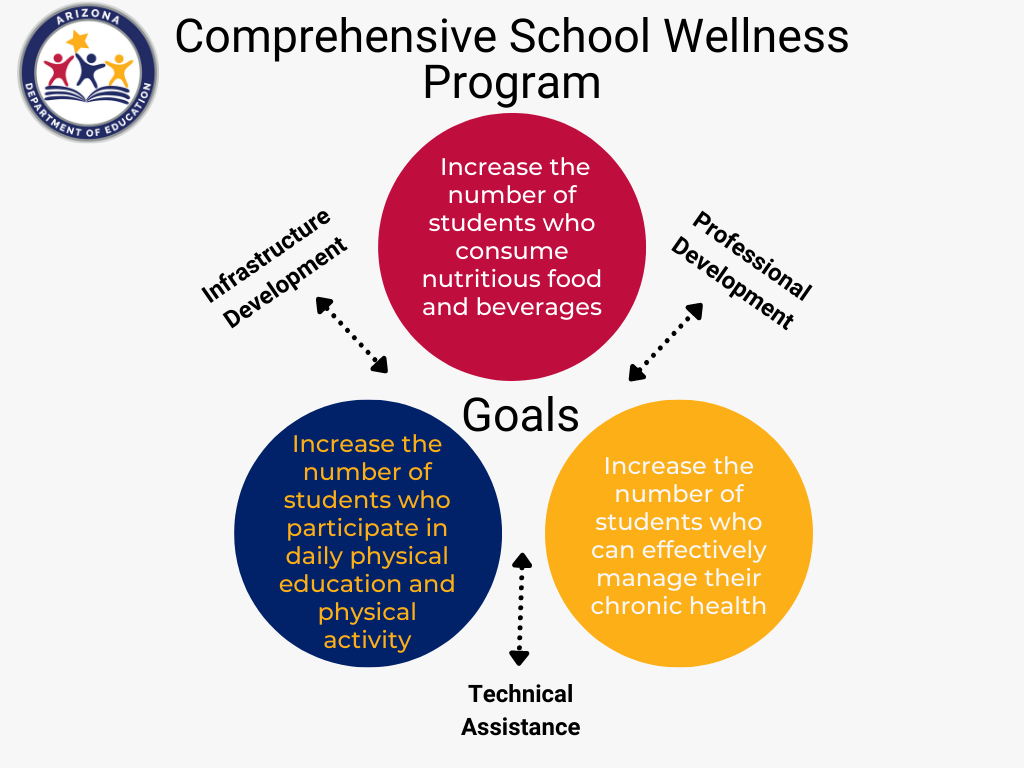
ADE works along three strategies to provide 1801 grant activities: infrastructure development, professional development, and technical assistance.

Infrastructure Development works to create a health-aware infrastructure among all regions of Arizona to support, assess, and develop health-promoting best practices and strategies that improve physical activity, nutrition, and the management of chronic conditions in schools. This directly enhances a student's social, emotional, and physical well-being. To do this, the CSW Program encourages schools to utilize the School Health Index, to assess and create supportive school environments.  In addition, Local School Wellness Policy guides local education agencies and school districts to create supportive school nutrition and physical activity environments. 

Professional Development activities promote school health by offering continuing education on important health topics. ADE delivers and partners with state agencies and local organizations to implement strategies that promote a healthy learning environment. In addition, ADE spreads awareness of the opportunities available to out-of-school health staff and officials.  Through professional development activities, ADE utilizes the WSCC model to develop training that utilizes school health tools and resources, while highlighting the connections between school health and academic achievement.

Technical Assistance is provided to all schools, districts, and LEAs across the state, free of charge. Our team works with school leaders to support and provide guidance on the health and wellness needs of their staff, students, and community through the development of CSW activities.

Complete the online Technical Assistance Request form and our team will contact you!

Technical Assistance Request

 1801 Grant Cross-Collaboration 

To effectively work throughout the state, ADE works alongside internal state partners and external community partners to provide support.  

  1. ADE’s Title IVA Safe and Healthy Students Program aims to provide support to schools and local education agencies (LEAs) so that every student can experience a safe, healthy, and supportive learning environment through a focus on physical and mental health, and safety. 
  2. The 1801 grant works in conjunction with Arizona school nurses and health staff in efforts to manage the prevalence of chronic disease in schools. Please visit the School Nursing and Health Staff webpage for more information on supporting health office staff and students managing their own chronic conditions. 
  3. ADE holds a collaborative partnership with the Arizona Department of Health Services (ADHS) which provides nutrition and physical activity support through AZ Health Zone.  AZ Health Zone focuses on supporting communities across Arizona to make healthy changes in homes and neighborhoods, both within the school and the home.

 CDC Healthy Schools 

CDC Healthy Schools works with states, school systems, communities, and national partners to prevent chronic disease and promote the health and well-being of children and adolescents in schools. CDC Healthy Schools supports state education agencies (SEAs) in the implementation and evaluation of evidence-based strategies to prevent and manage chronic health conditions prevalent in student populations.

CDC Healthy Schools

The CDC Healthy Schools website provides many resources that can be of use to schools across Arizona. 

Local Wellness Policy:  Local School Wellness Policy | Healthy Schools | CDC

School Health Guidelines: School Health Guidelines | Healthy Schools | CDC

School Health Index: School Health Index: A Self-Assessment and Planning Guide (cdc.gov)

School Nutrition: School Nutrition Environment | Healthy Schools | CDC

Video Training: Comprehensive School Physical Activity Programs: A Guide for Schools (cdc.gov)

Recess Planning in Schools: Recess Planning in Schools: A Guide to Putting Strategies for Recess into Practice (cdc.gov)

Out of School Time: Out of School Time (cdc.gov)

Chronic Health Conditions: Chronic Health Conditions in School Settings (cdc.gov)

School Health Services: School Health Services | Healthy Schools | CDC

Parents for Healthy Schools:  Parents for Healthy Schools | Healthy Schools | CDC

CDC’s Virtual Healthy School (VHS) is an interactive tool that shows schools how to support the health and academic achievement of students through a coordinated effort. 

The CDC Virtual School can provide examples within the school environment that allow for students to improve their dietary and physical activity behaviors and manage their chronic health conditions. Click the link below to navigate through a virtual healthy school! 

Virtual Healthy School

 Arizona School Health & Wellness Coalition

School Health and Wellness Coalition

The Arizona School Health and Wellness Coalition (ASHWC) is a collaboration of key school health stakeholders, state and local organizations, community members, parents and individuals whose primary goal is to assist schools in creating healthy school environments and communities. ASHWC serves as an organized platform that provides a voice to those who are passionate about school health. It promotes the multi-disciplinary approach to school health. 

Contact:

Email: [email protected]    

Website: https://www.azschoolhealth.com/

Contact the AZ School Health and Wellness Coalition

 School Spotlight 

The Comprehensive School Wellness (CSW) Program wants to highlight the amazing work that happens each day around our schools in Arizona. Positive school health environments include those coordinating policy, process and programs to ensure students are safe, healthy, engaged, supported, and challenged. We encourage you to nominate Arizona schools through the School Spotlight Nomination, As we continue through the year, the CSW Program is excited to share all of the dedication that goes into the work of our schools each day.

See what schools across Arizona are doing and gain inspiration for your own school health initiatives through a School Spotlight!

School Spotlight Form

Additional School Resources

The Comprehensive School Wellness Program is here to support your school. Through incorporating evidence-based health practices, we can ensure sustainability for healthy initiatives. There are many resources available to help guide the effective incorporation of health initiatives in schools.

Upcoming Professional Development Opportunities

We strive to provide ample opportunities to build knowledge that supports student health and academic acheievement.  We encourage participants to attend events for the opportunity to engage, connect, and receive credible resources from around the nation. Please view the upcoming trainings, webinars, conferences and/or other professional development events offered. 

 May 4th, 2023: In-Person Profressional Development with the Online Physical Eduation Network 

In celebration of National Physical Education and Sports Week, the Comprehensive School Health and Wellness Program at the Arizona Department of Education will be hosting a free in-person training with the Online Physical Education Network, OPEN! This training will provide individuals with teaching and learning resources aligned to the Arizona Standards for K-12 for Physical Education.

Details of the training:

When: May 4th, 2023|Secondary : 8 am – 11 am, Register here. | Elementary: 12 pm – 3 pm, Register here.

Where: The Salvation Army Kroc Center | 1375 E. Broadway Road, Phoenix, Arizona 85040 

What: This is an activity-based session - come prepared and ready to move! Every OPEN instructional module includes research-based teaching tools such as academic language resources, Marzano academic rigor strategies, and universal design strategies. Activities and associated resources will be aligned to the Arizona Standards for K-12 Physical Education and SHAPE America standards at the elementary, middle, and high school levels.  

Attendees will receive: Each attendee will receive an equipment piece modeled in the OPEN training.

Target Audience: Elementary and Secondary Physical Educators across Arizona. 

View the Flyer to Register

Comprehensive School Wellness On-Demand Opportunities 

We strive to provide ample opportunities to build knowledge that supports student health and academic achievement. On-demand learning can allow for easy access to great resources and information at your convenience. Each time the CSW program hosts a webinar, the recording and slides will be placed here. Please see below past profressional development webinars. 

Youth Substance Use in Arizona: Current Trends and Prevention Practices to Mitigate Risk

The ADE Comprehensive School Wellness Program hosted free virtual discussion on Youth Substance Use In Arizona on October 24, 2022 from 3:00-4:30 PM MST. 

Topic: Youth Substance Use in Arizona: Current Trends and Prevention Practices to Mitigate Risk

Objectives of the Webinar:

  1. Learn more about substance use trends among Arizona youth.
  2. Explain common risk factors for substance use and know what to look for when someone needs help.
  3. Gain resources to help keep youth safe and/or obtain treatment when they need it. 
  4. Gain resources on prevention practices that effectively mitigate risks associated with youth substance use.

Target Audience: K-12 school nurses and mental health professionals. Anyone interested in learning more about youth substance use is welcome!

Please see below for the webinar recording and slides. 

Webinar Recording

Webinar Slides

Webinar Recording Passcode:  GN#%?5qp

 School Health Resources Information Series 

Welcome to the Comprehensive School Wellness Program's three-part information series on school health resources that support improving and enhancing your school health environment. During each of these videos, you will have the opportunity to learn about forming a school health advisory council (SHAC), completing the school health index (SHI), and planning for improvement.

Building and Maintaining A School Health Advisory Council (SHAC)

In this video, we will discuss the involvement of the school health advisory council, or SHAC, and how they can best be sustained to further school health initiatives and enhance the school health environment.

Completing the School Health Index (SHI)

In this video, we will discuss completing the school health index, or SHI, and how the SHI can be used to facilitate a team-driven approach to assessing and improving school health policies and practices.

Planning for Improvement

In this video, you will learn about an improvement plan and how it allows your school to review recommendations, monitor progress, and identify low-cost to no-cost changes that enhance the school's health environment. 


 Trauma Informed Approaches Webinar Series 

Throughout the year, the Comprehensive School Wellness Program, in collaboration with AZ Health Zone, hosted a four-part webinar series on Trauma-Informed Approaches to Physical Activity and Nutrition. Please see below to access each recorded session. 

Session 1: Nourishing the Whole Child: Trauma Informed Approaches to Nutrition and Health Promotion and Engagement

Session 2: Trauma Informed Approaches to Nutrition and Health Promotion and Engagement

Passcode: c=9bGm-#

Session 3: The Language of Health: Trauma Informed Approaches to Messaging Part 1

 Passcode: T%pFvD2%

Session 4: The Language of Health: Trauma Informed Approaches to Messaging Part 2

Passcode: LH!4kBf+

Comprehensive School Physical Activity Programs Webinar

On December 7th, from 4:00 PM to 5:00 PM, the Arizona Department of Education invited teachers, health educators, and school administrators to a free discussion on the Comprehensive School Physical Activity Program (CSPAP). During this, we talked about CSPAP, which is a multi-component approach by which school districts and schools use all opportunities for students to be physically active, meet the nationally-recommended 60 minutes of physical activity each day, and develop the knowledge, skills, and confidence to be physically active for a lifetime. A CSPAP reflects strong coordination and synergy across all of the components: physical education as the foundation; physical activity before, during, and after school; staff involvement; and family and community engagement. This session will provide an overview of the CSPAP, including implementation strategies that include social-emotional learning and possible funding sources.

Please see below to access the recording. 

Comprehensive School Physical Activity Programs Webinar Recording

Passcode: K^zJWB5j

Comprehensive School Physical Activity Programs Webinar Slides

 A Holistic Approach to Family-School Partnerships 

On March 9th, 2023 from 3:30 to 4:45 PM, the Arizona Department of Education hosted a free discussion, A Holistic Approach to Family-School Partnerships, led by the Arizona State University REACH Institute. Research overwhelmingly demonstrates that involving families in educational partnerships is essential to student success. Approaching this work through a holistic lens is critical for creating and sustaining positive relationships between schools and families. This session focused on the benefits of these partnerships, the challenges of engaging families, and strategies to facilitate family engagement. A holistic approach encompassing a culturally responsive and trauma-informed framework was highlighted.

Objectives: Gain an understanding of the critical value of creating and maintaining positive family-school partnerships to promote student success; Articulate an understanding and engage in practices to work with students and families from a sociocultural perspective; Increase their knowledge of tangible strategies with which to engage families and students; Recognize contextual factors that impact family-school partnerships.

View the Recording

Passcode: ^=0H0adj

Continue to Stay up To Date on All Comprehensive School Wellness Professional Development Events!

Through the CSW calendar, you have the ability to save these events to your personal calendar. We encourage you to check regularly as Professional Development events are added on a recurring basis. 

  Meet the Team

The Comprehensive School Wellness team is composed of many Arizona school health champions. Through the inclusion of the 1801 grant, this team is lucky to partner with talented individuals that represent different perspectives of school health. This includes a AZ Health Zone School System Specialist from the Arizona Department of Health Services, an evaluation team from Arizona State University and a School Nurse Health Consultant; in addition to the Comprehensive School Wellness team. 


CSW Team

Michelle Cabanillas: Michelle serves as the Co-Director for the School Safety and Social Wellness Programs at ADE. Michelle directly supervises the 1801 grant and the Comprehensive School Wellness Program, as well as other wellness programs to include Project AWARE and the School Safety Program. She is a graduate of the School of Social Work at Arizona State University, where she earned a Master of Social Work with a concentration in Planning, Administration, and Community Practice.

CSW Team

Samantha Reeves: Samantha serves as the School Health and Wellness Specialist, focusing on the Comprehensive School Wellness Program and supporting School Nursing and Health Services. Through this, Samantha supports the 1801 grant and improves physical activity, nutrition, and the management of chronic conditions across Arizona schools. She is a native of Arizona, in where she received her Bachelors of Public Health and Master of Public Health from the University of Arizona, Beardown!  

Contact Us

Want to bring the CSW Program to your school?  Click below to email us your questions!

Contact Us

Welcome to School Safety

Welcome to School Safety


An image of many hands with a banner that says School Safety

The School Safety Mission

The School Safety Unit supports, promotes, and enhances safe and effective learning environments. Our vision is to be a leading force in promoting safe and healthy schools through strong partnerships and collaborative efforts, committed to prevention-focused initiatives that foster a culture of safety, wellness, and resilience. 

Who are we?

Our Unit is comprised of the School Safety Program and School Safety Partnerships and Health Programs. Together, we work collaboratively to create and maintain safe, supportive, and healthy learning environments. By integrating safety initiatives with health and wellness strategies, we ensure a comprehensive approach to school safety. Our team partners with schools, families, law enforcement, and community organizations to promote prevention, preparedness, and positive outcomes across all campuses. We are committed to fostering environments where students feel secure, supported, and empowered to thrive. 

School Safety Program 

School Safety Partnerships and Health Programs (School Nursing, Mental Health & Wellbeing, Preparedness)