Path
oie
Contact
Contact name or title
General Inbox

Arizona's Post-Secondary Native Education Programs

Resources for Teachers and Educational Leaders

Resources for Teachers and Educational Leaders

Please click on the drop-down menus below to view resources. 

If you need assistance with specific resources, please email [email protected]. 

 Culturally Relevant Curriculum and Instruction

 Virtual Data Training (2023, 2024)

Part 1 | November 2023

This session will provide participants with the opportunity to identify multiple sources of data that can be used, distinguish multiple types of data that can be collected, and use data to evaluate grant program progress and provide evidence of impact.

Part 2 | February 2024

This session will provide participants with the opportunity to organize and clean multiple data sources, use multiple approaches to analyze data, and support data-driven decision-making for grant projects, programs, and initiatives.

Part 3 | April 2024

This session will provide participants with the opportunity to understand and visualize data, select appropriate visualizations, and learn design principles for effective visualization.

Recordings of this series can be found on the OIE Virtual Data Series Padlet 

Professional Learning Opportunities from External Organizations

 National Center for Research on Evaluation, Standards, and Student Testing (CRESST) and WestEd

 From the University of Arizona 

 National Indian Education Association (NIEA) 

Native American Code Writer's Project

Native American Code Writer's Project

Per SB 1505, the primary goal of the Native American Code Writers Program (NACWP) is to introduce computer code writing curriculum and deliver a technology-focused education to better engage Native American high school students. The Computer Science (CS) content is designed to help students think critically, problem-solve, and work with technology integration by using app development, gaming, website design, multimedia, cyber security and robotics.

The initiative is designed to address the education and workforce preparation of Native youth not only in Arizona, but across the nation. The NACWP provides for a highly integrative series of four, year-long computer science high school courses, strategically integrated with business and industry mentoring, shadowing and internship experiences. Participating students acquire the knowledge and skills required for information technology, industry certification and/or matriculation into higher education computer science and information technology degree programs.

 Brief History

The Code Writers Initiative Pilot Program for Native American students in Arizona began in 2016 with a substantial award to Science Foundation Arizona (SFA) for school year 2016-2017 implementation. After a successful pilot, the program was renamed the Native American Code Writers Program (NACWP), and in 2018, the grant was renewed and awarded additional funds to continue the NACWP through SB 1505.

  • Read SB 1505 to learn more about the revised statue that supports this program

Tribal Education Department (TED)

Tribal Education Department (TED)

Tribal Education Departments (TEDs) are departments within tribes that assist with addressing multiple aspects of a child's education, including but not limited to health and nutrition, safety and wellness, heritage language, cultural practices, and family engagement. TED staff members administer their tribal education systems to meet the unique needs of their students - they know their children and communities best. Thus, it is imperative that TEDs are consulted and utilized as an effective resource when seeking assistance or guidance on how to best support the academic needs of Native American students.

 Tribe Contact Information
ak-chin tribal seal
 Ak-Chin Indian Community 

Mario Molina 

[email protected]

cocopah tribal seal
 Cocopah Indian Tribe 

Wynnie Ortega

[email protected] | (928) 627-4973

colorado river indian tribes CRIT seal
 Colorado River Indian Tribes 

Michael Drennan, Jr.

[email protected] | (928) 669-8831

fort mcdowell yavapai nation tribal seal
 Fort McDowell Yavapai Nation 

Dr. Victoria Corlett

[email protected] | (480) 789-7229

fort mohave indian tribe seal
 Fort Mojave Indian Tribe 

Christina Cameron-Otero

[email protected] | (928) 346-1121

gila river indian community tribal seal
 Gila River Indian Community Sherilyn Analla

[email protected] | (520) 562-3662

havasupai tribe seal
 Havasupai Tribe* 

Vice Chairman Armando Marshall

(928) 448-2731

Hopi flag
 Hopi Tribe* Noreen Sakiestewa

[email protected] | (928) 734-3501

hualapai tribe seal
 Hualapai Tribe 

Jonell Tapija

[email protected] | (928) 769-2200

kaibab band of paiute indians tribal seal
 Kaibab Band of Paiute Indians 

Amanda Bundy

[email protected] | (928) 871-7466

navajo nation tribal seal
 Navajo Nation 

Claudia Russell-Edgewater

[email protected] | (928) 871-7475

pascua yaqui tribe seal
 Pascua Yaqui Tribe 

Sarah Pendergrass

[email protected] | (520) 879-5707

pueblo of zuni tribal seal
 Pueblo of Zuni 

Bernadette Panteah

[email protected] | (505) 782-5998

quechan indian tribe seal
 Quechan Tribe Cyrus Ramirez

(760) 572-5268

salt river pima-maricopa indian community tribal seal
 Salt River Pima-Maricopa Indian Community

Miranda Johnson-Moya

[email protected] | (480) 362-2588

San Carlos Apache Tribe seal
 San Carlos Apache Tribe 

Flora Talas

[email protected] | (928) 475-2336

San Juan Southern Paiute tribal seal
 San Juan Southern Paiute Tribe 

Keenan Barlow

[email protected] | (928) 212-9794

Tohono O'odham Nation tribal seal
 Tohono O'odham Nation Patrick Andrews

[email protected] | (520) 349-2614

Tonto Apache Tribe seal
 Tonto Apache Tribe 

Christine Zuber

[email protected] | (928) 474-5000

White Mountain Apache Tribe seal
 White Mountain Apache Tribe Derrick Leslie

[email protected] | (928) 338-2572

Yavapai-Apache Nation tribal seal
 Yavapai-Apache Nation 

Leona Wathogoma

[email protected] | (928) 649-7112

Yavapai-Prescott Indian Tribe seal
 Yavapai-Prescott Indian Tribe 

Vacant

(928) 445-8790

* Oversees BIE schools only. There are 2 types of schools monitored by the Bureau of Indian Education: 1) BIE schools (federal entities) and 2) Tribally Controlled Grant Schools (administered by Sovereign Tribal Nations or are under the direction of a Governing Board authorized by Tribal Nations). Neither of these schools are considered a Public School on Tribal Lands nor has reporting requirements to the State Education Agency. However, ESSA Tribal Consultation must still be offered by applicable LEAs, /oie/tribal-consultation.

References:

UA Native Peoples Technical Assistance Office 

Frequently Asked Questions for Tribal Consultation

Frequently Asked Questions for Tribal Consultation

 When are Affirmation Forms Due?

Although grant applications are open for preliminary allocations, tribal consultation forms for public schools, do not need to be submitted on May 1st. All forms are due prior to the first grant revision thus allowing time to incorporate tribal feedback.

This deadline is referenced on the Affirmation Form in the agreement section as shown below:

Tribal Consultation Frequently Asked Questions reference

Please use the button below to be directed to the form:

Affirmation Form

 Do LEAs need to consult with tribes if they do not have any students enrolled from these tribes? 

Yes. Tribal consultation is based on building relationships to help support Indigenous students. Student enrollments fluctuate over the years.  When you consider the Title grants covered under ESSA consultation and the specific needs these grants address, they go beyond tribal membership. Tribes may have resources or best practices to assist the LEA in supporting all Indigenous students (migratory, at risk, English learner, etc.).

If an LEA does not have any students enrolled from a tribe, it is most likely the tribe will choose to opt out of tribal consultation, but the tribe needs to be given the option to do so.  In that case, the authorized tribal representative would check the "Tribal opt out option" box on the Affirmation of Tribal Consultation form and sign. 

However, an LEA may find that these tribes have valuable resources that could support the LEA's Title grant programs.  Particularly if you review the list of other LEAs these tribes are consulting with (Affected LEAs section, Tribes and Affected LEAs link). There could be best practices the tribe uses with other LEAs that may be applicable to your organization.  The intent of consultation is to open dialogue and identify all options for supporting our students.

 How do I contact the tribe for consultation? 

Contact information for the tribes can be found using the button below. Please contact us if you need assistance working with the tribes.

Tribal Education Department Contacts

  I am new to tribal consultation, where do I begin? 

The best place to start is with the Tribal Consultation Guide. The next step would be to review the training section of the website.  In addition, the OIE staff is available to provide virtual training with an organization's team. If interested, please contact the Tribal Grants Specialist, Brandon at [email protected].

 Are affected LEAs required to consult with a tribe that has "BIE Schools only"?

Yes, consultation is still required. The Local Educational Agency (LEA) may have students enrolled, such as the Hope Tribe.  In addition, if the Hopi Tribe is within the tribal consultation service area of the LEA, it is a Federal requirement to consult with the tribe. Consultation can only be dismissed if the tribe opts out.  Click the button below to read the tribal consultation requirements:

Tribal Consultation Requirements

The note regarding "BIE schools only" for the Hopi Tribe, identifies that there are only Bureau of Indian Education (BIE) schools on Hopi's tribal land.  The Hopi Tribe does not have any public schools on its reservation.

Tribal Enrollment for Arizona Students

Tribal Enrollment for Arizona Students

Identification matters for our communities

Now more than ever, as we strive to strengthen tribal sovereignty and have accurate representation in the U.S. Census, we must ensure Native American students have greater visibility in schools, treaty obligations are fulfilled, and programs designed to meet the needs of Native students are appropriately funded and directed.

Tribal enrollment helps support Native American students

American Indian and Alaska Native students are eligible to receive unique educational support from a variety of programs. However, many Native students do not receive the services they need and qualify for—simply because they are not identified as American Indian or Alaska Native.

Properly identifying Native youth helps ensure appropriate program funding, uphold treaty obligations, and track student achievement. It also suggests how to create school- or district-wide engagement plans for reaching out to Native American families and caregivers. The companion family resource guide, Native Youth Count can help clarify the circumstances in which Native students are eligible for different services.

Who can I reach out to for support with Tribal enrollment? 

Each individual tribe has different tribal enrollment policies, processes, and timelines. Please contact your tribe's tribal enrollment and/or records department for additional information. 

Common questions

What if the student is not enrolled in a tribe?  

Students up to two generations removed from a family member still qualify for many programs and services. Check with your district’s Title VI coordinator to explore available support.

What if the student doesn’t go to a school with an Indian Education program or is not receiving the supports requested? 

Students may qualify for services and benefits outside of Indian Education programs. Contact your district’s Indian Education director/staff or school administrator for support. You may also reach out to [email protected]. 

  What if the student is identified as an English learner student but speaks only English at home?

If a heritage language affects a student’s learning, regardless of what is spoken at home, the student may qualify for Title III/English learner support. Discuss options with your school’s Title III coordinator.

 When do I need to think about this?

You can start the conversation about identification anytime. Notably, it should be considered at the beginning of the school year or when you move.

OIE Connect (Webinar)

OIE Connect (Webinar)

The Office of Indian Education hosts a recurring virtual convening entitled OIE Connect (formerly Policy & Program Updates for Indigenous Stakeholders).

Purpose: Provide updates, resources, and information to support and strengthen collaboration among parents, educators, school staff, and Indigenous communities to advance the success and well-being of Native American students. 

Next OIE CONNECT:

Calendar Icon_OIE

Date: November, 9th 2026

Time: 3 PM - 4 PM (MST)

Presenter 1: ADE Johanna Kaiser

Presenter 2: Anthony Gray, Gila River Indian Community (GRIC) Culture and Language Program


virtual meeting icon_OIE

Please register to receive the Zoom link. 

November 9, 2026 Webinar Registration 

Announcement Icon_OIE

Subscribe to receive reminders!

Join Listserv

Johanna Kaiser, ADE K-12 Science Education Specialist

Headshot of Johanna Kaiser, Arizona Department of Educaiont

Integrating Local Phenomena and Indigenous Knowledge into Science Education

Discover how local phenomena and Indigenous knowledge can be used to create engaging, culturally relevant science learning experiences. This presentation will explore approaches that connect science instruction to students' communities, cultures, and lived experiences while supporting meaningful STEM learning.

Website: Arizona Science Standards | Department of Education

Anthony Gray, GRIC Tribal Education Culture and Language Program Manager

Headshot of Anthony Gray, Gila River Indian Community Culture and Language Program Manager

Cultural and Language Programs Supporting Indigenous Communities

Learn about how the GRIC cultural and language program help preserve Indigenous traditions, strengthen community connections, and support student success. This presentation will highlight the role of cultural and language programs in education.

Website: GRIC Cultural Program Home


Registration updates for 2026:

Beginning in January 2026, we will no longer provide a recurring meeting link. In order to access webinars in 2026, participants will have to register with their name and email address. After registration, you will receive the meeting link in your email. Feel free to join us for one or all webinars! You will receive a reminder email on the morning of our webinars. 

For scheduled presenters: Use the Zoom meeting registration above to receive the meeting link. Please log on by 2:50PM. Notify OIE staff if you have any issues.

Are you an education program or organization with available support, resources, or free events available for Arizona educators or Native American communities and want to present at an upcoming webinar? Email [email protected].

2026 Virtual Convenings

Webinar resources will be provided below. 

September 14th, 2026

April 20, 2026 

March 16, 2026 

February 23, 2026

January 26, 2026


    Policy & Program Updates Archives

     2025 Policy & Program Updates 

    December 15, 2025

    November 17, 2025 

    October 20, 2025

    September 15, 2025

    August 18, 2025

    July 21, 2025

    June 23, 2025

    May 19, 2025

    April 21, 2025 

    March 17, 2025 

    February 24, 2025 

    January 27, 2025 

     2024 Policy & Program Updates 

    January 22, 2024

    February 26, 2024 

    March 18, 2024

    April 15, 2024

    May 20, 2024

    June 24, 2024

    • OIE Slide Deck
    • Center for Indigenous Empowerment (University of Arizona) & Arizona School Board Association

    July 15, 2024

    August 19, 2024

    September 23, 2024

    October 24, 2024

    November 18, 2024

    December 9, 2024

    Understanding Tribal Regalia Protections at Graduation

    Understanding Tribal Regalia Protections at Graduation

    Arizona Revised Statute §15-348 protects the right of Native American students to wear traditional tribal regalia and objects of cultural significance during graduation ceremonies. School districts and charter schools may not prohibit students who are members of, or eligible for enrollment in, a federally recognized tribe from wearing tribal regalia, including eagle feathers and eagle plumes. A.R.S. §15-348 became effective April 20, 2021.


    Tribal Regalia Graduation Toolkit Resource Library Banner

    The Toolkit Library provides resources for students, families, schools, districts, governing boards, and the education community to support successful graduation planning and implementation of Arizona's tribal regalia protections.

    Resources for Students & Families


    On April 9, 2025, the Office of Indian Education released the AZ Tribal Regalia Graduation Toolkit for Students and Families, designed to provide valuable resources and guidance to help families and students navigate the wearing of tribal regalia in graduation ceremonies.

    OIE Families Toolkit


    View Student & Families Toolkit

    View PDF Version


    Resources for School/District Administrators & Governing Boards

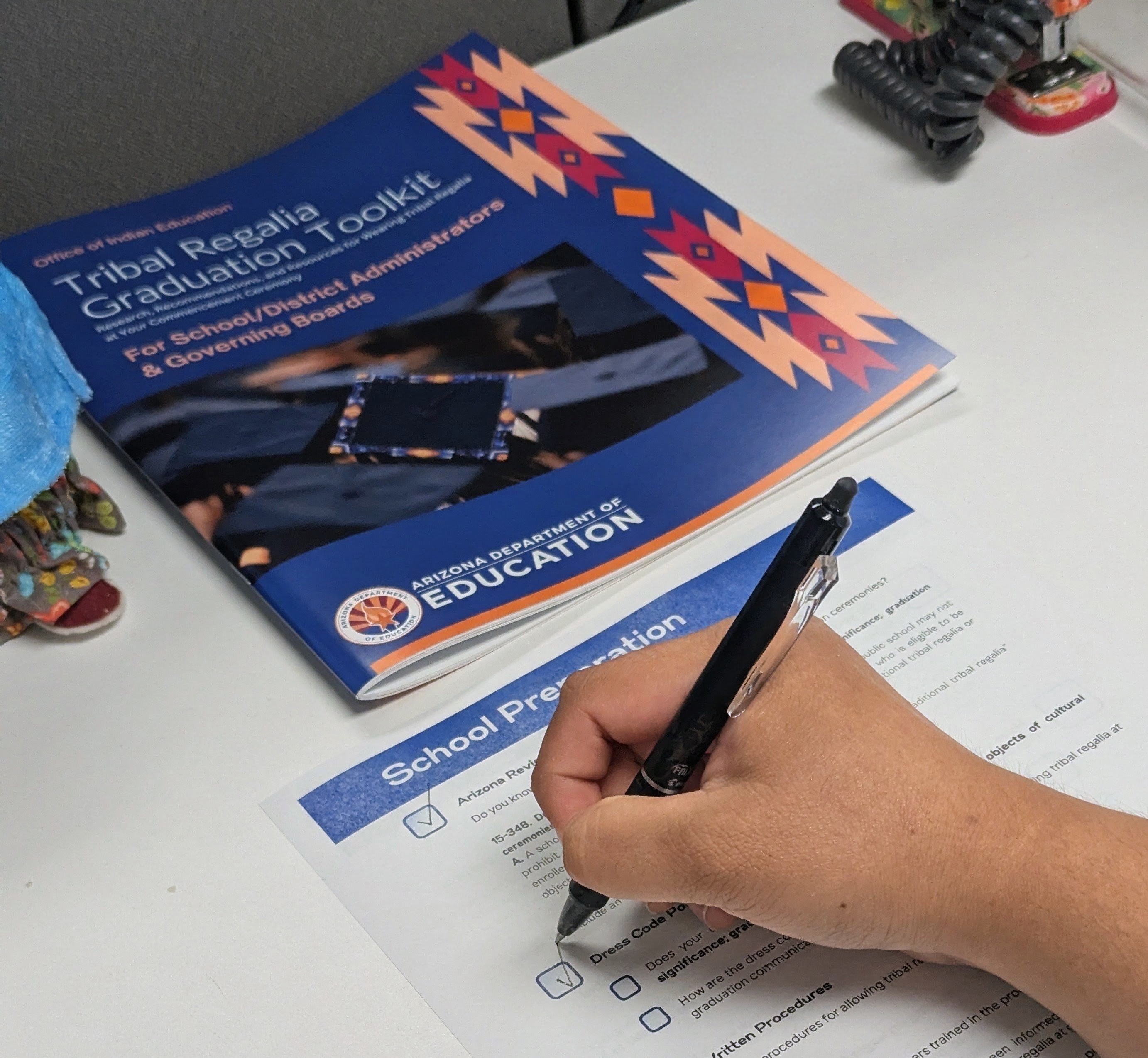
    On April 17, 2025, the AZ Tribal Regalia Graduation Toolkit for School/District Administrators and Governing Boards was released to provide additional guidance around procedures for the wearing of tribal regalia at graduation. Both toolkits have been created at the request of Arizona's tribal nations and Superintendent of Schools, Tom Horne.


    Toolkit LEA image


    View Administrators and Governing Boards Toolkit

    View PDF Version

    View Toolkit FAQ's


    Help your school community better understand tribal sovereignty, Native American student rights, and Arizona's Tribal Regalia Law. Explore our collection of free printables, including trifold brochures, one-page handouts, and classroom talking points designed to spark meaningful conversations and build awareness. Simply download, print, and share to help ensure everyone understands why Native American students have the right to wear tribal regalia and objects of cultural significance at graduation.


    Professional Learning Hub Banner

    Take your learning to the next level with live webinars and on-demand training focused on tribal regalia at graduation. Explore practical strategies, legal guidance, and ready-to-use resources that help schools, families, and communities support Native American students preparing for graduation ceremonies. Learn at your own pace or connect with colleagues through interactive live sessions.

    Tribal Regalia Graduation Toolkit Webinar Series 


    Image of the Toolkit and checklist


    A Year of Preparation, A Day of Celebration: Planning for Tribal REGALIA AT GRADUATION

    The Office of Indian Education is launching a Tribal Regalia Graduation Toolkit Webinar Series, a four-part professional learning opportunity designed to help schools, districts, and families support Native American students as they prepare for graduation. The series focuses on understanding tribal regalia protections, strengthening communication, and ensuring students can celebrate their achievements in accordance with Arizona law.

    Participants will explore Arizona tribal regalia laws, school and family responsibilities, graduation planning strategies, and resources from the Tribal Regalia Graduation Toolkit library. The webinars are scheduled throughout the school year, providing timely guidance from preparation in the Fall to reflection and future planning in the Spring.


    RECORDING: Webinar #1|Beginning with Understanding: Tribal Sovereignty, Arizona Law, and Graduation Planning (Available until 11/02/26)


    Tribal Regalia Graduation Toolkit Webinar Square

    TRGT 101: What You Need to Know About A.R.S. 15-348 & Arizona's Tribal Regalia Graduation Toolkits

    This webinar provides an overview of the Toolkits and best-practice recommendations, as well as guidance for training staff and volunteers on A.R.S. §15-348 prior to graduation. OIE offers this brief, easy-to-follow webinar at no cost to participants. Upon completion, attendees earn 1 Continuing Education Unit (CEU).

    Register for the course through ADE Connect and the Arizona Professional Learning & Development (APLD) platform.

    Create an ADE Connect account or access your existing account. These instructions provide step-by-step details and lead you to the APLD section required to register for the webinar.


    MEDIA

    Video - Arizona School Boards Association 

    What School Boards should know about tribal regalia at graduation. Under A.R.S. 15-348, school governing boards may not prohibit students who are members of, or eligible to be enrolled in, a federally recognized tribe from wearing tribal regalia or items of cultural significance, including eagle feathers, during graduation ceremonies. School board members play a crucial role in ensuring their district's policies and practices support both compliance and respect. The toolkit also underscores the importance of training staff and volunteers, particularly in the handling of eagle feathers, which are protected under federal law and cannot be removed by school personnel. 

    Video from ASBA: Your Guide to the AZ Tribal Regalia Graduation Toolkit 


    National Recognition 

    On October 9, 2025, OIE Professional Learning Specialist, Elaine Mollindo, was awarded the Community Service of the Year Award from the National Indian Education Association for her work on creating the AZ Tribal Regalia Graduation Toolkits. Listen to her acceptance speech below! Congratulations Elaine! 

    ``

    Title VII Funding - Impact Aid

    Title VII Funding - Impact Aid

    Impact Aid is Federal funding provided directly to school districts to make up for lost tax revenues from federally owned property within their boundaries (i.e., military bases and Indian Reservations). These Title VII funds are managed through the US Department of Education.  Impact Aid should not be considered extra funding, but funding that is provided  to equalize districts who do not receive tax realated revenues like other districts receive.

    Impact Aid Overview Infographic

    Resource Links

    About Impact Aid - National Association of Federally Impacted Schools

    - Frequently Asked Questions - Impact Aid Parent-Pupil Survey

    US Department of Education - Impact Aid Program

    ADE School & Student Data Resources

    Impact Aid Regulation - US Department of Education

    - Impact Aid Resources

    Beware Name Change - Title VII vs Title VI 

    There have been changes in the title programs that can cause some confusion. So it's important to understand the historical changes and to double check that everyone is referring to the same program.  

    Prior to 2017, the Title VI grant of today - Indian, Native Hawaiian, and Alaska Native Education grant, had the roman numeral identification VII with the same heading - Indian, Native Hawaiian, and Alaska Native Education. This numbering changed to VI under the new ESSA law (Every Student Succeeds Act).

    In other words, today's Title VI grant was previously known as Title VII, Indian, Native Hawaiian, and Alaska Native Education. However, after 2017 this grant became Title VI, with the same name. 

    To clarify further, Title VII now refers to Impact Aid funding. 

    It is beneficial for anyone working with these grants to double check when talking with stakeholders to make sure everyone is referring to the same grant.

    Professional Learning & Resources

    Professional Learning & Resources

    Join the OIE PL Listserv | CLICK HERE Resource: PL Padlet

    Per requirements in A.R.S. 15-244, Indian Education Act, the Office of Indian Education provides technical assistance to schools and tribal nations to meet the educational needs of Native American students, including the planning, development, implementation, and evaluation of curricula and instruction that are culturally relevant and aligned to state standards, and family and community involvement in the education of Native American students.

    Professional Learning from the Office of Indian Education:

    We compile our professional learning opportunities, such as webinars and recordings, online courses, and upcoming in-person events here. They are available to all educators in Arizona. Additionally, we have gathered free educational resources from tribal, local, state, and national organizations that can be used in classrooms and schools serving Native American students.

    2025 Indigenous Literacy project

    Stay tuned for details about the Fall 2025 Indigenous Literacy Project! We are working diligently to bring educators and unforgetable experience filled with learning and networking. Please check back soon for more information. 

    2025 Indigenous STEM Project 

    Thank you to those who attended and participated in our 2025 Indigenous STEM Symposium! Did you miss the virtual events? Visit the additional resources below to view recordings from the Indigenous STEM Educators Showcase and the STEM Professionals Panel! 

    Thank you to the following organizations!


    Additional OIE resources

     Previous Professional Learning Events 

    • Indigenous STEM Project 2025  
      • STEM Educators Showcase (virtual) - March 25, 2025
      • Indigenous STEM Symposium at Arizona Science Center - April 27-28, 2025
      • STEM Professionals Panel (virtual)- May 6, 2025
      • Thank you to the following for making this event possible: Arizona Science Center, Arizona Humanities, SRP, Indigenous Resilience Center, and the Office of Societal Impact at the University of Arizona. 
    • Integrating Indigenous Perspectives in K-12 Classrooms with Tribal Nations in Arizona

    The Office of Indian Education regularly partners with Tribal Nations in Arizona to co-host free, in-person trainings open to any educators in the region. We invite school districts who are interested in this training to reach out to [email protected]

    Previous Trainings

    • Prescott Area with Yavapai-Prescott Indian Tribe | Fall 2023 | Slide Deck
    • Verde Valley Area with Yavapai-Apache Nation | Spring 2024 | Slide Deck
    • Summer Social Studies Seminar Series in collaboration with ADE K-12 Social Studies | Summer 2023 
      • Indigenous Perspectives (K-5) 
      • Tribal Sovereignty (K-12) 
      • Indigenous Perspectives (6-12) 
      • Tribal Sovereignty (K-12) 
      • NOTE: If you're interested in viewing recordings and resources for this series, use the links below from Summer 2022
    • K-12 Educator Night: Teaching Academic Standards with Indigenous Storytelling | Spring 2023  
    • Teaching Tribal Sovereignty in K-12 Classrooms | Spring 2023
    • Changing the Narrative: K-12 Indigenous Literacy and Literature Symposium | Annual Fall Event

    Changing the Narrative: K-12 Indigenous Language & Literacy Symposium 2022 from Arizona Humanities on Vimeo.

     Virtual Data Training (2023, 2024)

    Part 1 | November 2023

    This session will provide participants with the opportunity to identify multiple sources of data that can be used, distinguish multiple types of data that can be collected, and use data to evaluate grant program progress and provide evidence of impact.

    Part 2 | February 2024

    This session will provide participants with the opportunity to organize and clean multiple data sources, use multiple approaches to analyze data, and support data-driven decision-making for grant projects, programs, and initiatives.

    Part 3 | April 2024

    This session will provide participants with the opportunity to understand and visualize data, select appropriate visualizations, and learn design principles for effective visualization.

    Professional Learning Opportunities from External Organizations

     National Center for Research on Evaluation, Standards, and Student Testing (CRESST) and WestEd

     Indigenous Teacher Preparation Program at the University of Arizona 

     Native Student Outreach, Access and Resiliency (SOAR) at the University of Arizona 

     Native Nations Institute at the University of Arizona 

     National Indian Education Association (NIEA) 

     National Native Children's Trauma Center (NNCTC) at the University of Montana 

     Native Knowledge 360 Initiative from the National Museum of the American Indian at the Smithsonian