Path
oie
Contact
Contact name or title
General Inbox

American Indian Student Needs (AISN)

American Indian Student Needs (AISN)

The American Indian Student Needs (AISN) is a competitive grant for public school districts used for school supplies for federally recognized American Indian students. Interest accrued on the SekvensTrust Fund provides the funding source for this grant.  This grant becomes available once a significant amount of interest has accrued to warrant opening the grant for competition (anticipated in FY25). 

*** Currently there are insufficient funds to open the grant. 

22 Federally Recognized Tribes in Arizona

22 Federally Recognized Tribes in Arizona

There are 22 federally recognized Tribes in Arizona. Most of the tribes have a Tribal Education Department (TED), a Tribal Education Director, or another designated representative. A few tribes solely contain schools that are operated by the Bureau of Indian Education. We have compiled tribal information and community profiles below. 

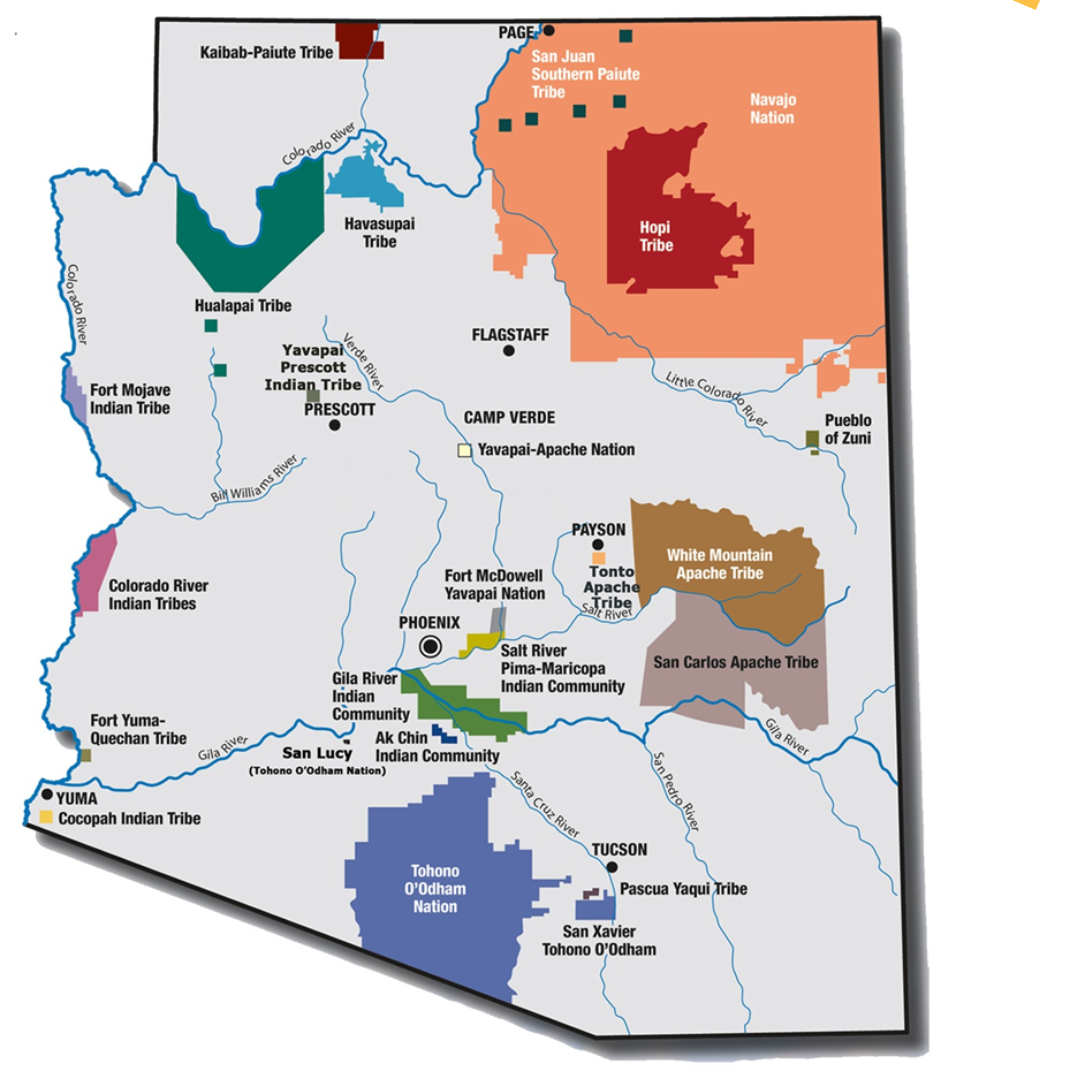
22 Federally Recognized Tribes of Arizona

Source: Map from Southwest Indigenous Women's Coalition (www.swiwc.org)

AZ Tribal Flags & Seals PDF

Information by Tribe

Click the drop-down menus below to view addresses and other information for each Arizona tribe. 

For a PDF version of the Tribal Education Department's contact information, click the button below. (If you are searching for tribal contacts for tribal consultation, please view our ESSA Tribal Consultation page.)

TED Contact List


Ak-Chin Indian Community 

Cocopah Indian Tribe 

Colorado River Indian Tribes

colorado river indian tribes CRIT seal

Address: 26600 Mohave Road, Parker, AZ 85344

Tribal Nation Website: https://www.crit-nsn.gov/

Tribal Education Department Website

Inter-Tribal Council of Arizona Member Tribe

CRIT Community Profile

Fort McDowell Yavapai Nation

fort mcdowell yavapai nation tribal seal

Address: 17661 E Yavapai Rd, Fort McDowell, AZ 85264

Tribal Nation Website: https://www.fmyn.org/

Tribal Education Department Website

Inter-Tribal Council of Arizona Member Tribe

Fort McDowell Community Profile


Fort Mojave Indian Tribe

fort mohave indian tribe seal

Address: 500 Merriman Ave, Needles, CA 92363

Tribal Nation Website: https://www.fortmojaveindiantribe.com/

Tribal Education Department Website

Inter-Tribal Council of Arizona Member Tribe

Fort Mojave Indian Tribe Community Profile

Fort Yuma-Quechan Indian Tribe


Address: 350 Picacho Road, Winterhaven, CA

Tribal Nation Website: https://www.quechantribe.com/

Inter-Tribal Council of Arizona Member Tribe

Fort Yuma-Quechan Community Profile

Gila River Indian Community

gila river indian community tribal seal

Address: 525 W Gu U Ki, Sacaton, AZ 85147

Tribal Nation Website: http://www.gilariver.org/

Tribal Education Department Website

Inter-Tribal Council of Arizona Member Tribe

GRIC Community Profile

Havasupai Tribe

havasupai tribe seal

Schools on Havasupai Tribe lands are operated by the Bureau of Indian Education

Address: 10 Main St, Supai, AZ 86435

Tribal Nation Website: theofficialhavasupaitribe.com/

Inter-Tribal Council of Arizona Member Tribe

Havasupai Community Profile

Hopi Tribe

Hopi flag

Schools on Hopi Tribe lands are operated as Tribally Controlled Grant Schools (P.L. 100-297).

Address: 1 Main St, Kykotsmovi, AZ 86039

Tribal Nation Website: https://www.hopi-nsn.gov/

Tribal Education Department Website

Inter-Tribal Council of Arizona Member Tribe

Hopi Community Profile

Hualapai Tribe

hualapai tribe seal

Address: 941 Hualapai Way, Peach Springs, AZ 86434

Tribal Nation Website: http://hualapai-nsn.gov/

Tribal Education Department Website

Inter-Tribal Council of Arizona Member Tribe

Hualapai Community Profile

Kaibab Band of Paiute Indians

kaibab band of paiute indians tribal seal

Address: 1 N Pipe Spring Rd, Fredonia, AZ 86022

Tribal Nation Website: https://www.kaibabpaiute-nsn.gov/

Tribal Education Department Website

Inter-Tribal Council of Arizona Member Tribe

Kaibab Band of Paiute Indians Community Profile

Navajo Nation

The Navajo Nation observes Daylight Savings Time (DST). During DST, Navajo Nation time corresponds to Mountain Daylight Time (MDT)

navajo nation tribal seal

Address: 2767 Morgan Blvd, Window Rock, AZ 86515

Tribal Nation Website: https://www.navajo-nsn.gov/

Tribal Education Department Website

Navajo Nation Community Profile

The Navajo Nation is not a member of the Inter-Tribal Council of Arizona.

Pascua Yaqui Tribe

pascua yaqui tribe seal

Address: 7474 S Camino De Oeste, Tucson, AZ 85746

Tribal Nation Website: https://www.pascuayaqui-nsn.gov/

Tribal Education Department Website

Inter-Tribal Council of Arizona Member Tribe

Pascua Yaqui Community Profile

Pueblo of Zuni

pueblo of zuni tribal seal

Address: 1203 B State Highway 53, Zuni, NM 87327

Tribal Nation Website: http://www.ashiwi.org/

Tribal Education Department

Inter-Tribal Council of Arizona Member Tribe

Pueblo of Zuni Community Profile


Salt River Pima-Maricopa Indian Community

San Carlos Apache Tribe

San Carlos Apache Tribe seal

Address: US Highway 70 & Moonbase Rd, Peridot, AZ 85542

Tribal Nation Website: https://www.scat-nsn.gov/

Inter-Tribal Council of Arizona Member Tribe

San Carlos Apache Community Profile


San Juan Southern Paiute

Tonto Apache Tribe

Tonto Apache Tribe seal

Address: #30 Tonto Apache Reservation, Payson, AZ 85541

Inter-Tribal Council of Arizona Member

Tonto Apache Community Profile

White Mountain Apache Tribe

White Mountain Apache Tribe seal

Address: 201 E Walnut St, Whiteriver, AZ 85941

Tribal Nation website: https://www.wmat.us 

Tribal Education Department Website

Inter-Tribal Council of Arizona Member Tribe

Tonto Apache Community Profile

Yavapai-Apache Nation

Yavapai-Apache Nation tribal seal

Address: 2400 W. Datsi St. Camp Verde, AZ 86322

Tribal Nation website: https://yavapai-apache.org/

Inter-Tribal Council of Arizona Member Tribe

Yavapai-Apache Community Profile

 Yavapai-Prescott Indian Tribe 

Yavapai-Prescott Indian Tribe seal

Address: 530 E Merritt, Prescott, AZ 86301

Tribal Nation website: https://ypit.com/about_ypit.htm

Inter-Tribal Council of Arizona Member Tribe

Yavapai-Prescott Community Profile

Want to report updated contact or website information? Please email [email protected]. 

Enrollment Information 

Enrolling with your Tribe is an important process to receive broader access to the programs and benefits offered to enrolled Tribal Members. Each Tribe has its own processes for tribal enrollment to determine whether an individual is eligible for membership. Each tribe maintains its own enrollment records and records about past members. The U.S. Department of the Interior has general information on the Tribal Enrollment process, however, to obtain information about your eligibility for membership, you must contact the tribal enrollment department. 

More Enrollment Information

Tribal College Dual Enrollment Program

Tribal College Dual Enrollment Program

The Tribal College Dual Enrollment Program provides Arizona’s high school students the opportunity to take college courses for both high school and college credit. Course costs are free to the student. Participating tribal colleges are reimbursed for tuition and fees associated with participating students. Effective September 24, 2022, the Arizona state legislature passed SB1300, allowing the Arizona Department of Education to reimburse the cost of books and instructional materials. 

Dual Enrollment Flyer

Native American Student Resources:  https://www.askbenji.org/native-student-resources

Postsecondary Pathway Resources | Arizona Department of Education

How It Works

College courses may be counted toward both high school and college graduation requirements. With the help of lottery funds, tribal colleges can be reimbursed for credit hours taken by high school students. Arizona high school districts interested in participating in this program must enter into an agreement with the participating Tribal Colleges. 

  • Diné College, in Tsaile, AZ, 928-724-6922, DC Website

  • Navajo Technical University satellite campuses in Chinle, AZ and Teec Nos Pos, AZ,  505-387-7364, NTU Website

  • Tohono O’Odham Community College, in Sells, AZ, 520-479-2300, TOCC Website

Who It Serves

High school freshmen, sophomores, juniors, or seniors.

 Participating Tribal Colleges 

At this time, accredited tribal colleges in Arizona eligible for dual enrollment funds include:  

  • Diné College,

  • Navajo Technical University 

    • Satellite campuses in Chinle, AZ and Teec Nos Pos, AZ   505-387-7364, NTU Website

  • Tohono O’Odham Community College

San Carlos Apache Indian Reservation’s recently established community college is currently seeking accreditation from the Higher Learning Commission. It could be eligible once accreditation is received. 

Participating High Schools

Public Schools

  • Baboquivari High School 

  • Chinle High School 

  • Ganado High School

  • Kayenta High School

  • Monument Valley High School 

  • Page High School  

  • Pinon High School  

  • Poston Butte High School  

  • Red Mesa High School 

  • San Carlos High School

  • Tuba City High School

  • Window Rock High School 

Bureau of Indian Education (BIE) Schools

  • Greyhills Academy

  • Many Farms High School

  • Tohono O’odham High School 

Other Schools

  • St. Michael Indian School

If your school is interested in participating in the Tribal College Dual Enrollment Program, please contact the tribal colleges listed on this page or e-mail [email protected] or [email protected]. 

Background 

Arizona Revised Statute 15-1821.01 governs the general requirements for dual enrollment in Arizona. 

The tribal college dual enrollment program was enacted in the 2015 Legislative session.  ARS Title 15, chapter 2, was amended by adding section 15-244.01 Tribal College Dual Enrollment Program Fund. ARS 15-244.01 establishes the Tribal College Dual Enrollment Program Fund which receives 15% of unclaimed lottery prize money with a cap at $325, 000 (increase from $250,000 in previous years).  The money is subject to legislative appropriation, meaning that the final budget decides how much of that money can actually be used for Tribal College Dual Enrollment.  The fund is administered by the state treasurer. The fund is also subject to lapsing, so any funding that goes unused in one Fiscal Year or isn’t approved to be used in the budget will revert back to the general fund.   A.R.S 15-244.01 was revised in 2022 to include technical assistance from the Office of Indian Education and guidance related to tribal language, government, and cultural courses. 

The program ensures a student’s Personally Identifiable Information (PII) is protected via the Family Educational Rights and Privacy Act (FERPA) (20 U.S.C. § 1232g; 34 CFR Part 99) federal law that protects the privacy of student education records.

Johnson O'Malley (JOM) Program

Johnson O'Malley (JOM) Program

Johnson-O’Malley (JOM) is a federal program whose main objective is to ensure Indian children receive educational opportunities that would not otherwise be provided through the public school system. JOM is a supplemental program providing special services to Indian students based on the needs of individual communities.

The Johnson-O'Malley Program is authorized by the Johnson-O'Malley Act of 1934, and the implementing regulations are provided in Part 273 of Title 25 of the Code of Federal Regulations. As amended, this Act authorizes contracts for the education of eligible Indian students enrolled in public schools.

A student’s Personally Identifiable Information (PII) must be protected. The Family Educational Rights and Privacy Act (FERPA) (20 U.S.C. § 1232g; 34 CFR Part 99) is a Federal law that protects the privacy of student education records.

Bureau of Indian Affairs Website

Resource About Access
Region 1 Quarterly Forum The overall purpose of this forum is to provide an opportunity for all JOM contractors in Arizona to unite and discuss any challenges with JOM, gain guidance, and share best practices.  Learn More
Training Video Series A collection of short, self-paced videos created by OIE at ADE about the JOM program.​ These videos will allow individuals to explore all aspects of JOM. Watch Now
Quarterly Forum Listserv Subscribe to receive relevant and timely reminders regarding the quarterly forum.

Join Here

Indian Education Committee (IEC) for Parents Upcoming events for Indian Education Committee members, including parents.  IEC Events

 PROGRAM INFORMATION 

 RESOURCES 

**   FREQUENTLY ASKED QUESTIONS (FAQs)   **

ELIGIBILITY

 Who is eligible for Johnson O'Malley? 

Reference, Part 273 of Title 25, Code of Federal Regulations, https://www.ecfr.gov

§273.112   An Indian student is eligible for benefits provided by a Johnson O'Malley contract if the student is:

  • From age three (3) years through grade(s) twelve (12);
  • Not enrolled in a Bureau-funded school or sectarian school (except the student is eligible if enrolled in a previously private school controlled by an Indian Tribe or Tribal organization); and
  •  Is either:
    • At least one-fourth (1⁄4) degree Indian blood descendant of a member of an Indian Tribe as defined in §273.106*;
    • A member of an Indian Tribe as defined in §273.106*.

*  Indian Tribe means any Indian Tribe, band, nation, rancheria, pueblo, colony or community, including any Alaska Native village or regional or village corporation as defined in or established pursuant to the Alaska Native Claims Settlement Act (85 Stat. 688) which is federally recognized as eligible by the U.S. Government through the Secretary for the special programs and services provided by the Secretary to Indians because of their status as Indians.

 Is a child eligible if they do not have 1/4 degree Indian blood but are enrolled in a tribe? 

Yes, if a child is a member of a federally recognized tribe (verified with enrollment number), they are JOM eligible. They must be between the ages of 3 and grade twelve.

JOM eligibility includes either:

  • At least one-fourth (1⁄4) degree Indian blood descendant of a member of an Indian Tribe as defined in §273.106*

 Is a child eligible if they are not enrolled in a tribe but have at least 1/4 degree of Indian blood as a descendent of a tribal member? 

Yes.  Verification of this criterion would be through the descendant's Certificate of Indian Blood (CIB) and the child's birth certificate. The child could be a descendant of someone who is enrolled in a federally recognized tribe, but the child themselves are not enrolled.  Proof would need to be provided (birth certificate) to show the child's lineage and to demonstrate they are at least ¼ degree of Indian blood (descendant's CIB). 

Another example:

A student is ½ Navajo and has their CIB.  However, their half-brother is not enrolled with the tribe, but they have the same father, who is 100% Navajo (based on his CIB).  The half-brother would qualify for JOM  as ½ Navajo, verified by the child's birth certificate and his father’s CIB.

ENROLLMENT

 If a child is in the Department of Child Services (DCS) care, can the DCS caseworker sign the JOM form to enter a child in the JOM program?

Yes, DCS would be covered under the JOM regulation definition of “parent”

Per JOM Regulation, CFR Title 25, §273.106:  

  • Parent means the lawful father or mother of someone and may include an individual or agency whose status as a guardian has been established by judicial decree.

STUDENT COUNT

 Is there a date that the count should be based on?

Yes, use Oct 1 data. 

Recognizing that student enrollment fluctuates and counts will be different depending on when they are done, using Oct 1 data provides consistency when conducting comparisons and additional analysis. The Oct 1 data is also used for most Federal reports.

Reference the Student Count Guidelines under the Program Information section above.

 Should students be counted as Eligible or Potential if proving their JOM eligibility via lineage (parent's Certificate of Indian Blood (CIB))?

Eligibility via a parent's CIB is sufficient certification to enroll the student in JOM, therefore, this student would be counted on the eligible  worksheet, unless they were enrolled after the Oct 1 count date.

Reference the Student Count Guidelines under the Program Information section above.  Students enrolled in JOM after Oct 1 would be listed on the potential worksheet, as well as any Native American student who does not have the necessary documentation to certify their JOM eligibility.

RECORDS RETENTION

 How long should records be retained for JOM?

  • 5 Years for the Parent Indian Education Committee Verification form (Form A-IEC)
  • 3 Years for Indian Student Enrollment Certification of Eligibility form (Form 305) 

Office of Indian Education Resources for Educators

Office of Indian Education Resources for Educators

How to Challenge Misconceptions of Native Americans 

Lessons Learned from a Non-Native Teacher 

Booklists and Multimedia Classroom Materials

Library of Congress Classroom Materials  

Native Voices Arts Academy

OIE Reports

OIE Reports

ESSA Tribal Consultation

ESSA Tribal Consultation

Important Changes to the FY28 Tribal Consultation Process 

  • Tribal Consultation form submissions will now be performed through the Educational Monitoring, Assistance and Compliance (EMAC) Portal.
  • Failure to complete required Tribal Consultation by May 1, 2027, will result in a hold on FY28 federal Title funds (e.g., Title I, Part A,B,C; Title II, Part A; Title III, Part A; Title IV, Part A,B; Title V, Part B; and Title VI, Part A) until all Tribal Consultation requirements are met.
  • If an affected LEA serves 30 or more AI/AN students affiliated with a specific tribe (e.g. Navajo), the LEA must engage in Tribal Consultation if requested by that tribe.
  • The ADE Tribal Consultation Affirmation form has been updated and is available in the resource table below. However, for this year only (FY28), ADE will continue to accept submission of the previous affirmation form via EMAC.

ESSA Tribal Consultation versus Tribal Collaboration

We use the term consultation in reference to the public law requirement for certain LEAs (see the Affected LEA section for more details), whereas collaboration refers to a general building of relationships with tribes which is recommended for all school districts to engage in, in order to be culturally responsive.

Tribal Consultation is required by law for certain schools meeting criteria defined by the Every Student Succeeds Act (ESSA) of 2015, Public Law 114-95.

School districts, also called Local Educational Agencies (LEAs), that meet specified criteria are required to consult with tribes in their service area. These LEAs are labeled "affected" LEAs.

    Use the table below to access resources, tools, and contact lists:

    RESOURCE About Access

    FY28 List of Affected LEAs with Native American Student Enrollment of 50% or Greater

    List of LEAs with 50% or greater Native American Student Enrollment and Tribes required to consult for the 2027-2028 school year.

    View Here

    Updated: October 8th, 2026

    FY28 List of Affected LEAs that received Title VI funding exceeding $40,000 List of LEAs that received Title VI funding exceeding $40,000 and Tribes required to consult for the 2027-2028 school year. Pending release from the U.S. Office of Indian Education. Anticipated January 2027.

    Tribal Consultation Guide


    This guide includes information and resources that can assist in supporting the completion of Tribal Consultation for Tribal Education Departments and School Districts to prioritize the needs of Indigenous youth.


    View Here

    Updated: October 8th, 2026

    Tribal Consultation Infographic Quick overview of Tribal Consultation requirements, process, and suggested timeline.

    View Here

    Updated: October 8th, 2026

    Contacts: Tribal Consultation Representatives  List of Tribal Education Department representatives that assist with addressing multiple aspects of a child's education, including but not limited to health and nutrition, safety and wellness, heritage language, cultural practices, family engagement, and/or tribal consultation. 

    View Here  

    Updated: March 2026

    Affirmation of Tribal Consultation  The form with instructions for filling out the Affirmation of Consultation document.

    View Here

    Updated: October 8th, 2026

    Note: An LEA may meet one or both criteria of ESSA Tribal Consultation.

    Click the drop-down menus to view additional information and requirements for tribal consultation. 

    Affected LEAs

    Helpful Information

    • SY27-28 (FY28) Affected LEAs and Tribes.
      • SY27-28 (FY28) Affected LEAs and Tribes - LEAs that have 50% or more Native American student enrollment.
      • SY27-28 (FY28) Affected LEAs and Tribes - The list of affected LEAs and tribes for SY 2027-2028 (FY 2028), based on LEAs that received Title VI funding exceeding $40,000, is currently pending from the U.S. Office of Indian Education. The list is expected to be available in January 2027.
      • Note: An LEA may meet one or both criteria of ESSA Tribal Consultation.

    • Updated Affirmation Form of Tribal Consultation for SY27-28 (FY28)

    • Student Data to Support Meaningful Consultation
    • Service Areas - Maricopa Association of Governments (MAG) Boundary Data

    Affected LEA Lists from Previous Years

    Criteria for Affected LEAs

    Criteria* for school districts to be considered an affected LEA

    • School District has 50% or more Native American student enrollment, OR
    • School District received over $40,000 in Title VI funding **

    * These criteria are based on previous school-year data. For example, School Year (SY) 2021-2022 data will be used to determine the affected school districts that will be required to consult during the 2022-2023 school year.
    ** List posted on the U.S. Department of Education website, Resources | U.S. OIE Formula Grant Program.

    Covered Title Programs

    LEAs who are considered affected (they meet at least one of the criteria above) are required to consult with tribes regarding selected federal funding programs covered under ESSA. These "covered" programs are specific U.S. Department of Education Title funds.

    Covered Title Programs for ESSA Tribal Consultation:

    • Title I, Improving the Academic Achievement of the Disadvantaged
      • Part A: Improving Basic Programs Operated by State and Local Educational Agencies
      • Part C: Education of Migratory Children
      • Part D: Prevention and Intervention Programs for Children and Youth Who Are Neglected, Delinquent, or At-Risk
    • Title II, Part A: Supporting Effective Instruction
    • Title III, Part A: English Language Acquisition, Language Enhancement, and Academic Achievement
    • Title IV, 21st Century Schools
      • Part A: Student Support and Academic Enrichment Grants
      • Part B: 21st Century Community Learning Center
    • Title V, Part B, Subpart 2: Rural and Low-Income School Program
    • Title VI, Part A, Subpart 1, Indian, Native Hawaiian, and Alaska Native Education

    Affected LEAs are required to consult with local tribal officials on plans or applications for a covered program under ESSA.

    Frequently Asked Questions

    Click the drop down menus below to view answers to frequently asked questions. 

     When are Affirmation Forms due? 

    Although grant applications are open for preliminary allocations, tribal consultation forms for public schools, do not need to be submitted on May 1st. All forms are due prior to the first grant revision thus allowing time to incorporate tribal feedback. This deadline is referenced on the Affirmation Form in the agreement section as shown below:

    WE AGREE that we have participated in meaningful and timely consultation prior to the affected  local educational agency’s submission of a required plan or application for a covered program under this Act or for a program under Title VI of this Act

     Do LEA's need to consult with tribes if they do not have any students enrolled from these tribes? 

    Yes. Tribal consultation is based on building relationships to help support Indigenous students. Student enrollments fluctuate over the years. When you consider the Title grants covered under ESSA consultation and the specific needs these grants address, they go beyond tribal membership. Tribes may have resources or best practices to assist the LEA in supporting all Indigenous students (i.e. migratory, at risk, English learner, etc.). 

    If an LEA does not have any students enrolled from a tribe, it is most likely the tribe will choose to opt out of tribal consultation, but the tribe needs to be given the option to do so.  In that case, the authorized tribal representative would check the "Tribal opt out" box on the Affirmation of Tribal Consultation form and sign. 

    However, an LEA may find that these tribes have valuable resources that could support the LEA's Title grant programs.  Particularly if you review the list of other LEAs these tribes are consulting with (Affected LEAs section, Tribes and Affected LEAs link). There could be best practices the tribe uses with other LEAs that may be applicable to your organization.  The intent of consultation is to open dialogue and identify all options for supporting our students.
     How do I contact the tribe for consultation? 

    Contact information has been updated in the Tribal Consultation Representative list. Contact our office if you need assistance connecting and working with tribes. Note that for some tribes, the tribal education director conducts tribal consultations and for other tribes, another designated staff member conducts tribal consultations. 

    Consultation Representatives List

     I am new to tribal consultation, where do I begin? 

    Begin with the Tribal Consultation Guide. In addition, the OIE staff is available to provide virtual training with an organization's team. If interested, please contact the Tribal Grants Specialist, using the tribal consultation inbox at [email protected]

      Are affected LEAs required to consult with a tribe that has "BIE Schools only"? 

    Yes, consultation is still required. The Local Educational Agency (LEA) may have students enrolled, such as the Hopi Tribe.  In addition, if the Hopi Tribe is within the tribal consultation service area of the LEA, it is a Federal requirement to consult with the tribe. Consultation can only be dismissed if the tribe opts out. 

    The note regarding "BIE schools only" for the Hopi Tribe, identifies that there are only Bureau of Indian Education (BIE) schools on Hopi's tribal land.  The Hopi Tribe does not have any public schools on its reservation.

    Indian Education Advisory Council Meetings

    Indian Education Advisory Council Meetings

    The Indian Education Advisory Council (IEAC) is mandated by law (A.R.S. 15-244) and is made up of students, parents, educators, and community members representing various Native American communities across Arizona. The IEAC discusses issues and advises the State Superintendent and the Department of Education on department policies and practices impacting Native American students and educators. The council also collaborates with experts and additional stakeholders to advance the council’s priorities and goals.

    2025-2026 Members represent: 

    • Ak-Chin Indian Community
    • Amphitheater Unified School District
    • Arizona State University Library
    • Bureau of Indian Education
    • Cocopah Indian Tribe
    • Colorado River Indian Tribes
    • Dine College
    • Future Inspired Native American Leaders Youth Council, student representatives
    • Gila River Indian Community
    • Kaibab Band of Paiute Indians 
    • Keeping Teachers Teaching Inc. 
    • National Indian Education Association
    • Northern Arizona University, College of Education
    • Phoenix Indian Center
    • Salt River Schools
    • San Carlos Unified School District
    • Tohono O'odham Nation 
    • University of Arizona, Indigenous Resilience Center
    • White Mountain Apache Tribe
    • Yavapai Apache Nation

    2024-2025 Meeting Dates

    DATELOCATION 
    November 13-14, 2024Phoenix, AZAgenda
    January 15, 2025Phoenix, AZAgenda
    February 26, 2025Virtual Meeting 
    June 11, 2025Virtual Meeting 
    September 2, 2025Phoenix, AZ  
    January 14, 2026 In-Person - Phoenix, AZ 
    April 16, 2026Virtual Meeting 
    July 28, 2026 Virtual Meeting 
    September 2026 In-Person - Date TBA 

    Questions: [email protected]


    Office of Indian Education Unit Contacts

    Office of Indian Education Unit Contacts

    OIE Staff Position contact method
    Sophia Begody Deputy Associate Superintendent

    (602) 542-5235

    [email protected]

    Leann Smith Program Project Specialist

    (602) 542-8822

    [email protected]

    Elaine Mollindo Professional Learning Specialist

    (602) 542-0188

    [email protected]

    Brandon Clark Tribal Grant Specialist

    (602) 542-2345

    [email protected]

    Vacant Education Program Specialist


    Kai-Se Toledo Education Program Specialist

    (602) 364-0779

    [email protected]

     OIE Contact Information

    General Inbox: [email protected]

    Mailing Address:

    Arizona Department of Education

    Office of Indian Education

    1535 West Jefferson Street, Bin 14 

    Phoenix, Arizona 85007 

    Join our digital community

    Click each dropdown menu below to learn more.

     General Listserv

    Subscribe to our bi-weekly listserv to receive updates and information on opportunities for teachers, parents, partners, and Native American students!

    Subscribe Here

     JOM Forum Listserv

    Join the NJOMA Region 1 representative and OIE Tribal Grant Specialist to discuss Johnson O'Malley updates, receive guidance, and share best practices for grantees.

    Subscribe Here

     OIE Connect Listserv

    Join our OIE Connect listserv to receive email reminders about upcoming webinars. 

    Subscribe Here