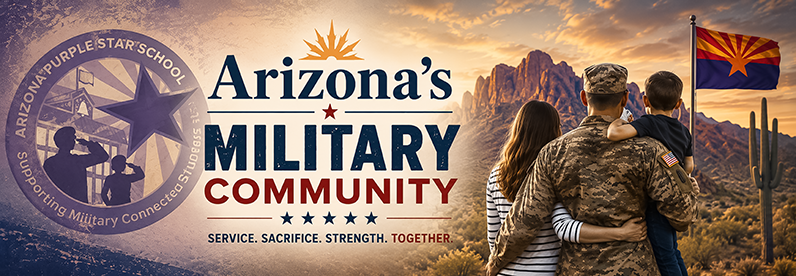
A military-connected student is defined as a child with a parent or guardian who is serving, or has served, in the United States Armed Forces. This includes active duty service members, National Guard and Reserve members, recently separated veterans, and, in some cases, families of those who were injured or killed in service. These students represent a diverse and resilient population whose experiences are shaped by the unique demands of military life.
Arizona is home to approximately 42,000+ school-aged military-connected students, each bringing a wide range of experiences influenced by frequent moves, parental deployment, and integration into new communities. While no two students share the exact same journey, many navigate common transitions that can impact academic continuity, social relationships, and emotional well-being. At the same time, military-connected students often demonstrate significant strengths, including adaptability, independence, cultural awareness, and resilience.
Arizona’s military presence plays a significant role in shaping local communities. The state is home to multiple major installations, including Luke Air Force Base, Davis-Monthan Air Force Base, Fort Huachuca, Marine Corps Air Station Yuma, Yuma Proving Ground, Camp Navajo, and Papago Military Reservation, along with National Guard and Reserve units across the state. These installations contribute to both the economic and cultural landscape of Arizona, creating strong partnerships between schools, military organizations, and community agencies.
For educators, understanding the local military context is essential. Military-connected students may enroll at any point during the school year, often with varying academic records, course sequences, and experiences. Additionally, events such as deployment cycles, training schedules, and reintegration periods can influence attendance, focus, and emotional regulation. Awareness of these factors allows educators to provide stability, maintain high expectations, and implement supports that reduce barriers to learning.
Equally important is recognizing the role of connection and communication. School Liaison Officers (SLOs) serve as vital resources, helping bridge the gap between military installations and school systems. These professionals provide guidance on enrollment, transitions, postsecondary planning, and access to specialized supports. Building partnerships with these liaisons—and with military families themselves—strengthens a school’s ability to respond effectively and proactively.
As you continue this module, consider how Arizona’s military landscape shapes the students in your classroom. Understanding the broader system in which military families live and work allows educators to move beyond surface-level awareness and toward intentional, informed support.
(Click Image Below, you will be taken to another site)
Take time to explore and bookmark the "Meet Your SLO/SLPMs" School Liaison page. You will find information and resources on topics ranging from student enrollment to college admissions.
The great seals of United States Armed Forces.