Path
/cte/

Career Awareness

Career Awareness
k-to-5

Career Awareness Standards

The Arizona Career Literacy Standards were created in 2019 and updated and renamed Career Awareness for Grades K-5 in December 2024. The standards prepare students for middle school career exploration. This update includes the knowledge and skills needed for employment and career discovery opportunities.

Resources

Junior Achievement Programs K-5 and JA BizTown: FREE career discovery experiences aligned to the AZ K-5 Career Awareness standards.

  • Grade-specific in-class programs delivered by teachers or community volunteers, typically in 5-7 lessons.
  • JA BizTown is a hands-on experiential learning facility in Tempe paired with preparatory curriculum.

Contact JA COO, Anne Landers, at [email protected] to learn more!

American School Counselor Association (ASCA): Elementary School Career Conversations 
"If you woke up tomorrow and were an adult, what career would you like to have?" English ~ Spanish

Arizona Science Center (Grades K-8): Guides and Curriculum
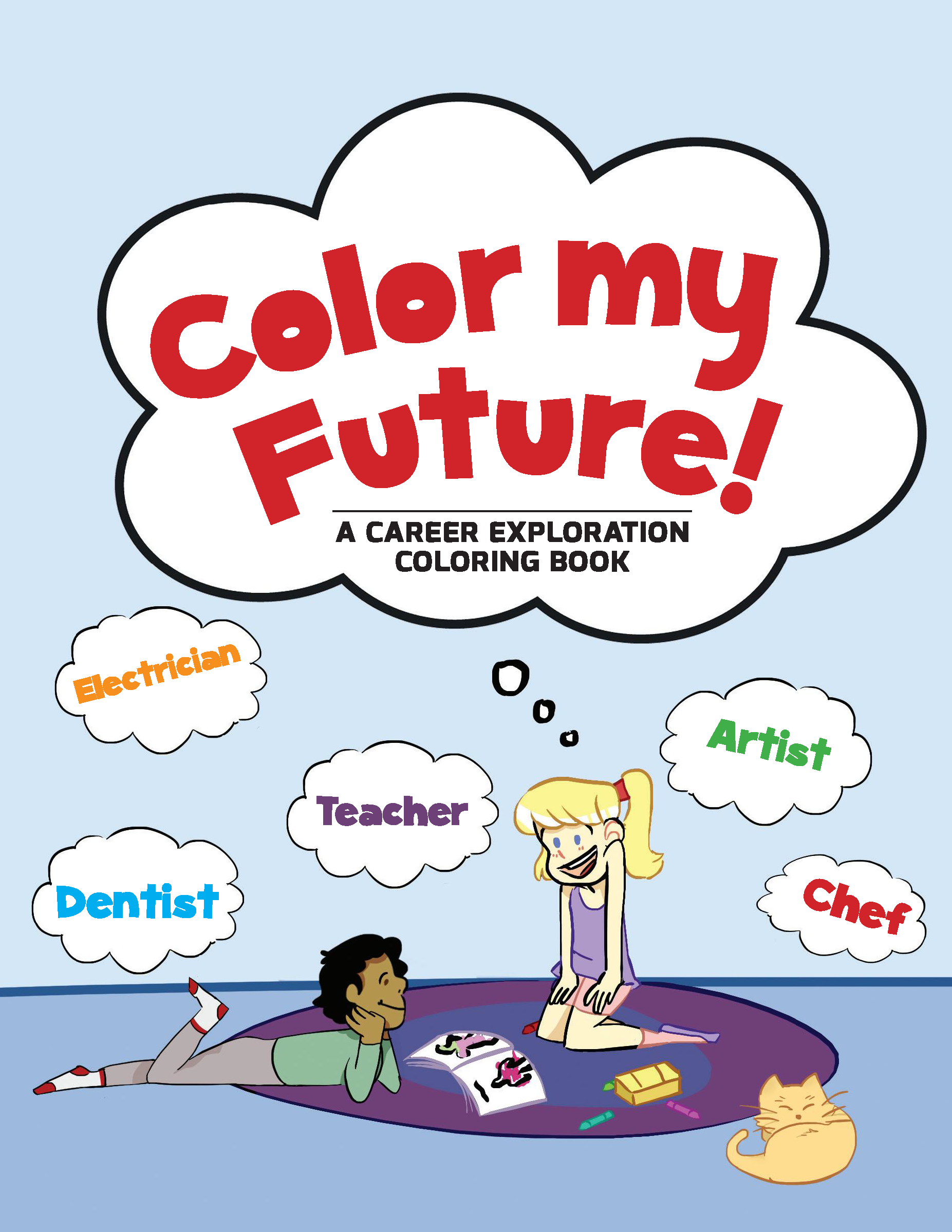
Career Coloring Books

Free resources to color and display on the refrigerator for at-home career discussions!

Career Discovery Corner: Elementary Librarian Activities designed by Arizona K-5 Librarians and tied to K-5 Career Literacy Standards

Career Trek: This K-5th Grade adventure has a stop along the way for each grade that engages students with games, interactive art, and multimedia features. Scaffolded vocabulary and activities introduce and reinforce evidence-based career development concepts.

Defined Careers K-5: Students have a day in the life experience of different careers in their community and beyond. The hands-on products provide opportunities to connect classroom skills to the real world.

American Farm Bureau Foundation for Agriculture: Free downloadable activities and agricultural education materials

iCEV Online Career: Exploration Lessons: Introduction to career clusters and pathways.

My American Farm: Free and fun agriculture discovery activities.

nXu K-5 Curriculum Overview: nXu Education: Lessons designed to build purpose, emotional wellness, and durable skills which are essential to long-term success. Curriculum is aligned to Arizona's K-5 Career Awareness Standards, with emphasis on self-awareness, interpersonal competencies, and goal-setting.

Contact [email protected] to learn more!

TeachSTEM: Explorers-Arizona Educational Foundation: Free lessons on career exploration and STEM careers.

Virtual Job Shadow Junior: Interactive Career Exploration Platform for K-5 students

Please note: The Arizona Department of Education does not endorse curriculum. The curricular resources on this webpage are posted for teacher consideration and offer instructional ideas to teach Career Awareness.
Back to K - 8 Career Literacy

Responsibilities of Parents in WBL

Responsibilities of Parents in WBL

Parents remain the number one influence on young people. Therefore, if a work-based program is to reach all students, parents must recognize its value to their own children and be willing to encourage participation. Since many work-based experiences occur off school premises or outside of normal school hours, parents must be willing to assume a portion of the responsibility for their children’s participation, including risks associated with transportation and indirectly monitored activities.


Parents Role:

  • Encourage students to have good attendance at the worksite.
  • Be involved and informed about the progress of their students’ work experience program.
  • Provide transportation, as needed, to allow the student to work off the school premises.
  • Discuss work challenges with the student; encourage students to set and work toward obtainable goals.
  • Value and encourage continuing education with purpose.
  • Parents will not always be involved in scenario or in class simulation-based WBL.

Responsibilities of Businesses Participating in WBL

Responsibilities of Businesses Participating in WBL

The best partnerships require planning, commitment, energy, and patience. They require serious focus and a defined purpose. Partnerships are worth the effort, but they require an understanding of the different business and industry cultures, including perception and valuation of time, measures of success, comfort with the work/school environment, planning/management skills, market orientation, scheduling priorities, reward structure, and an understanding of working with youth.


Business Benefits:

  • Creates a pool of skilled and motivated potential employees.
  • Enables organizations to develop new projects with student assistance.
  • Opens the door to involvement in curriculum development.
  • Provides developmental opportunities for the current workforce.
  • Offers opportunities to provide community service.
  • Industry experience and current demands in the working classroom.


Business Role:

  • Co-create a training agreement and training plan.
  • Interview students.
  • Sign and abide by agreements/forms.
  • Facilitate the student’s exposure to all aspects of the field.
  • Orient the student to the worksite with information about business operations, performance expectations, administrative policies, and job-specific training.
  • Assist the student in his/her efforts to accomplish personal and professional goals.
  • Meet with the WBL coordinator during the duration of the student’s WBL experience to assess the student’s progress and address problems that arise.
  • Complete formal evaluations of the student’s work and the work-based learning process.

Responsibilities of the WBL Coordinator (Coop, DCE, Internships)

Responsibilities of the WBL Coordinator (Coop, DCE, Internships)

 Discussions, Planning, and Agreements

All parties must be prepared to discuss productivity, compensation, and learning. The planning and management of the experience is critical to the success of the work-based learning. 

  • Each party must agree to the experience.
  • The minimum length of the experience should be negotiated in advance to ensure that the employer will recover some of the training costs associated with participation and to discourage impulsive terminations.
  • Such agreements detail the student’s responsibilities and discourages changes based on short-term compensation or minor personality conflicts.

 Successful planning and management of a WBL program must include:

  • Appropriate access is granted for the student. 
  • Activities are carefully planned and integrated into the curriculum.
  • Student and work-based learning experience are carefully matched.
  • Selection of training site – It is the role of the coordinating teacher to identify appropriate types of locations, jobs, and companies for student learners and to develop a formal, written, training agreement that clearly documents both the training sites and the school’s commitment to the WBL experience.
  • Identification of sponsor – The coordinating teacher works with the appropriate management personnel to identify a specific individual who will serve as the student’s training sponsor/mentor at the worksite.
  • Agreement on learning outcomes – A carefully documented training agreement and training plan must be used to clarify learning expectations and to facilitate the scheduling of specific activities and work-based assignments to include experience not typical of most teen jobs. The coordinating teacher and sponsor/mentor must identify clear expectations for student learning over the agreed-upon period.
  • Coordinate regular worksite visits – The frequency of the visits will vary with each situation, but, ideally, the coordinating teacher should plan to visit:
    • Once a week during the first and second weeks of employment.
    • Once every two weeks during the next six to ten weeks of employment.
    • Once a month for the duration of the experience.
    • On demand, as necessary, to mediate performance problems and to ensure adherence to the training agreement and training plan.

 Required Documentation:

  • Detailed description of the WBL experience. WBL opportunity must be available to ALL CTE students
  • Training agreement (include District-mandated permission slips if required by District.)
  • Training plan with clear program-specific goals
  • Wage and/or hour report (hours if not paid)
  • Journal/Diary
  • Other Documentation suggestions:
    • Visitation notes/reports
    • Employer evaluation reports

Resources and Sample Forms

 Worksite Visit Details: 

To protect the teacher and the school from liability, worksite visits should be planned with the employer’s consent and needs in mind. It is necessary to have the teacher visit the student at the worksite to ensure that training agreements and plans are being followed and that the workplace remains safe. Each visit should address some, or all, of the following:
• Observe the student.
• Confirm parties’ responsibilities and skills.
• Check safety conditions.
• Validate work hours and assist in negotiation of future schedules.
• Evaluate student performance on assigned responsibilities.
• Check that duties and tasks are aligned to the agreed-upon training plan.
• Assure compliance with laws.
• Assist in negotiation of rewards and/or disciplinary actions.
• Discuss additional opportunities for involvement in the program.
• Make a courtesy call on senior management.

 Liability Concerns:

Work with your district’s attorneys, as they know your school/district policies regarding student safety, security, legal obligations, and responsibilities. Some schools use The Trust to provide property and liability coverages or related services. https://www.svc.the-trust.org/Home/AboutUs.
The experience uses training agreements and training plans to outline what students are expected to learn and demonstrate at the worksite. The training agreements and training plans emphasize what training partners are expected to provide along, and outline the coordination of, and integration between, the worksite and the classroom. All parties must become knowledgeable about laws governing students between the ages of 16 and 17 in the workplace. See these links for more information:
• https://www.minimum-wage.org/arizona
• https://www.youthrules.gov/
• DOL Department of Labor Wage and Hour Division - https://www.dol.gov/whd/
• Labor laws https://www.azica.gov/labor-youth-employment-hours-restrictions
Every contract/agreement used for WBL student participation must state that there is a safe working environment, including protection from discrimination and sexual harassment. The contract/agreement must also contain a statement that the school has the right to immediately terminate the student in WBL if there is a breach of stipulated obligations.

Develop a Checklist

Develop a Checklist

Checklist items beneficial to setting up a successful internship might include:

  • arranging meeting times
  • planning with program coordinator to ensure that academic requirements are met
  • signing structured training agreements and training plans
  • arranging student work space
  • informing students about company policies and procedures

Suggestions for Industry Instructions and Activities

Suggestions for Industry Instructions and Activities

Worksite supervisors may be unaccustomed to the unique challenges of communicating and working with young people.

They may be faced with student attitudes and expectations that may seem unrealistic in the workplace.

Discuss possible scenarios with worksite supervisors and encourage them to provide as many active learning experiences as possible.

Activity suggestions

  • The purpose of an internship is to provide students with an environment where learning can take place.
  • Encourage supervisors to allow students to participate in as many learning activities as possible; especially those activities that offer an opportunity to develop workplace skills.

Overview of Legal Responsibilities

Overview of Legal Responsibilities

Worksite supervisors need to be aware of legal issues related to a work-based learning experience.

These include safety, child labor, discrimination, and sexual harassment laws.

The WBL coordinator must ensure that worksite supervisors understand their legal responsibilities and potential liabilities in advance.

For unpaid work experiences, all parties must be aware of federal guidelines related to unpaid work experience. Please see the resources button on the Internship page. 

WBL Primary Goal

WBL Primary Goal

The primary goal of WBL is to bridge the gap between theoretical knowledge gained in the classroom and the application of practical skills and knowledge required in the workforce.

Work Based Learning Experiences cannot replace the Carnegie Units of credit needed for the program sequence.

WBL Experiences Must:

WBL Experiences Must:

Demonstrate how the student is applying the technical skills learned in their programs through hands-on learning.
Allow students to develop professional skills to enhance their employability.
Be a real-life scenario or simulation-based.
WBL opportunity must be available to ALL CTE students.
Integrate the technical skills related to the CTE program.
Must comply with federal, state, and business risk management policies.

Work-Based Learning Continuum

Work-Based Learning Continuum

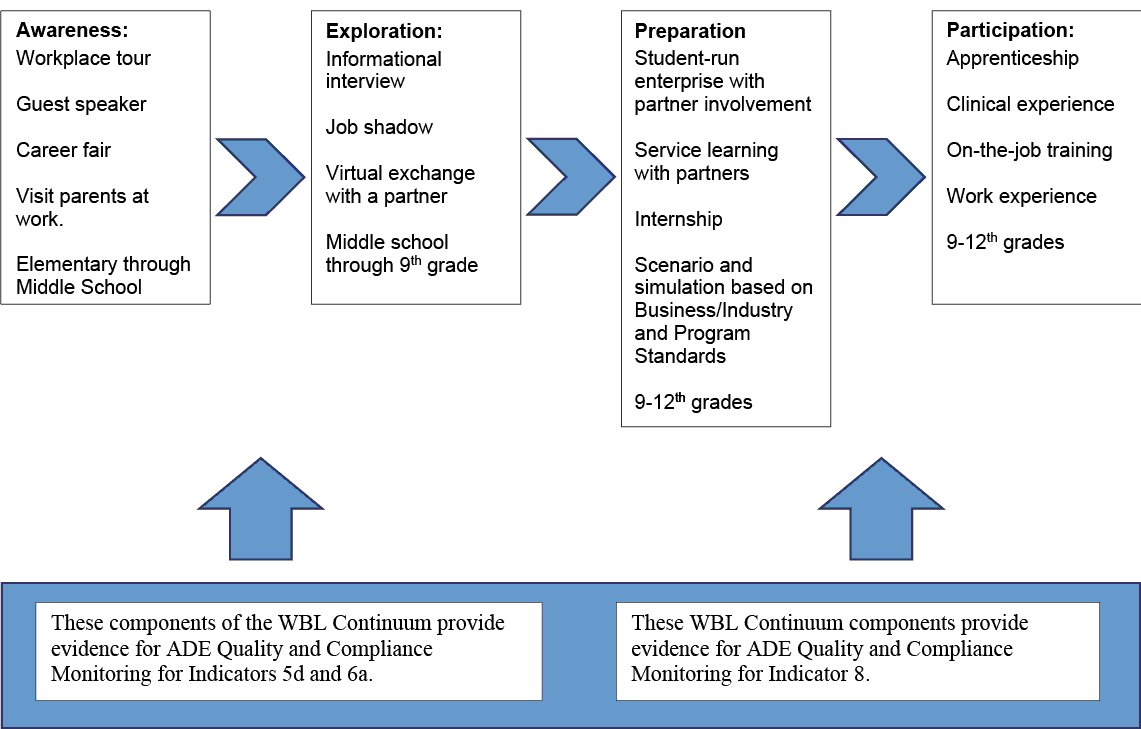
The WBL guide is intended to assist districts, administrators and teachers achieve the Work-Based Learning Continuum at their schools. The items below are examples, and not an extensive list of approved experiences.

  • Due to the diverse needs of schools in our state, these experiences may vary greatly. The experiences listed below in the continuum are examples of what can be embedded into Work-Based Learning planning at districts across the state.
  • Recommended stages for delivery of Career Awareness, Exploration, Preparation, and Participation are included in the continuum graphic below.
  • Once the Career Awareness and Career Exploration stages are completed, Local Education Agencies can use this guide to assist them in planning for the Career Preparation and Career Participation Stages.

Continuum graphic