Path
scienceofreading
Contact
Contact name or title
Click below to subscribe to the ELA Listserv

Podcasts

Podcasts

Podcasts

Listen to any one of these audio documentaries from American Public Media's Senior Correspondent, producer and host, Emily Hanford.

Emily Hanford 2017-2020 Series

Emily Hanford @ehanford

1. Hard to Read: How American schools fail kids with dyslexia

 LISTEN

Released Sept. 2017 – 

There are proven ways to help people with dyslexia learn to read, and a federal law that's supposed to ensure schools provide kids with help. But across the country, public schools are denying children proper treatment and often failing to identify them with dyslexia in the first place.


2. Hard Words: Why aren’t kids being taught to read?

 LISTEN

Released Sept. 2018 – 

Scientific research has shown how children learn to read and how they should be taught. But many educators don't know the science and, in some cases, actively resist it. As a result, millions of kids are being set up to fail.


3. At a Loss for Words: How a flawed idea is teaching millions of kids to be poor readers

 LISTEN

Released August 2019 – 

For decades, schools have taught children the strategies of struggling readers, using a theory about reading that cognitive scientists have repeatedly debunked. And many teachers and parents don't know there's anything wrong with it.


4. What the Words Say

 LISTEN

Released August 2020 –

A false assumption about what it takes to be a skilled reader has created deep inequalities among U.S. children, putting many on a difficult path in life.


For more information, Science of Reading: The Podcast, by Amplify released an episode on their podcast series. Take a listen here. 

Season 1 – Episode 3:  A Conversation with Emily Hanford

 LISTEN

Emily Hanford New Series: "Sold a Story: How Teaching Kids to Read Went So Wrong"

Emily Hanford @ehanford

Want to discuss Sold a Story?
This discussion guide, created by a teacher, invites educators, parents, community members and kids to have a conversation about the podcast.

All episodes can be found here: Sold a Story: How Teaching Kids to Read Went So Wrong Podcast


**The views and opinions expressed in any third-party resource do not necessarily reflect those of the Arizona Department of Education (ADE) and do not imply an endorsement by ADE.
Books

Books

Featured Book

Speech to Print: Language Essentials for Teachers, 3rd ed.

by Louisa C. Moats, Ed. D.

For two decades, Speech to Print has been a bestselling, widely adopted textbook on explicit, high-quality literacy instruction. Now the anticipated third edition is here, fully updated with ten years of new research, a complete package of supporting materials, and expanded guidance on the how of assessment and instruction in today’s classrooms.

For companion materials, free resources, and to order the text: Brookes Publishing  

Archived Books

Fundamentals of Literacy Instruction & Assessment, PreK-6, Second Edition 

Edited by Martha C. Hougen, Ph. D., & Susan M. Smartt, Ph.D. 

Understand the science of reading and how to implement evidence-based instruction to increase the reading and writing achievement of pre-K–6 students, including those at risk for reading difficulties. Fully revised and updated, this core text covers the research base for structured literacy instruction and practical guidance on the essential components of literacy instruction.
Want to learn more about the new edition? Check out the following resources: 

•    A handy resource that shows you what’s been added and updated in the new edition 
•    A book excerpt that includes the full table of contents 
•    A slide deck that provides a comprehensive overview of the new edition 

For more information and to purchase this book: https://products.brookespublishing.com/Fundamentals-of-Literacy-Instruction-Assessment-Pre-K-6-Second-Edition-P1184.aspx


Fundamentals of Literacy Instruction and Assessment, Grades 6-12

by Martha C. Hougen, Ph. D.

Prepare educators to strengthen the literacy skills of students in Grades 6–12 with this adolescent literacy textbook, based on current research, standards, and recommended instructional practices. This expertly organized volume covers all the fundamentals of how reading and writing skills develop in older students and how to teach literacy within key academic content areas: language arts, math, science, and history. This text includes classroom examples, helpful objectives and summaries, and sample lesson plans.

For more information and to purchase this book: Brookes Publishing
 

Explicit Instruction: Effective and Efficient Teaching 

by Anita L. Archer and Charles A. Hughes

This book lays the foundation for what is explicit instruction, why it is important, for whom it is essential, and how to provide it. This is ideal for PreK-6th grade educators.

For more information and to purchase this book: https://explicitinstruction.org/
 

Effective Instruction for Middle School Students with Reading Difficulties

by Carolyn Denton, Ph.D., Sharon Vaughn, Ph.D., Jade Wexler, Ph.D., Deanna Bryan, and Deborah Reed, Ph.D.

This book arms language arts teachers with the lessons, strategies, and foundational knowledge they need to resolve older students' reading difficulties and increase their chances for academic success. Ideal for use with struggling readers in Grades 6-8 (though these strategies would benefit older students with reading difficulties as well), this book clearly lays out the fundamentals of effective teaching for adolescents with reading difficulties.

For more information and to purchase this book: https://products.brookespublishing.com/Effective-Instruction-for-Middle-School-Students-with-Reading-Difficulties-P620.aspx


Overcoming Dyslexia

by Sally Shaywitz, M.D. and Jonathan Shaywitz, M.D.

One in five American children has trouble reading. But they are not stupid or lazy. In Overcoming Dyslexia, Dr. Sally Shaywitz, codirector of the Yale Center for the Study of Learning and Attention and a leader in the new research into how the brain works, offers the latest information about reading problems and proven, practical techniques that, along with hard work and the right help, can enable anyone to overcome them. This book gives the tools that parents and teachers need to help the dyslexic child, age by age, grade by grade, step by step. 

For more information and to purchase this book: Penguin Random House


The Reading Comprehension Blueprint: Helping Students Make Meaning from Text

by Nancy Lewis Hennessy (foreword by Louisa Cook Moats)

Comprehension is a primary ingredient of reading success—but most educators aren't taught how to deliver structured comprehension instruction in their classrooms. Meticulously researched and masterfully organized, this book offers a clear blueprint for understanding the complexities of reading comprehension and delivering high-quality, evidence-based instruction that helps students construct meaning from challenging texts.

Resources:

Articles

Articles

"Teaching Reading is Rocket Science, What Expert Teachers of Reading Should Know and Be Able to Do" by Dr. Louisa Moats

Article: https://www.aft.org/ae/summer2020/moats  

Louisa C. Moats  has been a teacher, psychologist, researcher, graduate school faculty member, and author of many influential scientific journal articles, books, and policy papers on the topics of reading, spelling, language, and teacher preparation. After 15 years as a licensed psychologist specializing in evaluation and consultation with individuals who experienced reading, writing, and language difficulties, she served as a site director of the National Institute of Child Health and Human Development’s Early Interventions Project and research advisor and consultant with Sopris Learning.

**The views and opinions expressed in any third-party resource do not necessarily reflect those of the Arizona Department of Education (ADE) and do not imply an endorsement by ADE.

Quality Instruction

Quality Instruction

All students have the right to read! Therefore, the right to have access to a highly trained, knowledgeable teacher.
On a scale of 1-10, how much does the application of science matter to you in other fields? Medicine, architecture, aviation? 

Why would we expect any less when it comes to reading instruction? 

Moral responsibility:

  • Society 
  • Mental health 

The Matthew Effect kicks in with vengeance if grades K-1 teachers do not teach reading effectively.

Teachers have the right to quality training 

Instructional equity is the key to teaching equity

You can’t have knowledgeable students without knowledgeable teachers. 

Reading Researchers

Reading Researchers

Reading Researchers

The science of reading is derived from researchers from multiple fields: cognitive psychology, communication sciences, developmental psychology, education, implementation science, linguistics, neuroscience, and school psychology.

Learn more from these experts!

Field of study:Researcher/Expert:Social Media:

Neuroscience

Dr. Mark Seidenberg@markseidenberg
Brain Studies and Neuroscience

Dr. Stanislas Dehaene

Dr. Daniel Willingham

@StanDehaene

@DTWillingham

Brain Research

Brain Research

“It is simply not true that there are hundreds of ways to learn to read…when it comes to reading, we all have roughly the same brain that imposes the same constraints and the same learning sequence.” - Stanislas Dehaene, Cognitive Neuroscientist.

When we read, our brains transform the shapes of letters and characters on a page into the sounds of spoken language. But how does the brain do this? That’s what cognitive neuroscientist Stanislas Dehaene is trying to find out. Dehaene, a professor at the Collège de France and a winner of the 2014 Brain Prize, studies how reading takes place in the brain, and his research has revealed the brain networks involved.

Learn more about this research – and its implications for how we teach reading – in this video. [YouTube, 2016]

**The views and opinions expressed in any third-party resource do not necessarily reflect those of the Arizona Department of Education (ADE) and do not imply an endorsement by ADE.

Structured Literacy

Structured Literacy

Structured Literacy is an approach to reading instruction that is characterized by the provision of systematic, explicit instruction that integrates (1) listening, (2) speaking, (3) reading, and (4) writing. A structured literacy approach emphasizes the structure of language across the speech sound system (phonology), the writing system (orthography), the structure of sentences (syntax), the meaningful parts of words (morphology), the relationships among words (semantics), and the organization of spoken and written discourse. (IDA/CERI, 2018c, March)

These principles tell us HOW we teach in all grades:

Teaching the structure of our English language includes these elements:

  • Explicit instruction with modeling
  • Systematic, simple to complex (scope and sequence)
  • Cumulative (new concepts linked to previously learned, review)
  • Diagnostic (differentiate based on student need)
  • Multisensory
  • Phonology
  • Orthography
  • Syntax
  • Morphology
  • Semantics

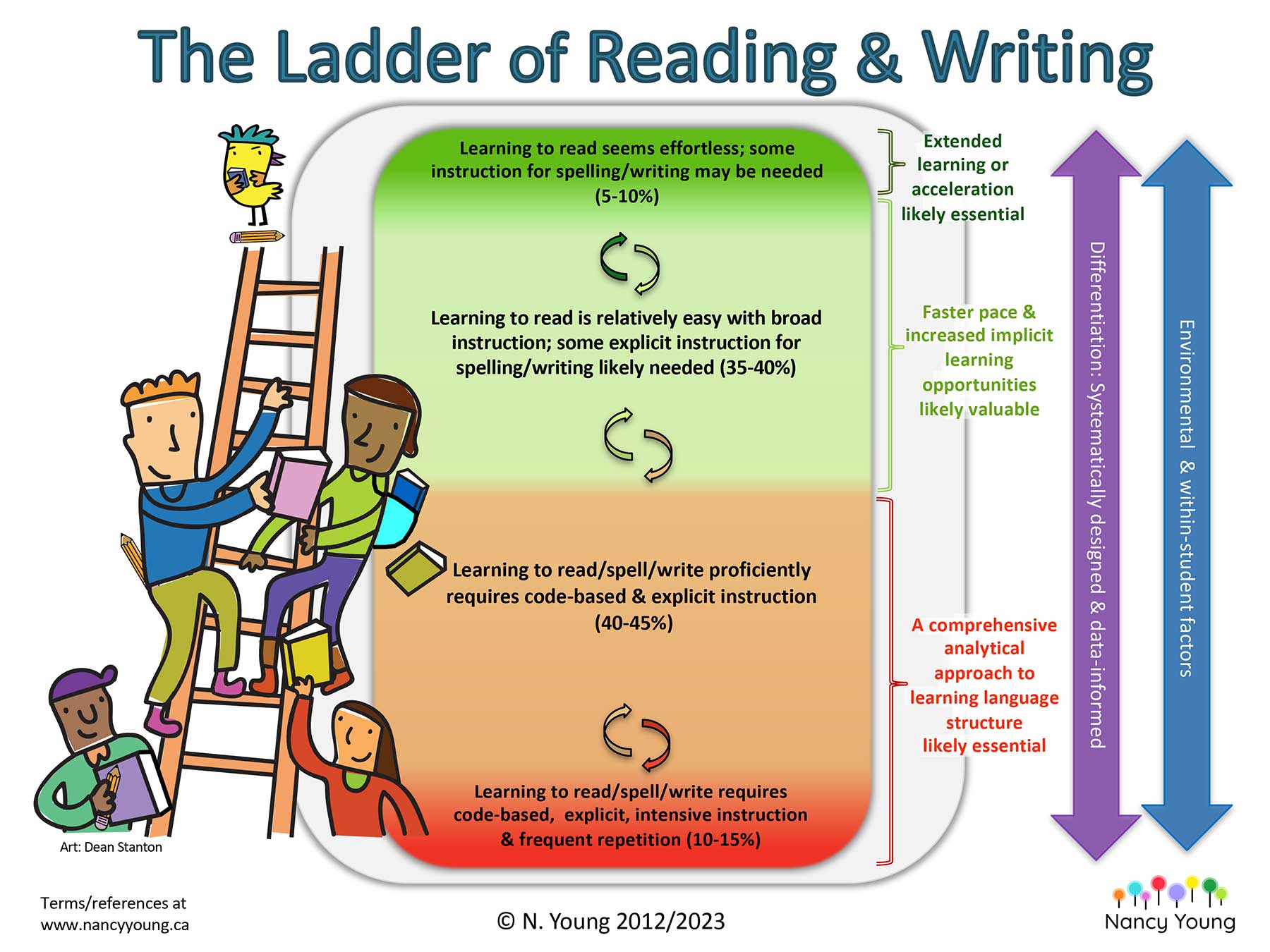
The Ladder of Reading and Writing

Visit Nancy Young's website to download a PDF version of The Ladder of Reading and Nancy's helpful primer on "What is structured literacy?".

The Ladder of Reading and Writing shows that a structured literacy approach is essential for at least 50-65% of our students, whereas the remaining 40% are still advantaged by a structured literacy approach. Also, you can read more on Nancy's blog.

Ladder of Reading Writing Young

(Used with Nancy Young's permission)

Key Principles of Structured Literacy:

Explicit instruction – Explicit (direct) instruction is systematic, direct, engaging, and success-oriented, and has been shown to promote achievement for all students.

  • Leaves nothing to chance with clear teacher modeling
  • Demonstrates, and opportunity for practice

Systematic instruction – Systematic instruction in reading is a plan of instruction (e.g. scope and sequence) that takes students through an explicit sequence of learning activities.

  • Easiest concepts to the most complex

Cumulative instruction – Skills and concepts that have been previously taught are consistently reinforced and practiced over time, building on what has come before, as you introduce new concepts and skills.

Diagnostic instruction – Teacher is consistently monitoring the progress of their students so they can intervene appropriately

Multisensory instruction - Instruction that provides explicit, direct instruction in the decoding and spelling of the language. Multisensory learning enhances memory and learning of written language through simultaneous use of visual, auditory, and kinesthetic-tactile pathways. Links are consistently made between the language seen (visual) and heard (auditory), and symbols felt (kinesthetic-tactile) while learning to read and spell.

**The views and opinions expressed in any third-party resource do not necessarily reflect those of the Arizona Department of Education (ADE) and do not imply an endorsement by ADE.

Welcome to the Science of Reading!

Welcome to the Science of Reading!


English Language Arts Science of Reading

The Science of Reading is a vast, interdisciplinary body of scientifically based research about reading and issues related to reading and writing. This research has been conducted over the last five decades across the world, and it is derived from thousands of studies conducted in multiple languages. (The Reading League)

The Science of Reading is built on two fundamental truths:

  1. We were never born to read. Our brains are hardwired for speech, not print.
  2. The alphabetic principle is the foundation of our alphabetic writing system. It is fundamentally different from pictograph and logograph systems.

What the Science of Reading is not:

  •  an ideology or philosophy
  •  a fad, trend, new idea, or pendulum swing
  •  a political agenda
  •  a one-size-fits-all approach
  •  a program of instruction
  •  a single, specific component of instruction, such as phonics

Click here for The Science of Reading: Defining Guide from The Reading League! 

Download the Science of Reading infographic here.

Watch a 3-minute "elevator speech" about the Science of Reading, as explained by Dr. Stephanie Stollar.

Want to learn more? 

Take one of our courses to learn more about the science of reading, especially the Evidence-Based Decision Making Course, which directly aligns and supports learning in the science of reading and the shifts to structured literacy.

Literacy Professional Learning


AZ State Literacy Instruction Plans

Provide Feedback

We are so happy you are here to learn more about the Science of Reading! 
We would love to hear your feedback on this page so that we know what you need and how we can support you in your understanding of how the brain learns to read. 


Please take a moment to complete a simple survey by clicking the Feedback button.


**The views and opinions expressed in any third-party resource do not necessarily reflect those of the Arizona Department of Education (ADE) and do not imply an endorsement by ADE.