
Chinle Case Study
About the Chinle Case Study
Chinle Unified School District (CUSD) demonstrated significant academic growth between school years 2016 and 2025. Located in rural northeastern Arizona on the Navajo Nation, the district serves a predominantly Navajo student population and operates across a large geographic area.
This case study examines changes in district practices that coincided with improved student outcomes over time, utilizing a mixed methods approach of a qualitative interview with CUSD administrators and school principals and a survey of CUSD Teachers. Study participants included CUSD administrators, school principals and teachers from CUSD schools serving students in kindergarten through eighth grade.
The study explores district practices and organizational conditions present during a period of academic growth, including strategic planning and vision, professional development, data-driven decision-making, and collaboration across schools. It is important to note that this study does not identify the cause of improvements in student achievement and does not establish a causal relationship between district practices and student outcomes. Rather, the study documents strategies, conditions, and practices that occurred alongside improvements in academic performance and examines how district leaders, educators, and stakeholders supported student success during this period.
The findings may provide insights for other rural, and tribal-serving school systems seeking to improve student outcomes.
Case Study Report and Presentation
Explore the full case study and companion presentation to learn about Chinle Unified School District's educational context, districtwide initiatives, and student outcome trends from 2016 to 2025.
The study examines factors associated with improvement but does not identify the cause of observed outcomes.
 |
 |
|
Download the full case study report, including background, methodology, findings, discussion and appendix on study materials. |
Chinle Case Study Presentation Download the Chinle Case Study presentation, presented at the 2026 Office of Indian Education Summit by Superintendent Quincy Natay, Randolph Ottem, and Russel Potter. |
Context of Chinle Unified School District
Chinle Unified School District serves communities across the Navajo Nation in northeastern Arizona. The district educates more than 2,800 students, approximately 98% of whom are Navajo, and services an area of approximately 2,500 square miles.
Appointed in 2013, Superintendent Quincy Natay led Chinle Unified School District (CUSD) through a period of meaningful improvement by bringing educators, families, Tribal stakeholders, community members, and the governing board together around a shared vision for student success. A member of the Chinle community, Superintendent Natay strengthened the district's focus on academic achievement while demonstrating how collaboration and community engagement can drive positive outcomes for students across the Navajo Nation.
Prior to these improvements, the district faced challenges in establishing a unified vision for student success. Historically, stakeholders held differing views regarding district priorities, making it difficult to build consensus around academic achievement as a districtwide focus. Creating meaningful and lasting change required collaboration among educators, families, community members, and the governing board.
Like many rural school districts, CUSD also faced challenges related to its geographic isolation. Distance from metropolitan areas limited access to external professional learning opportunities and reduced the pool of available educators and staff. In the presentation associated with the case study, Supt. Natay also discussed broader community challenges, including poverty, infrastructure limitations, and food insecurity. Despite these challenges, district leaders, educators, families, and community members worked together to focus on factors within their control and create conditions that support student success.
The Approach
Rather than focusing on a single initiative, Chinle Unified School District implemented a districtwide effort centered on improvement. District leaders worked with the governing board, educators, families, and community members to establish a shared mission, vision, and strategic plan focused on improving student outcomes.
To support this vision, CUSD invested in ongoing professional learning opportunities that were available daily, weekly, monthly, and annually. Academic coaches and school leaders provided job-embedded professional learning, classroom observations, instructional coaching and collaborative learning opportunities. The district also emphasized the use of data to inform instructional decisions and developed strategies focused on helping students move from minimally proficient to higher levels of proficiency. In addition, CUSD fostered collaboration across schools and grade levels, allowing educators to share ideas and support smoother transitions for students as they progressed through the school system.
What We Learned
A Shared Vision for Student Success
The study found that student success was driven by a districtwide commitment to improvement rather than a single program or school initiative. District leaders, educators, the governing board, families, and community members worked together to establish a shared vision and culture focused on academic achievement. This common direction helped create consistency across schools and sustained progress over time.
Supporting Educators
Teacher support emerged as a consistent theme throughout the study. Survey results showed that 71 percent of CUSD K-8 teachers reported receiving the support they needed from both school and district leaders to be successful. District leaders prioritized creating systems that helped educators succeed, including instructional support, coaching, and opportunities to collaborate with colleagues across the district.
Building Internal Capacity
Rather than relying solely on outside professional learning opportunities, CUSD invested in developing professional capacity within the district. Teachers had access to professional learning on a daily, weekly, monthly, and annual basis through academic coaches and collaborative professional learning structures referred to as clusters. Educators also collaborated across schools and grade levels to share effective practices and support smoother transitions for students.
Data-Driven Decision-making
The study found that data played an important role in instructional planning and decision-making across the district. Interviewees described regularly reviewing student performance data with educators to monitor progress, identify areas of need, and guide instruction. Participants also highlighted districtwide efforts to support students performing at the minimally proficient level and help them progress toward higher levels of proficiency.
Impact
The study documented improvement in student outcomes across Chinle Unified School District. While the study does not establish what caused these changes, the data below provide context on the academic outcomes observed between 2016 and 2025.
|
Figure 1: Mathematics Assessment results CUSD and AZ State Average: 2016 to 2025 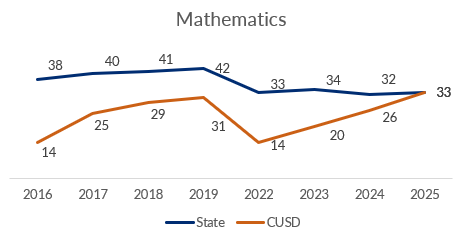 |
CUSD K-8 Mathematics Assessment: The mathematics pass rate improved from 24 percentage points below the state average in 2016 to meeting the state average in 2025. A student is considered to have passed the assessment by achieving a rating of Proficient or Highly Proficient. Assessment data were not collected in 2020 or 2021 due to the COVID-19 pandemic.
|
Figure 2: English Language Arts Assessment results CUSD and AZ State Average: 2016 to 2025 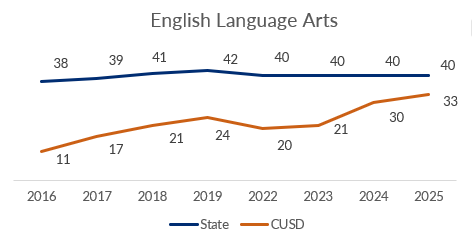 |
CUSD K-8 English Language Arts (ELA) Assessment: The ELA pass rate, defined as the percentage of students achieving a proficiency rating of Proficient or Highly Proficient, increased from 27 percentage points below the state average in 2016 to 7 percentage points below the state average in 2025. Assessment data were not collected in 2020 or 2021 due to the COVID-19 pandemic.
|
Table 1: Arizona State Letter Grades by school between FY17 and FY25 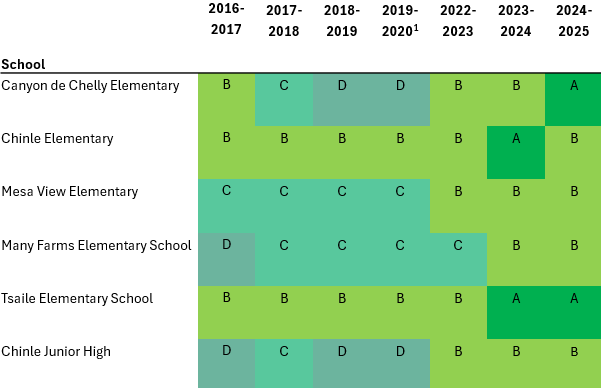 |
CUSD K-8 School Letter Grades: School letter grades improved across the district between 2018 and 2025. From 2018-20, school grades ranged from D to B. By 2024-25, two schools earned A letter grades, and the remaining schools earned B letter grades.
Voices from CUSD
As part of the case study, ADE conducted in-depth interviews with district administrators and K-8 school principals to better understand the context surrounding student outcome trends in Chinle Unified School District. The anonymized quotations below illustrate themes that emerged during the interview analysis and provide additional insight into participants' experiences and perspectives.
"...supporting a teacher, I think, is one of the most important roles that administrators have in the school."
CUSD Principal (Anonymous study participant)
"...one big thing that I know makes us successful is being data-driven. We look at numbers to make decisions...for the best interest of the students of mine."
CUSD Principal (Anonymous study participant)
"...our strategic and school plans, the plans for support, have helped us. If we didn't have those goals, we would be lost."
CUSD Principal (Anonymous study participant)