Module 1 Topic 2
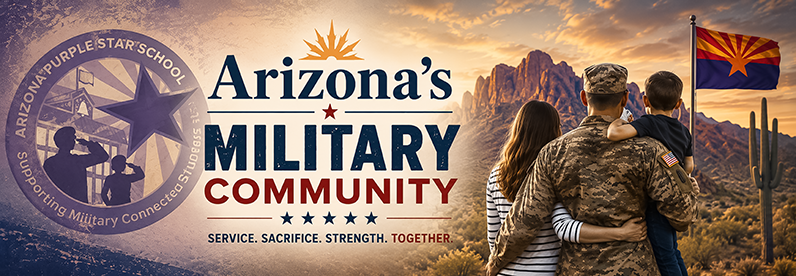
Arizona's Military Community
Arizona's connection to the United States Armed Forces extends far beyond the boundaries of its military installations. Military service members, veterans, National Guard and Reserve members, civilian employees, and their families live and work throughout communities across the state.
For Arizona educators, understanding this military presence provides important context for understanding the students and families they serve.
Who Is a Military-Connected Student?
A military-connected student is generally a child whose parent or guardian is serving, or has served, in the United States Armed Forces. This may include children of active-duty service members, members of the National Guard and Reserve, recently separated veterans, and, in some circumstances, families of service members who were injured or killed while serving.
Military-connected students are not a single, uniform group. Their experiences may differ depending upon a parent's branch of service, duty status, assignment, deployment history, family structure, geographic location, and the number of transitions they have experienced.
Understanding these differences is important because a military connection may influence a student's life even when that connection is not immediately visible at school.
Military-Connected Students Across Arizona
Arizona is home to approximately 42,000+ school-aged military-connected students. These students attend public district schools, charter schools, private schools, Department of Defense schools, and other educational programs throughout the state.
Some live near large military installations, while others live many miles away from a base or post. National Guard and Reserve families, veterans, and military families living off installation may be represented in schools that do not traditionally consider themselves part of a military community.
An Important Perspective
A school does not need to be located beside a military installation to serve military-connected students.
Military families can be found throughout Arizona. Building awareness of military-connected students therefore benefits schools statewide—not only communities immediately surrounding military installations.
Arizona's Military Presence
Arizona has a significant and diverse military presence. Major installations and military communities include:
- Luke Air Force Base in the West Valley
- Davis-Monthan Air Force Base in Tucson
- Fort Huachuca in southeastern Arizona
- Marine Corps Air Station Yuma
- Yuma Proving Ground
- Camp Navajo in northern Arizona
- Papago Military Reservation in the Phoenix metropolitan area
- Arizona National Guard and Reserve units located throughout the state
These installations and organizations contribute significantly to Arizona's economy, workforce, communities, and culture. They also create important opportunities for collaboration between military organizations, schools, families, and community agencies.
The Military Experience Can Shape the School Experience
Military-connected students may experience educational transitions differently from students whose families remain in one community for an extended period of time.
A Permanent Change of Station, commonly known as a PCS, may require a family to relocate to another installation, another state, or even another country. Students may arrive at a new school during the academic year with different course sequences, graduation requirements, grading systems, academic calendars, extracurricular opportunities, or instructional expectations.
Other aspects of military life can also influence students' experiences. These may include:
- Frequent school and community transitions
- Parental deployments or extended training assignments
- Periods of family separation
- Reintegration following deployment
- Changes in caregivers or family responsibilities
- Uncertainty surrounding future assignments or moves
- Transitions between state, national, or international school systems
These experiences do not automatically mean that a student will struggle. Rather, they provide important context that can help educators understand changes in attendance, classroom engagement, peer relationships, academic placement, or behavior.
Recognizing Strengths, Not Just Challenges
Supporting military-connected students requires more than identifying potential challenges. It is equally important to recognize the strengths and experiences these students may bring to the school community.
Military-connected students frequently develop skills and perspectives through their experiences living in different communities, states, or countries. Depending upon the individual student, these may include:
- Adaptability
- Independence
- Resilience
- Cultural awareness
- Flexibility
- Problem-solving skills
- Experience forming new relationships
- Comfort interacting with people from different backgrounds
Strength-based practice matters. Military-connected students should not be viewed solely through the lens of transition, deployment, or potential difficulty. Their experiences can also contribute valuable perspectives, leadership, adaptability, and cultural awareness to a classroom and school community.
Why This Matters for Educators
Military-connected students may enroll at virtually any point during the school year. Educators may encounter students arriving with different transcripts, curriculum sequences, assessment experiences, credits, graduation plans, special programs, or extracurricular backgrounds.
Understanding the broader military context helps educators respond with both flexibility and high expectations.
When educators recognize that a student is navigating a transition, they are better positioned to provide predictable routines, establish relationships quickly, communicate with families, address academic gaps without making assumptions, and connect students with appropriate school resources.
The goal is not to lower expectations. The goal is to remove unnecessary barriers so students can continue progressing academically and socially despite changes occurring around them.
School Liaisons: Connecting Military Families and Schools
One of the most valuable resources available to schools serving military-connected students is the military School Liaison.
School Liaisons help connect military families, installations, school districts, educators, and community organizations. They can provide information and assistance related to educational transitions and help families navigate unfamiliar school systems.
Depending upon the situation and installation, School Liaisons may help families and schools with topics such as:
- School enrollment and registration
- School transition questions
- Educational options within a community
- Military Interstate Children's Compact concerns
- Academic placement and graduation questions
- Special education navigation and available resources
- Extracurricular participation
- College and postsecondary planning
- Connections between military installations and local schools
Build the Connection Before You Need It
Schools are encouraged to identify the School Liaison or military education contact supporting their geographic area before a transition concern occurs.
Establishing that relationship in advance creates a direct connection that can be used when military families enroll, transfer, or need assistance navigating educational requirements.
Take time during this module to explore and bookmark Arizona's School Liaison resources for future use.
Understanding the Community Strengthens School Culture
Learning about Arizona's military community ultimately benefits more than military-connected students.
Practices that support highly mobile military students—clear communication, welcoming procedures, consistent transition supports, rapid relationship building, flexible problem solving, and intentional student connection—also strengthen the experience of other students entering a school community.
A student transferring because of military orders may have different circumstances from a student moving because of foster care placement, migrant employment, housing instability, family relocation, or another life transition. Yet each student benefits when a school has systems designed to help newcomers quickly understand where they belong, whom they can ask for help, and how they can become part of the school community.
The larger goal is belonging. When schools develop intentional systems for welcoming and supporting military-connected students, they strengthen their capacity to support highly mobile learners and create a more connected school culture for everyone.
One Military Community, Distinct Service Cultures
The United States Armed Forces are composed of distinct military service branches, each with its own history, mission, traditions, terminology, organizational structure, and culture.
Educators do not need to become experts in every branch. However, recognizing that military experiences differ can help prevent assumptions about students and families.
As this module continues, you will explore military culture in greater depth and consider how both the visible and less-visible aspects of that culture may influence the students and families you serve.

The United States Armed Forces include distinct service branches with unique missions, traditions, and cultures.
Reflection
As you consider Arizona's military community, reflect on the following:
- How might military mobility influence enrollment, academic placement, instructional planning, and student support at your school?
- What strengths might military-connected students bring to your classroom or school community?
- How prepared is your school to welcome a student who enrolls unexpectedly in the middle of a semester?
- Who in your school or district serves as the primary point of contact when a military-connected family needs transition assistance?
- How could a relationship with a military School Liaison strengthen your school's ability to support students and families?
Looking Ahead
Understanding where military-connected students come from provides important context. The next step is understanding the culture and experiences that may shape military life beneath the surface.
In the next topic, you will explore military culture and examine how values, traditions, expectations, terminology, service experiences, and family life can influence military-connected students.